
Frozen Food Packaging Film: Low-Temperature Toughness and Sealing
Frozen food packaging film explained: low-temperature toughness, puncture, freezer burn, sealing through frost, ventilated bags, formats and machines.
A bag that survives ambient handling can still split when cold or puncture against frozen edges. Select film using the full temperature and product conditions, and confirm performance on cold, filled packages.
Scroll horizontally to view all columns if needed. ↔
| Input | Record from the project | Why it changes the trial |
|---|---|---|
| Storage / transport | Minimum and maximum temperatures, cycle and time | Sets conditioning and cold handling |
| Product / weight | Frozen shape, sharp points and actual fill mass | Sets puncture and drop challenge |
| Seal contamination | Frost, moisture and fines at the seal | Sets clean-versus-contaminated trials |
| Heating use | No heating, or specified microwave / steam cycle | Requires a separately qualified heating structure |
| Machine | Format, settings and production speed | Connects film results to the actual line |
What goes wrong with frozen food
- Brittleness at low temperature: polymers stiffen as they get cold. Some films that handle well at room temperature crack or split when bags are dropped or flexed in a freezer chain. PE stays relatively tough at low temperatures, which is why it dominates this segment.
- Sharp frozen pieces: frozen vegetables, fries, nuggets, bones and ice crystals can poke through a film during filling, shipping and handling. Puncture and impact strength decide whether bags arrive intact.
- Moisture loss and freezer burn: water slowly leaves the surface of the food and condenses as frost or leaves dry, discolored patches. A better water vapor barrier, a tight pack with little headspace and a pinhole-free film reduce this.
- Frost and condensation: moving product from a cold room to a warmer filling area, or back, creates condensation or ice on the film and the seal area.
- Sealing through ice and moisture: frozen product often brings moisture, frost or fines into the seal. A sealant with a wide seal window and good hot tack handles contamination better.
- Cooking in the pack: microwave and steam packs add heat resistance and venting requirements on top of freezer performance.
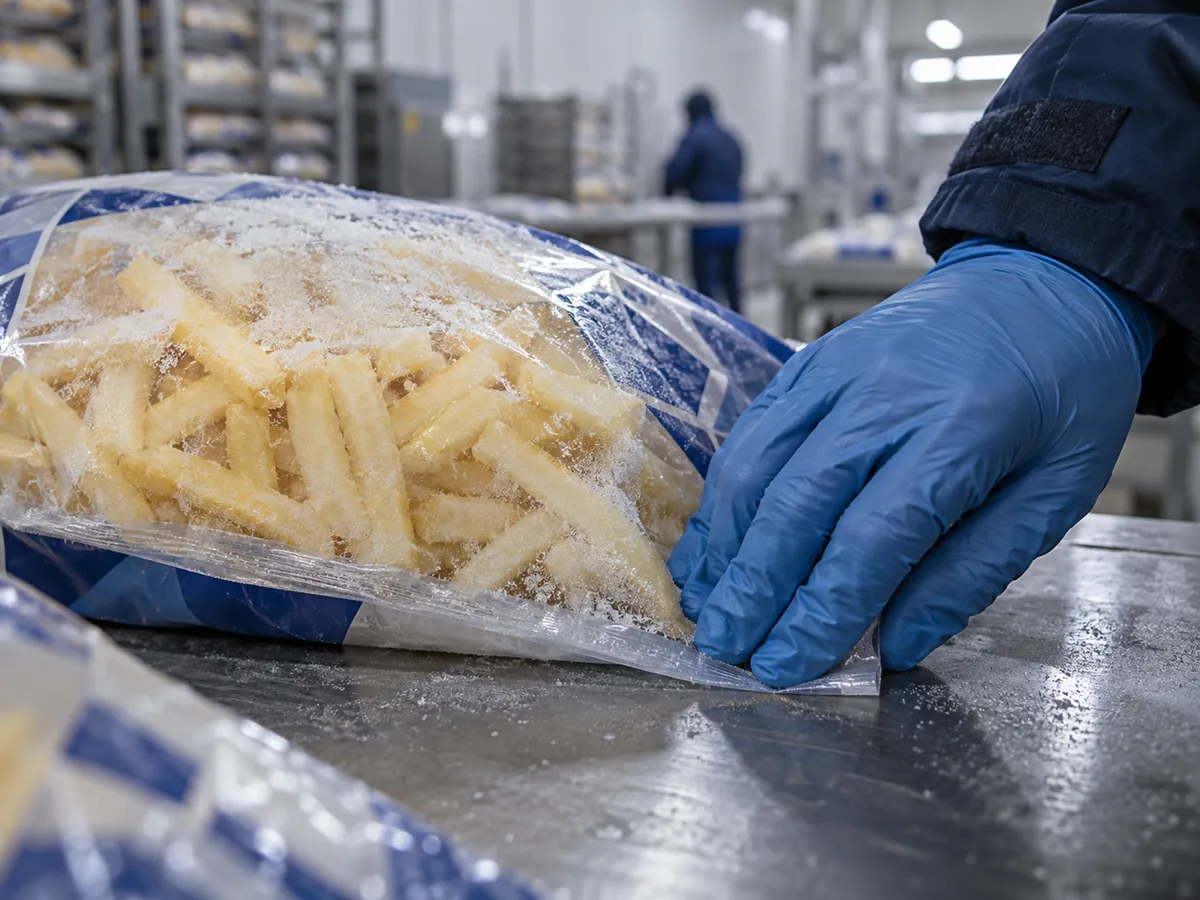
Frozen food packaging materials: typical structures
PE is the base for most freezer bags and pillow bags. Laminates add print quality, stiffness or barrier where the product calls for it. Treat the table as a starting point and confirm values with supplier data. WVTR and OTR results depend on the test temperature and humidity, so ask for the conditions.
Scroll horizontally to view all columns if needed. ↔
| Frozen product | Common structure | Why it is used |
|---|---|---|
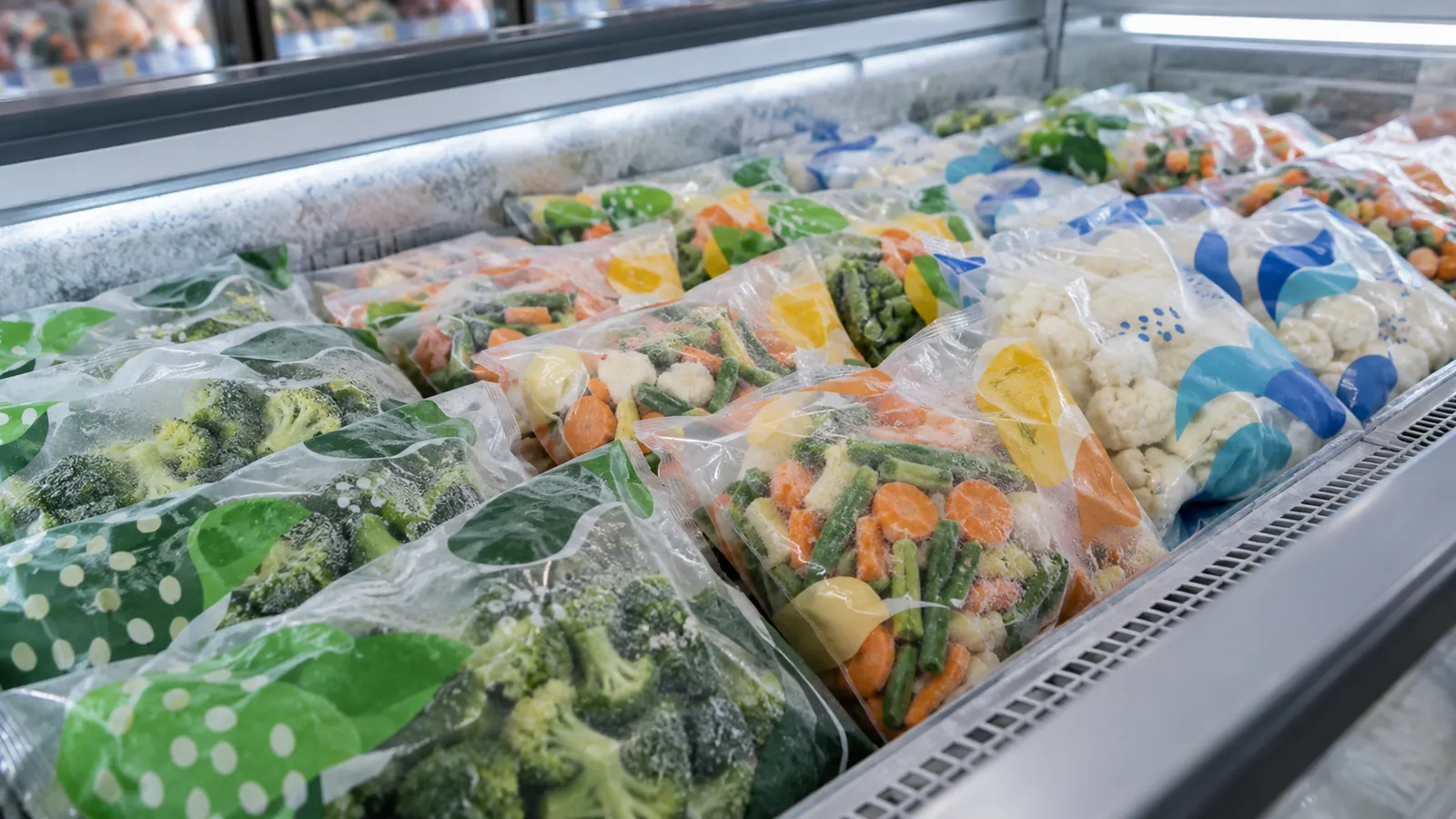
| Frozen vegetables, fruit | Coextruded PE or PET / PE laminate | Low-temperature toughness, moisture barrier, good heat seal |
| Fries, potato products | Coextruded PE, PET / PE or OPP / PE | Puncture resistance and clear or printed appearance |
| Meat, poultry, seafood | Nylon / PE or PET / nylon / PE, sometimes vacuum | Puncture resistance, oxygen barrier and vacuum capability |
| Ready meals | Only a structure and vent system qualified for the actual heating cycle | Validate heating, venting and food-contact suitability; generic PET / PE or PP is insufficient |
| Ice cream, frozen desserts | OPP or PET based laminate with a suitable sealant | Moisture control and reliable seals on cold, frosty surfaces |
| Bread dough, pastry | PE or OPP / PE | Moisture control and frozen handling |
PE film covers the grades, including LLDPE film, which is often used for toughness. Nylon film adds puncture and flex-crack resistance where frozen items are sharp, and PET film adds stiffness and printability as an outer layer.
PE-rich structures
PE blends are candidates for freezer films; request results for the actual grade, gauge and conditions rather than assuming low-temperature toughness from the family name. A coextruded film with an LLDPE core and an LDPE or sealant skin gives a good seal range. Gauge is a trial variable: compare toughness and sealing on the actual structures (see film thickness). Ask the supplier for puncture resistance and dart impact data with the test temperature stated, because ambient results alone cannot establish freezer suitability. ASTM D1709-24 covers free-falling dart impact on film specimens. ASTM F1306-21(2025) covers slow probe penetration and specifies room-temperature testing. Identify any cold-temperature adaptation as a departure from the standard method; neither specimen test establishes cold, filled-bag drop performance.
PET / PE and nylon where needed
PET / PE gives a glossy printed bag with stiffness and a PE sealant. Nylon is added where product edges are sharp or when vacuum packing meat and fish, because it adds puncture strength and oxygen barrier. These laminates cost more than a coextruded PE film, so use them where the product demands it.
Microwave and steam-venting packs
Microwaveable frozen meals need sealants and structures that tolerate the heat of reheating and release steam in a controlled way. Common approaches include a pressure-release seal, a laser-scored vent, or a designed weak spot that opens as steam builds. Test the pack in the actual microwave, with the real product, in the wattage range the consumer will use. Any food-contact or “microwave safe” claims must be confirmed for the destination market.
Ventilated film for frozen food
A freezer-safe ventilated film is a frozen food bag film with a hole or micro-perforations that let excess air leave the pack. A frozen food ventilated wrap, or a ventilated wrap for frozen products, matches that holed bag when the pack is made on a vertical wrapper. A 17 October 2017 Packaging Europe report on a vertical form-fill-seal air-extraction system says manufacturers make a hole or micro-perforations because excess air makes the bag bulky and fewer packs fit on a pallet. The report says long storage with those openings can taint the food, and that punched holes or perforations are a route for external contamination.
ULMA’s 10 October 2017 note on that system, written for frozen product, says traditional bagging perforates the bag to reduce its volume. The note says that, with no perforations, there is no risk of contaminating the product. The Packaging Europe report says the system removes air before the bag is sealed. It names frozen fish, seafood, vegetables and precooked food. Neither source states a hole diameter, a permeability, or a transmission rate.
Record which opening is on the sample:
Scroll horizontally to view all columns if needed. ↔
| Opening | Job | Record with the sample |
|---|---|---|
| Hole or micro-perforation in a frozen bag | Let excess air out and reduce bag volume | Storage result with the opening present |
| Steam vent | Release steam during heating | Heating cycle, product and vent result from the section above |
| Micro-perforated produce film | Respiration of fresh produce | The flow wrap use; specify it here only when the product is still respiring |
The freezer-burn route on this page is a closed film: a water-vapor barrier, little headspace and a film without pinholes. A perforated bag is a separate choice. Cold toughness and puncture still need a filled-pack trial. Freezer-safe is that trial result for the grade, gauge and temperature you record.
These sources describe bags on vertical wrappers. For a wrap around a tray or a block, record that format on its own.
Frozen food packaging formats
- Pillow bags are the standard for frozen vegetables, fries and small items.
- Stand-up pouches suit premium frozen products, often with a zipper for reclosing.
- Zipper freezer bags are resealable bags for household freezing and some retail packs.
- Vacuum pouches are used for frozen meat and seafood.
- Lidded trays and overwraps are used for ready meals and some desserts.
Machines for frozen food packaging
Most frozen products are filled on vertical form-fill-seal machines that pull film over a forming collar, make a vertical seal and cross seals, and drop product in from a multihead weigher. The film must run through the machine, seal through ice crystals and dust, and stay supple enough to avoid cracking in the cold packing area. A film that is too stiff or too slippery will track poorly. The VFFS film guide covers friction, seal range and film stiffness for these lines.
Pouch formats can go through premade pouch fillers; see premade pouch materials.
Sustainability
Frozen packs are often all-PE, which suits mono-material design. Replacing a PET / PE laminate with a PE / PE structure can make the pack easier to recycle, but it may reduce gloss, stiffness and print quality, and machine speed can change. Verify recyclability claims against the guideline you design for and the collection reality in your market. See mono-material packaging.
Steps to specify a frozen food film
Scroll horizontally to view all columns if needed. ↔
| Check | Record for each sample / time point | Result / action |
|---|---|---|
| Material specimens | Grade, thickness, method / version, probe or dart; temperature and conditioning time | Record any departure from standard conditions |
| Cold filled packs | Product shape, actual mass, pack temperature at drop, conditioning and drop orientation / height | Record tear, leak, failure location and result |
| Seal contamination | Frost / moisture / fines; settings and clean control | Compare seal and leak results |
| Cold-chain cycle | Temperature history, timing and handling | Repeat integrity checks after the cycle |
| Heating if intended | Qualified structure; product, microwave power / time, vent result | No heating claim without matching validation |
Why ambient data are insufficient
F1306 states that probe response depends on temperature, thickness, probe shape and penetration rate. Cold contents also load a finished seal differently from a flat film specimen. Keep standard laboratory comparisons separate from a documented cold-pack handling trial.
Method and sources
Official public scopes establish what the specimen methods measure. The finished-pack record is a project worksheet, not an ASTM drop-test procedure. ASTM scopes checked 2026-10-08; no cold-drop results are supplied.
The ventilated-film section uses two public 2017 descriptions of perforated frozen bags and a non-perforated air-extraction alternative. They state no hole diameter, permeability or transmission rate, so none is given. Checked 2026-10-12.
Continue reading
Related articles
Snack Packaging Film: Structures, Formats and Machines
Snack packaging film explained: typical BOPP and PET structures, barrier needs, nitrogen flushing, bag formats and the machines that run them.
Spice Packaging Materials: Aroma, Moisture and Contact-Layer Checks
The best spice packaging depends on whole or ground form, climate and how spice oils meet the inner layer. Compare the risks, then copy a sample record.
Bakery Packaging Film: Keeping Bread and Cakes Fresh
Bakery packaging film explained: how staling, moisture loss and mold shape film choice for bread, cakes, cookies and tortillas, plus formats and machines.