
Package Strength Testing: Burst vs Creep (ASTM F1140 vs F2054)
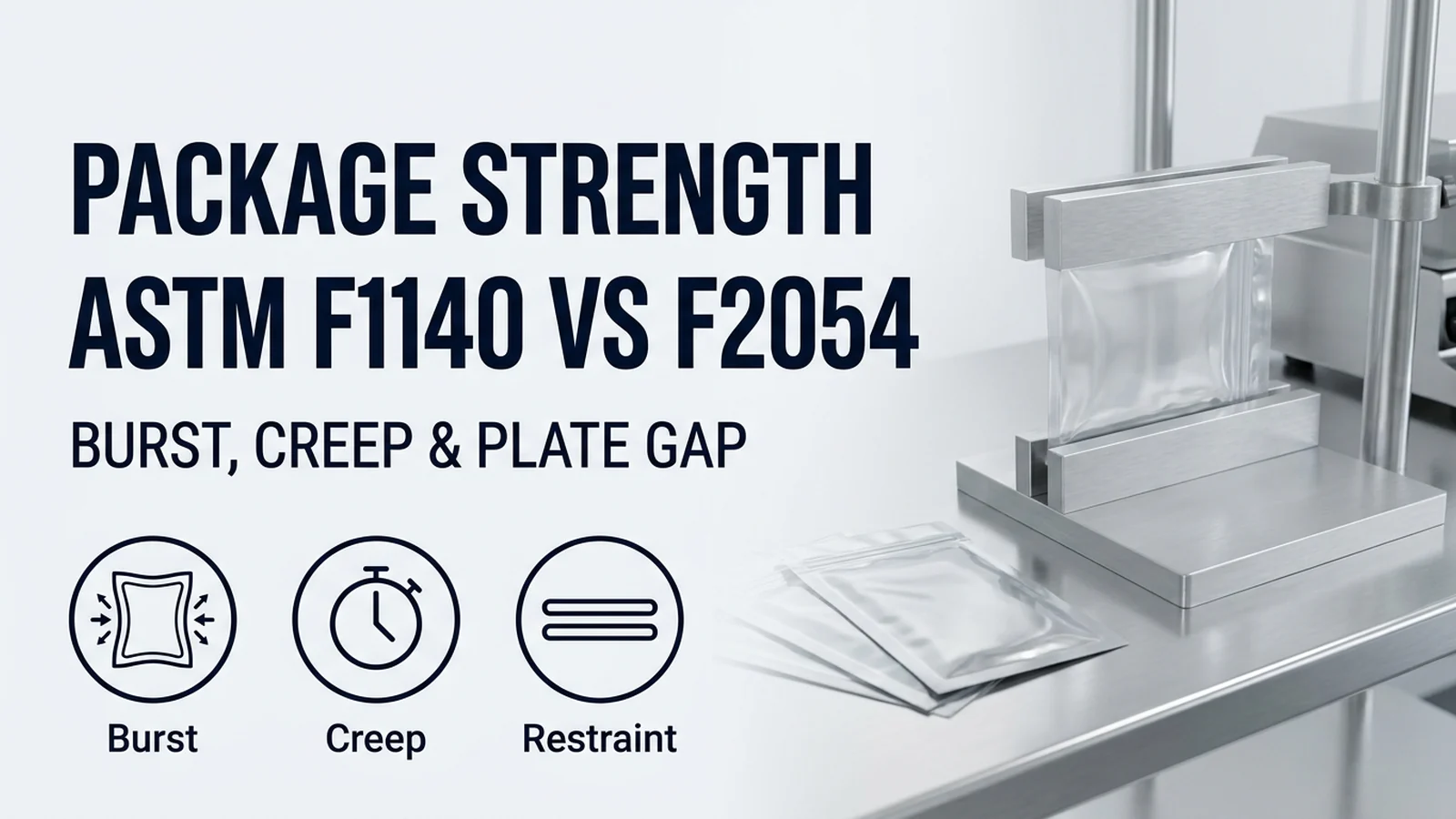
Package strength testing measures whole-pack resistance to internal pressure. Separate unrestrained ASTM F1140 burst or creep from ASTM F2054 plate tests.
Package strength testing measures the force required to separate two components of a package, such as two flexible components of a pouch or a flexible lid from a thermoformed tray. DDL says these forces are commonly measured in pounds of force per inch width, as in the seal/peel test, or in pounds per square inch, as in the burst test method. Whole-package internal pressurization splits into two active ASTM methods: ASTM F1140/F1140M-13(2025) (F1140_F1140M-13R25) for unrestrained burst and creep testing, and ASTM F2054/F2054M-13(2024) (F2054_F2054M-13R24) for perimeter-seal burst testing inside restraining plates.
An unrestrained ASTM F1140 burst or creep pressure is not interchangeable with an ASTM F2054 restraining-plate burst pressure. Under unrestrained conditions the stress on the package is highest at the middle of the pouch where it inflates to its maximum diameter, whereas restraining plates keep the package dimensionally stable so the stresses are applied more uniformly along the perimeter seal. ASTM F2054 Clause 5.4 states that this test may not necessarily provide correlation with package seal strength as typically measured using Test Methods F1140 or F88, and ASTM F1140 Clause 5.4 states that its methods do not necessarily provide correlation with actual package seal strength as typically measured using Test Method F88. Use the packaging film performance hub for full property screening across barrier and mechanical tests, packaging seal strength for overview seal definitions, and the seal strength tester ASTM F88 acceptance guide when specifying cut-strip tail support and grip geometry.
What Is the Difference Between ASTM F1140 and ASTM F2054?
ASTM F1140 leaves the package unrestrained so it inflates freely, while ASTM F2054 encloses a flexible pouch between rigid restraining plates so internal air pressure stresses the perimeter seal more uniformly. Under ASTM F2054 Clause 1.2, the two procedures are functionally similar except for the restraining plates: without plates, internal pressurization stresses are not distributed uniformly across all seal areas because stress is highest at the middle of the pouch where it inflates to its maximum diameter, which means F1140 may not reliably detect the weakest area of the seal. Under Clause 1.3, placing the pouch between restraining plates maintains dimensional stability during inflation, giving the burst test a higher probability of detecting the weakest spot along the perimeter seal.
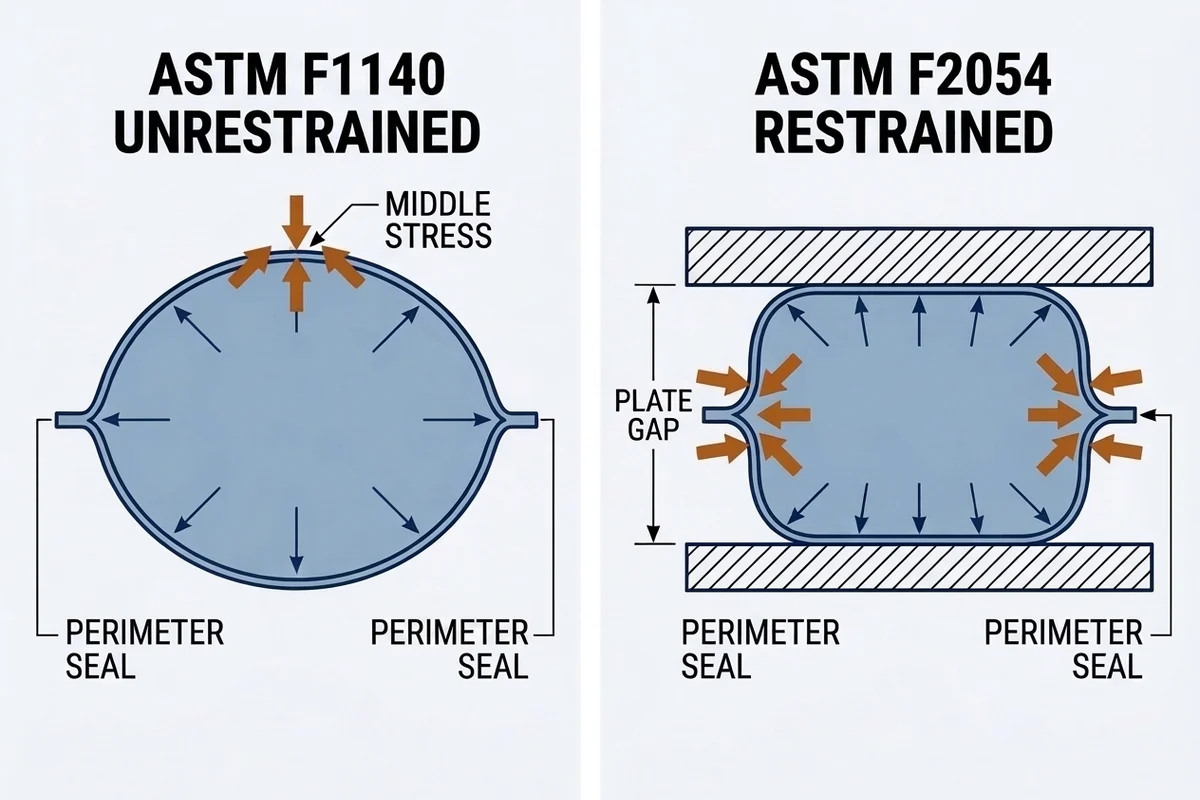
ASTM F2054 applies only to flexible packages with perimeter seals, a narrower package form than unrestrained F1140. Clause 1.4 limits F2054 to flexible packages with seals placed around the perimeter (pouches) and notes particular applicability to peelable seals that an end user peels open to remove contents. Under Clause 1.4.1, porous barrier materials may fail to reach adequate pressure to burst the package seals because of insufficient volume flow, with additional context referenced in Appendix X4. Clause 1.6 advises particular caution where users design and fabricate restraining-plate fixtures, and points to Appendix X3 for stress-factor calculations and structural design considerations.
Scroll horizontally to view all columns if needed. ↔
| Method attribute | ASTM F1140/F1140M-13(2025) | ASTM F2054/F2054M-13(2024) |
|---|---|---|
| Active store designation and update | F1140_F1140M-13R25, last updated Oct 22, 2025 (5 pages, Vol. 15.10, Subcommittee F02.20, ICS 55.180.40) |
F2054_F2054M-13R24, last updated Nov 15, 2024 (8 pages, Vol. 15.10, Subcommittee F02.20, ICS 55.040) |
| Package restraint and stress path | Unrestrained inflation; stress peaks at the middle of the pouch at maximum diameter (F2054 Clause 1.2) | Enclosed within restraining plates; dimensional stability loads the perimeter seal more uniformly (Clauses 1.1 and 1.3) |
| Package and seal scope | General ability of unrestrained packages to withstand internal pressurization (Clause 1.1; F2054 Clause 1.2) | Flexible packages with perimeter seals (pouches), particularly peelable seals; porous barriers need adequate volume flow per Clause 1.4.1 and Appendix X4 |
| Pressurization modes | Burst test to failure (Clause 1.2) and creep hold test for a specified time or until failure (Clause 1.3) | Minimum burst strength of the perimeter seal under increasing internal air pressure (Clauses 1.1 and 1.3) |
| Correlation and unit rules | Does not necessarily provide correlation with seal strength measured by Test Method F88 (Clause 5.4); SI and inch-pound systems stay separate (Clause 1.4) | May not necessarily provide correlation with seal strength measured by Test Methods F1140 or F88 (Clause 5.4); SI and inch-pound systems stay separate (Clause 1.5) |
Both standards enforce strict unit separation. Under ASTM F1140 Clause 1.4 and ASTM F2054 Clause 1.5, values stated in SI units or inch-pound units are regarded separately as standard, are not necessarily exact equivalents, and shall not be combined across the two systems.
How Do Burst, Creep, and Creep-to-Failure Tests Differ?
A burst test increasingly pressurizes the package until the package fails, whereas a creep test maintains a specified pressure for a specified time or until the package fails. ASTM F1140 Clause 5.1 evaluates tendencies for package failure when the package is exposed to a pressure differential during processes such as sterilization and transportation, while ASTM F2054 Clause 5.1 evaluates tendencies for package seal failure under a pressure differential during sterilization and transportation, and both Clauses 5.2 note frequent use during manufacturing and at various stages of the package life cycle. In the public ASTM F1140 scope, Clause 1.2 defines the burst test and Clause 1.3 defines the creep test without assigning lettered sub-method codes.
Intertek’s public ASTM F1140 method note supplies the lettered sub-method labels and fixture terminology commonly seen on laboratory request sheets. In Intertek’s summary, ASTM F1140 applies to open or closed flexible packages tested with or without product and outlines three tests: Test Method A (Burst Test), Test Method B1 (Creep Test), and Test Method B2 (Creep to Failure). Intertek also separates fixture geometry into an Open Package Test, in which an open package is inserted and clamped in the equipment, and a Closed Package Test, in which a pressurization probe is inserted into a sealed package.
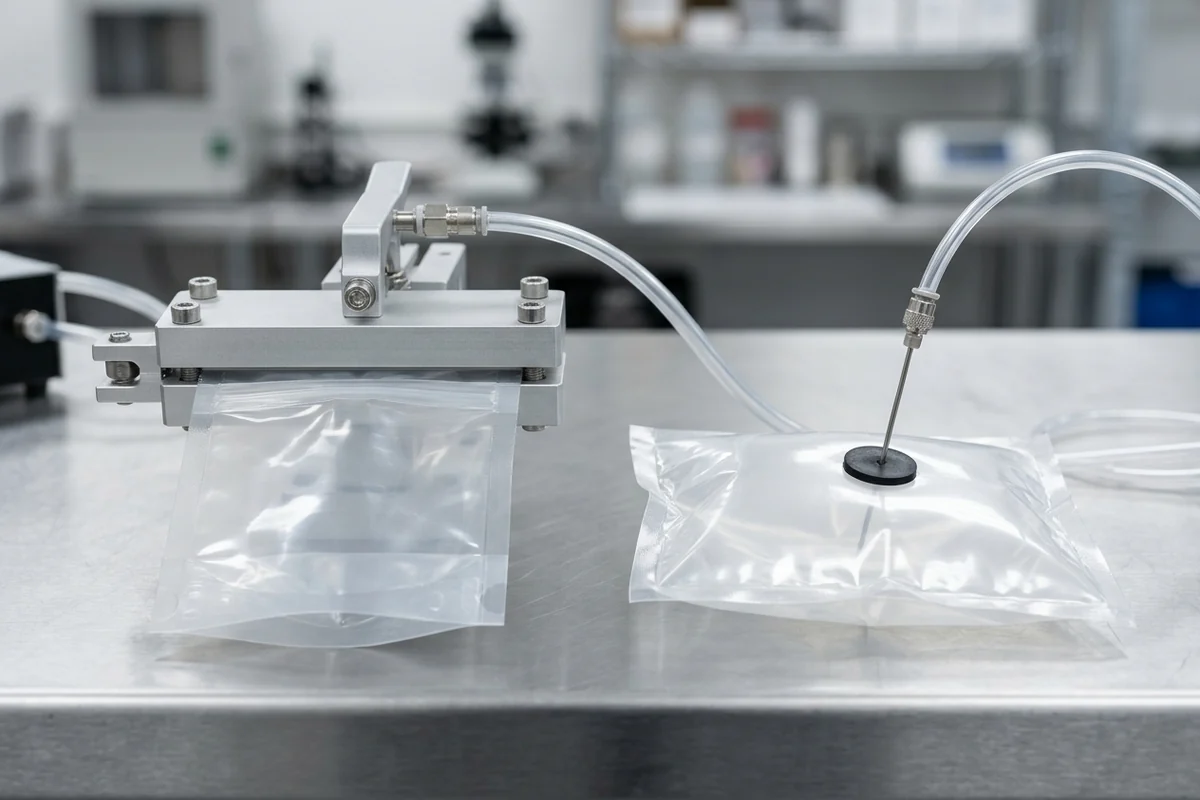
Each pressurization mode answers a different engineering question and requires its own recorded data fields:
- Burst to failure (
Test Method A (Burst Test)in Intertek; ASTM F1140 Clause 1.2): Increasingly pressurizes the package until the package fails, reporting the burst pressure value and the failure location. - Creep hold (
Test Method B1 (Creep Test)in Intertek; ASTM F1140 Clause 1.3): Applies a specified pressure for a specified time to determine pass or fail, reporting the time and pressure at which the package was held. - Creep to failure (
Test Method B2 (Creep to Failure)in Intertek; ASTM F1140 Clause 1.3): Creep tests the package until failure, reporting the time and pressure at which the package failed.
Record the burst pressure value with the failure location, and record the time and pressure at which the package was held for a creep test or the time and pressure at which the package failed for creep to failure.
Does Passing a Burst Test Prove Package Integrity?
No, passing an internal burst or creep test does not prove that a flexible package or sterile barrier is leak-free. ASTM F2054 Clause 5.1 states explicitly that restraining-plate burst testing provides an indicator of minimum burst strength where failure normally occurs in one or more areas of the seal, but cannot measure package seal uniformity, cannot evaluate overall package integrity, and cannot determine the burst strength of package areas that contact the restraining plates. Clause 5.1 adds that burst testing should be combined with dedicated methods for overall package integrity, seal uniformity, or opening functionality when those properties are required.
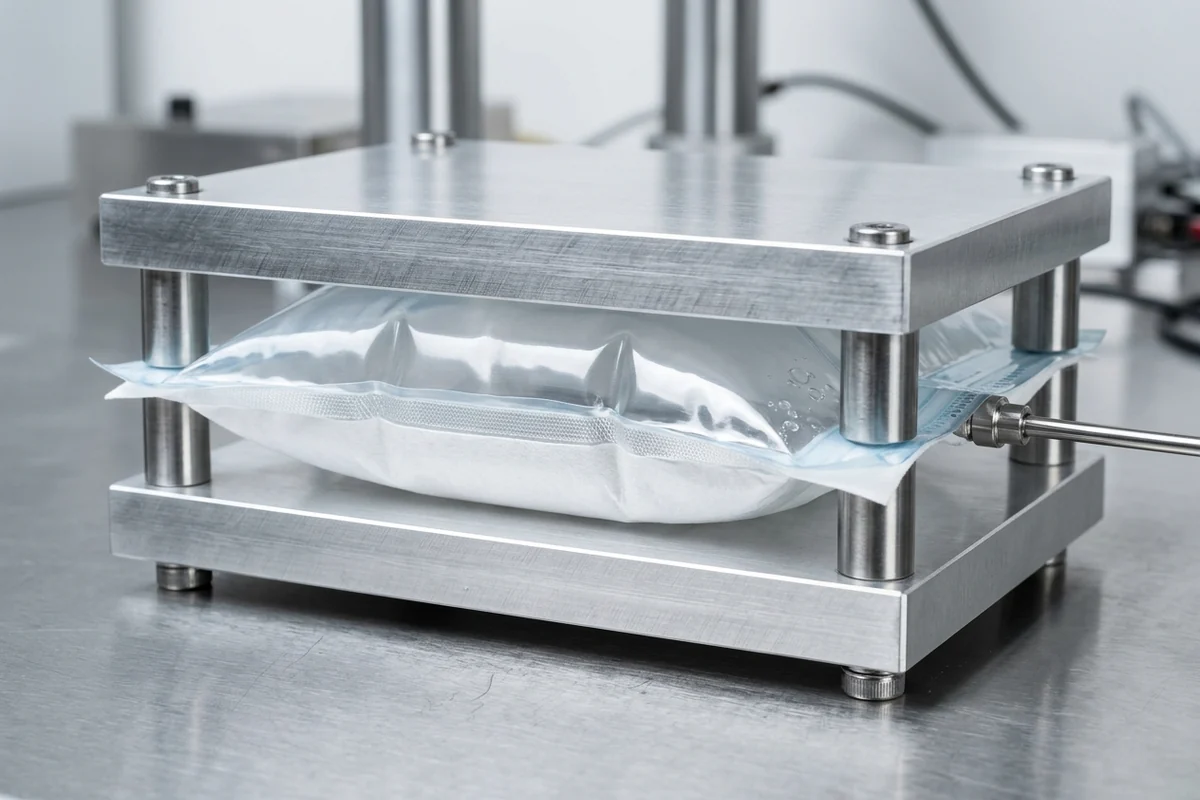
DDL says a seal strength measurement may be within the design specification while that same seal has a channel leak that dye leak testing would find, indicating a breach in package integrity. Keep whole-pack burst testing distinct from strip peel testing on the seal strength tester ASTM F88 acceptance guide and from the seal overview on packaging seal strength. On porous barrier materials, failure to reach adequate pressure to burst the package seals may be due to insufficient volume flow, as ASTM F2054 Clause 1.4.1 and Appendix X4 describe, including pouches used for medical device packaging.
Which Edition and FDA Rules Apply to Device Packaging?
The ASTM store’s active catalog editions are newer than the editions currently listed in the FDA Recognized Consensus Standards database, so regulatory submissions should state the exact designation tested and recognized. On the ASTM store, the active unrestrained standard is ASTM F1140/F1140M-13(2025) (F1140_F1140M-13R25, last updated Oct 22, 2025, DOI 10.1520/F1140_F1140M-13R25, listed above F1140_F1140M-13R20E01), and the active restraining-plate standard is ASTM F2054/F2054M-13(2024) (F2054_F2054M-13R24, last updated Nov 15, 2024, DOI 10.1520/F2054_F2054M-13R24, listed above F2054_F2054M-13R20). In the FDA database, FR Recognition Number 14-402 (FR Recognition List 034, Date of Entry 01/30/2014, Sterility Specialty Task Group, Complete standard) recognizes ASTM F1140/F1140M-13 (Reapproved 2020)e1 as the single FDA search result for F1140, while FR Recognition Number 14-403 (List 034, Date of Entry 01/30/2014, Complete standard) recognizes ASTM F2054/F2054M-13 (Reapproved 2020).
Both FDA recognition records state that the standards are relevant for all medical devices where sterilization and packaging are components of product development and manufacture, and both cite ISO 11607-1 (Part 1: requirements for materials, sterile barrier systems and packaging systems), ISO 11607-2 (Part 2: validation requirements for forming, sealing and assembly processes), ISO/TS 16775 (First edition 2014-05-15), and the September 2018 voluntary consensus standards guidance as supportive publications. See our medical device packaging overview for sterile-barrier pouch structures and check the FDA recognition database directly before citing a newer publisher catalog reapproval in a regulatory filing.
For premarket submissions on sterile devices, Item 5 of the January 2024 FDA 510(k) sterility guidance PDF (also posted on the FDA 510(k) sterility guidance page) states that the sponsor should provide a description of the sterile barrier system and how it will maintain the device’s sterility, and a description of the package test methods, but not package test data. That guidance recommends package test methods covering simulated distribution with associated package integrity, plus simulated and/or real-time aging with associated seal strength testing, referencing the currently FDA-recognized version of the AAMI/ANSI/ISO 11607 series.
Under the Quality Management System Regulation in 21 CFR Part 820, § 820.1 governs the methods, facilities, and controls used for the design, manufacture, packaging, labeling, storage, installation, and servicing of finished devices intended for human use, and § 820.7 incorporates ISO 13485:2016(E) (Third edition, March 1, 2016) by reference for §§ 820.1, 820.3, 820.10, 820.35, and 820.45. Section 820.45 (Device labeling and packaging controls), alongside ISO 13485 Clause 7.5.1, requires documented procedures ensuring labeling and packaging integrity, inspection, storage, and operations across customary processing, storage, handling, distribution, and use, plus pre-release accuracy checks of UDI or UPC, expiration date, storage instructions, handling instructions, and additional processing instructions, with labeling release and mixup-prevention inspections documented per ISO 13485 Clause 4.2.5.
Why Do Burst Reports Disagree, and What Must You Record?
If correlations between pieces of test equipment are to be made, ASTM F1140 Clause 5.3 says it is important that all parameters of the test method be exactly the same, and ASTM F2054 Clause 5.3 says it is important that all parameters of the test be equivalent, including air-flow rate, sensitivity to pressure drop, article position, restraining-plate rigidity, and the distance between restraining plates. ASTM F1140 Clause 5.3 states that typical parameters may include, but are not limited to, package size, material, seal configuration, test equipment, rate of air flow into the package, sensitivity (machine response to pressure drop), and position of the test article (Fig. 1). ASTM F2054 Clause 5.3 states that typical parameters can include, but are not limited to, package size, material, seal configuration, rate of air flow, the pressure-detection sensing mechanism and sensitivity, position of the test article, the rigidity of the restraining plates, and the distance between restraining plates, and it points to Appendix X2 for further correlation detail.
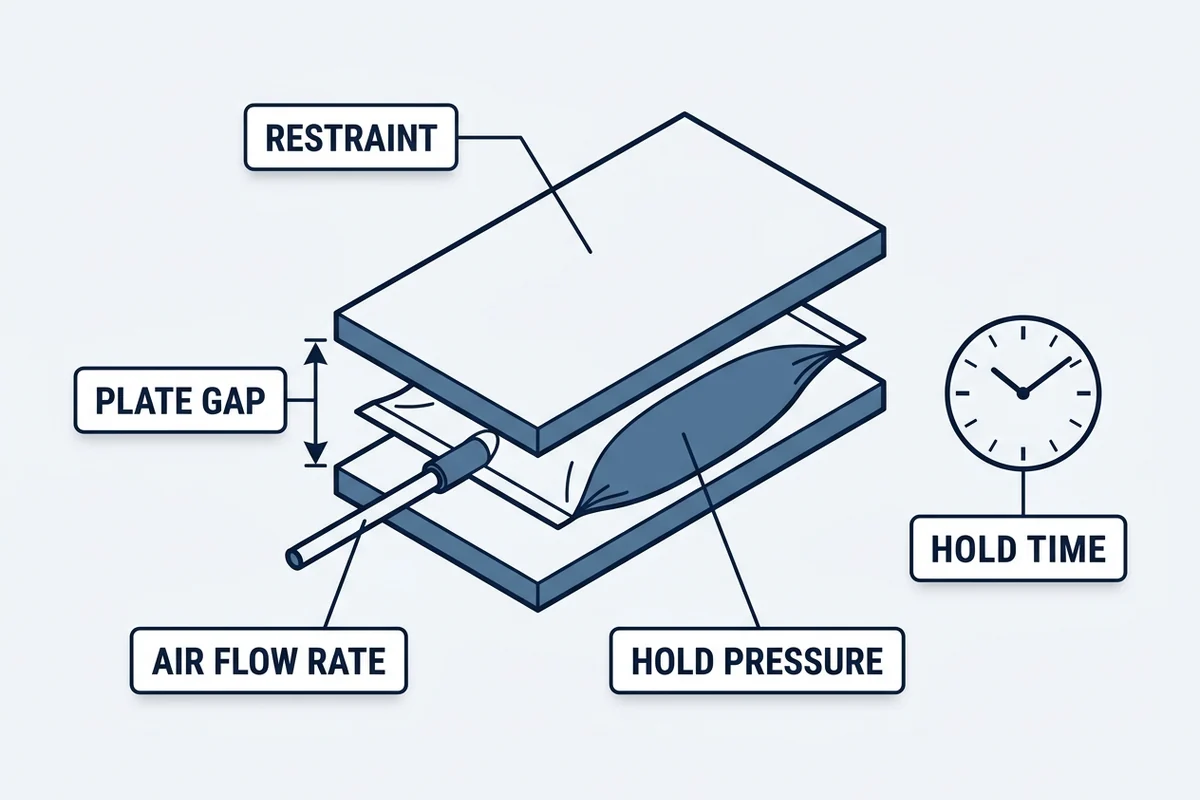
Apply four verification rules before comparing two internal-pressurization reports:
- Do not compare a pressure recorded without plates (ASTM F1140) against a pressure recorded inside restraining plates (ASTM F2054), because unrestrained stress is highest at the middle of the pouch at maximum diameter and plates apply stress more uniformly along the perimeter seal (F2054 Clauses 1.2, 1.3, and 5.4).
- For cross-instrument correlation under ASTM F2054 Clause 5.3, record the rigidity of the restraining plates and the distance between restraining plates.
- Keep all dimensions, flow settings, and pressures inside either SI units or inch-pound units without mixing the two systems (F1140 Clause 1.4; F2054 Clause 1.5).
- When a porous barrier does not reach adequate pressure to burst the seals, treat insufficient volume flow as a possible cause (F2054 Clause 1.4.1 and Appendix X4).
Attach this test-condition record to laboratory requests and incoming quality sheets so pressurization numbers remain auditable across production lots and test benches:
Scroll horizontally to view all columns if needed. ↔
| Test-condition field | Information to lock and record on the report | Governing clause or source |
|---|---|---|
| Standard designation and edition | Exact method run (F1140_F1140M-13R25, F2054_F2054M-13R24, or the 2020 FDA-recognized reapproval 14-402 / 14-403) |
ASTM store catalog; FDA recognition records 14-402 and 14-403 (List 034) |
| Unit system | SI units only or inch-pound units only; do not combine units across systems | F1140 Clause 1.4; F2054 Clause 1.5 |
| Package geometry and materials | Pouch dimensions, web structure (including porous barriers), and perimeter or peelable seal configuration | F1140 Clause 5.3; F2054 Clauses 1.4, 1.4.1, and 5.3 |
| Fixture entry and article position | Open package inserted and clamped vs. closed package with a pressurization probe inserted, plus contents status and article position (Fig. 1) |
F1140 Clause 5.3; F2054 Clause 5.3; Intertek method note |
| Restraint condition and plate gap | Unrestrained vs. restraining plates; when restrained, record plate rigidity, plate fixture design (Appendix X3), and distance between restraining plates (Appendix X2) |
F2054 Clauses 1.6 and 5.3 |
| Air-flow rate and drop sensitivity | Rate of air flow into the package, pressure-detection sensing mechanism, and machine sensitivity to pressure drop | F1140 Clause 5.3; F2054 Clause 5.3 |
| Loading mode and hold settings | Burst to failure (Test Method A), pass/fail creep time and pressure (Test Method B1), or creep-to-failure time and pressure (Test Method B2) |
F1140 Clauses 1.2 and 1.3; Intertek method note |
| Measured result and failure location | Burst pressure value and failure location, time and pressure at which the package was held, or time and pressure at which the package failed | Intertek method note; F2054 Clause 5.1 |
| Companion integrity and peel checks | Separate package-integrity method, including dye leak testing named by DDL, and an ASTM F88 strip peel record when seal strength is also compared |
F1140 Clause 5.4; F2054 Clauses 5.1 and 5.4; DDL engineering note |
Sources
- ASTM F1140/F1140M-13(2025): Standard Test Methods for Internal Pressurization Failure Resistance of Unrestrained Packages — store.astm.org
- ASTM F2054/F2054M-13(2024): Standard Test Method for Burst Testing of Flexible Package Seals Using Internal Air Pressurization Within Restraining Plates — store.astm.org
- FDA Recognized Consensus Standards Database: Recognition Number 14-402, ASTM F1140/F1140M-13 (Reapproved 2020)e1 — accessdata.fda.gov
- FDA Recognized Consensus Standards Database: Recognition Number 14-403, ASTM F2054/F2054M-13 (Reapproved 2020) — accessdata.fda.gov
- FDA Recognized Consensus Standards Database: Search Results for Reference Number F1140 — accessdata.fda.gov
- FDA Guidance for Industry and FDA Staff (January 2024): Submission and Review of Sterility Information in Premarket Notification (510(k)) Submissions for Devices Labeled as Sterile — fda.gov (Guidance PDF — fda.gov)
- eCFR Title 21 Part 820: Quality Management System Regulation (§§ 820.1, 820.7, and 820.45) — ecfr.gov
- Intertek Testlopedia, Burst of Unrestrained Packages ASTM F1140 (open vs. closed package fixtures; Test Method A, Test Method B1, and Test Method B2 designations and reported fields)
- DDL, Package Strength Testing (force per unit width vs. burst pressure units and strength vs. channel-leak integrity distinction)
Continue reading
Related articles
Seal Strength Tester Setup: ASTM F88 Tail Support (Technique A, B, C) and Acceptance Records
Configure a seal strength tester under ASTM F88/F88M-23 by locking tail support (Technique A, B, or C), strip width, and Clause 10.1 acceptance records.
Hot Tack Tester Setup: Mapping ASTM F1921 Delay Time to Seal-Jaw Window
Set up an ASTM F1921 hot tack tester by aligning delay time, dwell, jaw geometry, and peel speed with your VFFS seal-jaw temperature window.
OTR Tester Setup: ASTM D3985 Dry vs Controlled-Humidity (ASTM F1927) Conditions
Configure an oxygen transmission rate tester for dry ASTM D3985 and humidified ASTM F1927 flat barrier film evaluation.