
Modified Atmosphere Packaging: Gas Mix and Film Permeability
Modified atmosphere packaging places an atmosphere different from air that may change with film permeability or food respiration, pairing gas and film to food.
Modified atmosphere packaging places an atmosphere inside a food package with a composition different from air, which contains approximately 21% oxygen at sea level, by reducing or replacing oxygen or increasing gases such as carbon dioxide or nitrogen, and that atmosphere may change over time because of packaging material permeability or food respiration. In the FDA Food Code 2026 definitions, controlled atmosphere packaging differs by maintaining continuous control of that non-air atmosphere until the package is opened, while vacuum packaging in a vacuum pouch removes air and hermetically seals the container so a vacuum remains inside. As across our packaging applications guides, film selection starts with the product rather than the film: the oxygen-barrier page says the film must hold a filled mix in, the Torry fish note requires low gas permeability for those fish packs, and harvested fruits and vegetables continue to respire so the package atmosphere may change with film permeability.
How do gas mixes work in modified atmosphere packaging?
Oxygen in ambient air hastens both chemical breakdown and microbial spoilage of many foods, so USDA Food Safety and Inspection Service (FSIS) guidance notes that modified atmosphere packaging and controlled atmosphere packaging help preserve foods by replacing some or all package oxygen with gases such as carbon dioxide or nitrogen. Each published gas mixture below stays with the food and the source that states it.
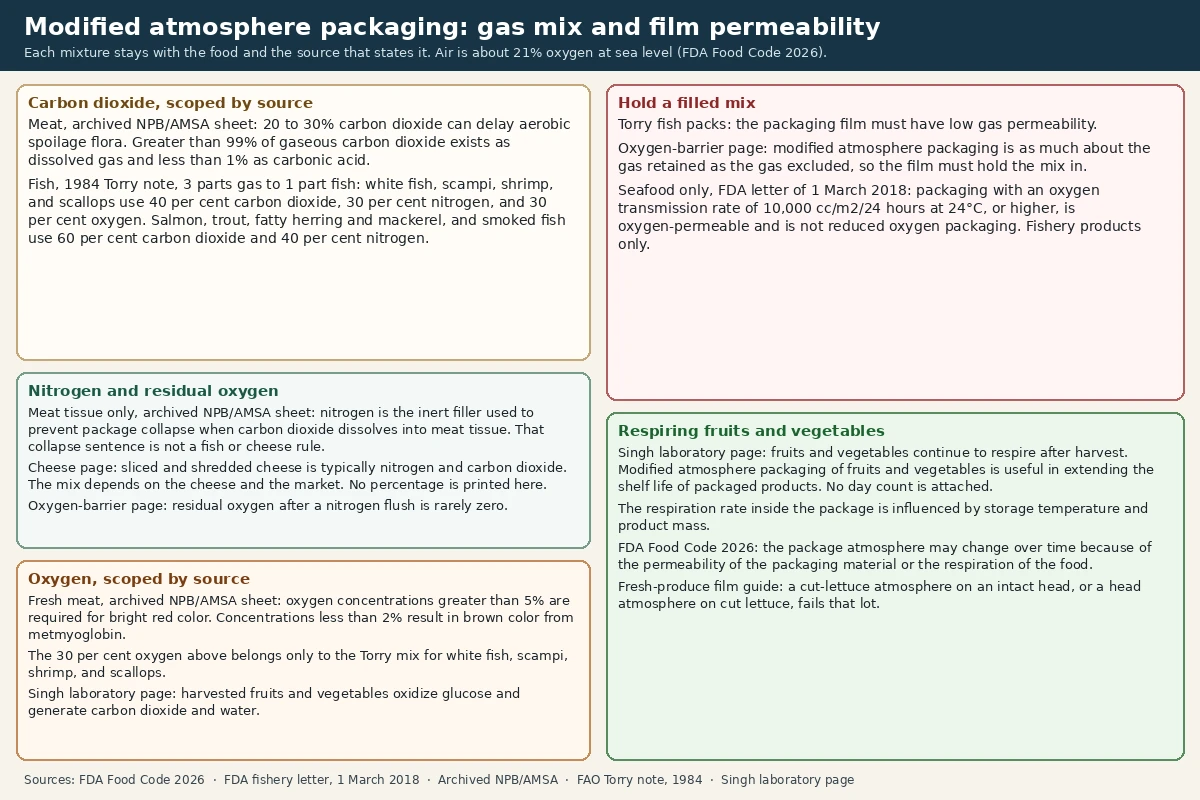
On the Pork Information Gateway page, which notes that it has been archived and may contain outdated content and was originally published as a National Pork Board and American Meat Science Association (NPB/AMSA) fact sheet, carbon dioxide, oxygen, and nitrogen are listed as the commonly used gases for meat alongside trace carbon monoxide, argon, and helium. In that meat fact sheet, greater than 99% of gaseous carbon dioxide exists as dissolved gas and less than 1% as carbonic acid, and incorporating 20 to 30% carbon dioxide in gas mixtures can delay the growth of aerobic spoilage flora of meat. Because carbon dioxide dissolves into meat tissue, nitrogen is normally used as an inert filler to prevent package collapse. For fresh meats, the same archived sheet says oxygen concentrations greater than 5% are required for the desired bright red color, while concentrations less than 2% result in brown color due to metmyoglobin formation; carbon monoxide ranging from 0.3-0.5% can stabilize fresh meat color, and the sheet says FDA approved it in 2002 as Generally Recognized as Safe (GRAS) up to 0.4% in a MAP gas mixture. In its pork-loin storage table at 4°C, the 70% O2 and 30% CO2 mixture lists off-odor at 14 days, the 0.4% CO, 60% CO2, and 40% N2 mixture lists off-odor at 21 days, and a third listed atmosphere uses 60% CO2 and 40% N2 with an oxygen absorber in the pack.
Fisheries guidance uses distinct gas ratios and stricter chill targets. In the Food and Agriculture Organization (FAO) reprint of the Torry Advisory Note on packing fish in a modified atmosphere, recommended mixtures assume a volume ratio of 3 parts gas mixture to 1 part fish in the pack: white fish, scampi, shrimp, and scallops use 40 per cent carbon dioxide, 30 per cent nitrogen, and 30 per cent oxygen, whereas salmon, trout, fatty fish such as herring and mackerel containing at least 8 per cent fat, and smoked fish products use 60 per cent carbon dioxide and 40 per cent nitrogen. Under those Torry note conditions, packs must be kept at or close to 0°C throughout distribution and should be stored as near to 0°C as possible and never above 5°C; cod fillets of high initial quality, packed in the recommended gas mixture at a 3:1 gas-to-product volume ratio, keep up to 50 per cent longer at 0°C than when stored under vacuum or unwrapped, raw shell-on scampi and shrimp keep up to 30 per cent longer at 0°C in a modified atmosphere pack than in other types of pack, and the storage life of herring, mackerel, salmon, trout, and smoked fish products is not extended in a modified atmosphere at 0°C.
For sliced and shredded cheese covered in our cheese packaging guide, modified atmosphere packs replace air with a gas mix, typically nitrogen and carbon dioxide, and the gas mix and the shelf life depend on the cheese and on the local market.
Scroll horizontally to view all columns if needed. ↔
| Food Scope | Published Gas Mixture | Stated Temperature & Ratio Basis | Published Authority |
|---|---|---|---|
| Fresh pork loin (high-oxygen retail color row) | 70% O2 / 30% CO2 | 4°C storage column; off-odor listed at 14 days | Archived NPB/AMSA meat fact sheet |
| Fresh pork loin (trace-CO row) | 0.4% CO / 60% CO2 / 40% N2 | 4°C storage column; off-odor listed at 21 days (FDA 2002 GRAS up to 0.4% CO) | Archived NPB/AMSA meat fact sheet |
| Fresh pork loin (scavenger row) | 60% CO2 / 40% N2 with in-pack O2 absorber | Listed alongside 4°C pork-loin study atmospheres | Archived NPB/AMSA meat fact sheet |
| White fish, scampi, shrimp, and scallops | 40 per cent CO2 / 30 per cent N2 / 30 per cent O2 | 3 parts gas to 1 part fish by volume; near 0°C, never above 5°C | FAO Torry fish note |
| Salmon, trout, herring and mackerel (at least 8 per cent fat), and smoked fish | 60 per cent CO2 / 40 per cent N2 | 3 parts gas to 1 part fish by volume; storage life not extended at 0°C | FAO Torry fish note |
| Sliced and shredded cheese | Gas mix, typically N2 and CO2 | Mix and shelf life depend on the cheese and on the local market | Cheese packaging scope |
Active high-barrier flush vs. passive respiring exchange
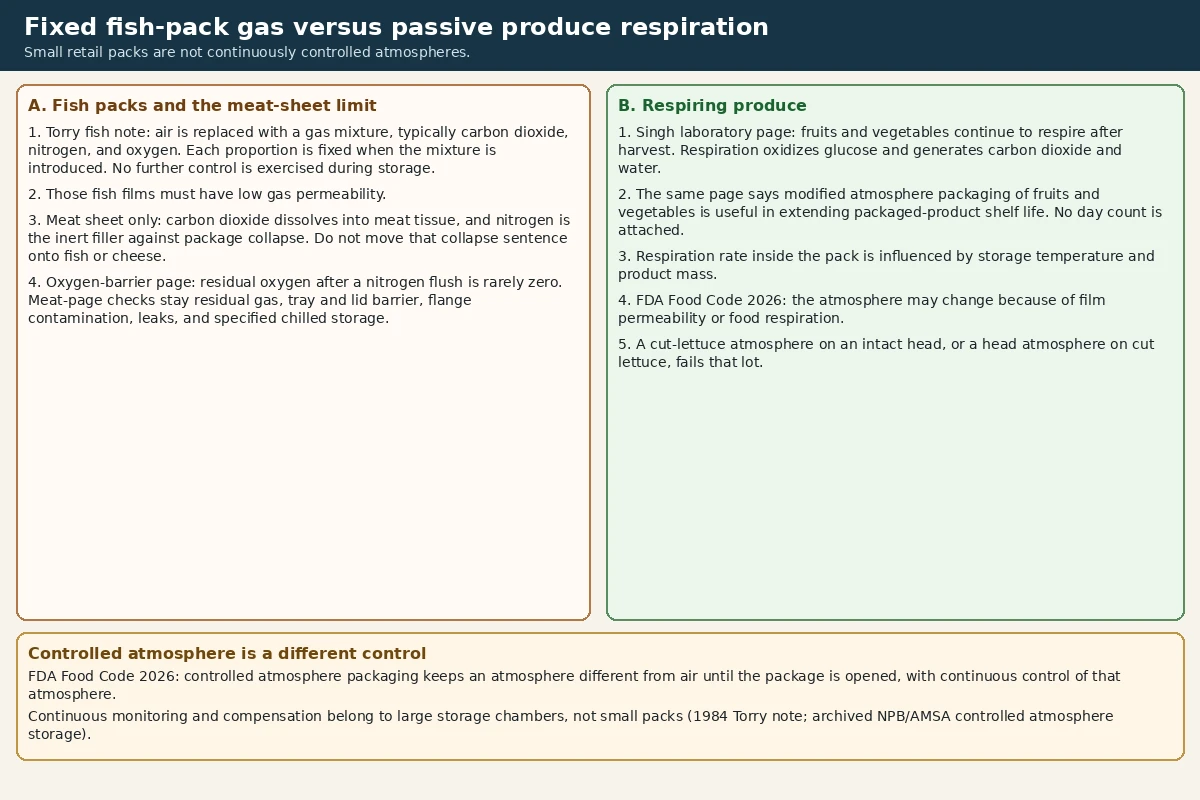
Small retail packs do not actively regulate their headspace after sealing. As the FAO Torry fish note explains, modified atmosphere packing of fish replaces air with a gas mixture, typically some combination of carbon dioxide, nitrogen, and oxygen, with each component proportion fixed when the mixture is introduced and no further control exercised during storage. That Torry note adds that modified atmosphere packing is often incorrectly called controlled atmosphere packing, because continuous control of gas composition is possible in large storage units rather than in small packs; the archived NPB/AMSA sheet likewise defines controlled atmosphere storage (CAS) as maintaining a precisely defined chamber atmosphere through continuous monitoring and compensation.
For the fish packs in the Torry note, the packaging film must have low gas permeability so the introduced mixture stays inside the pack. When fresh produce is packed, the R. Paul Singh food engineering laboratory page says modified atmosphere packaging of fruits and vegetables is useful in extending the shelf life of packaged products, and that harvested fruits and vegetables continue to respire by oxidizing glucose and generating carbon dioxide and water. Inside that sealed polymeric film package, the product respiration rate is influenced by storage temperature and product mass, and the package atmosphere may change over time because of food respiration and film permeability.
Which films suit MAP food packaging?
Specifying film for MAP food packaging separates packs that retain a flushed gas mixture from packs that breathe with a living crop. As detailed on our oxygen barrier page, modified atmosphere packaging is as much about retaining the filled gas as excluding outside air, so the structure has to hold the mix in, and residual oxygen after a nitrogen flush is rarely zero. Film oxygen transmission rate (OTR) measures the volume of oxygen passing through a unit area of film in a given time under defined test conditions, which differs from total oxygen ingress of the finished sealed package across trays, seals, and closures.
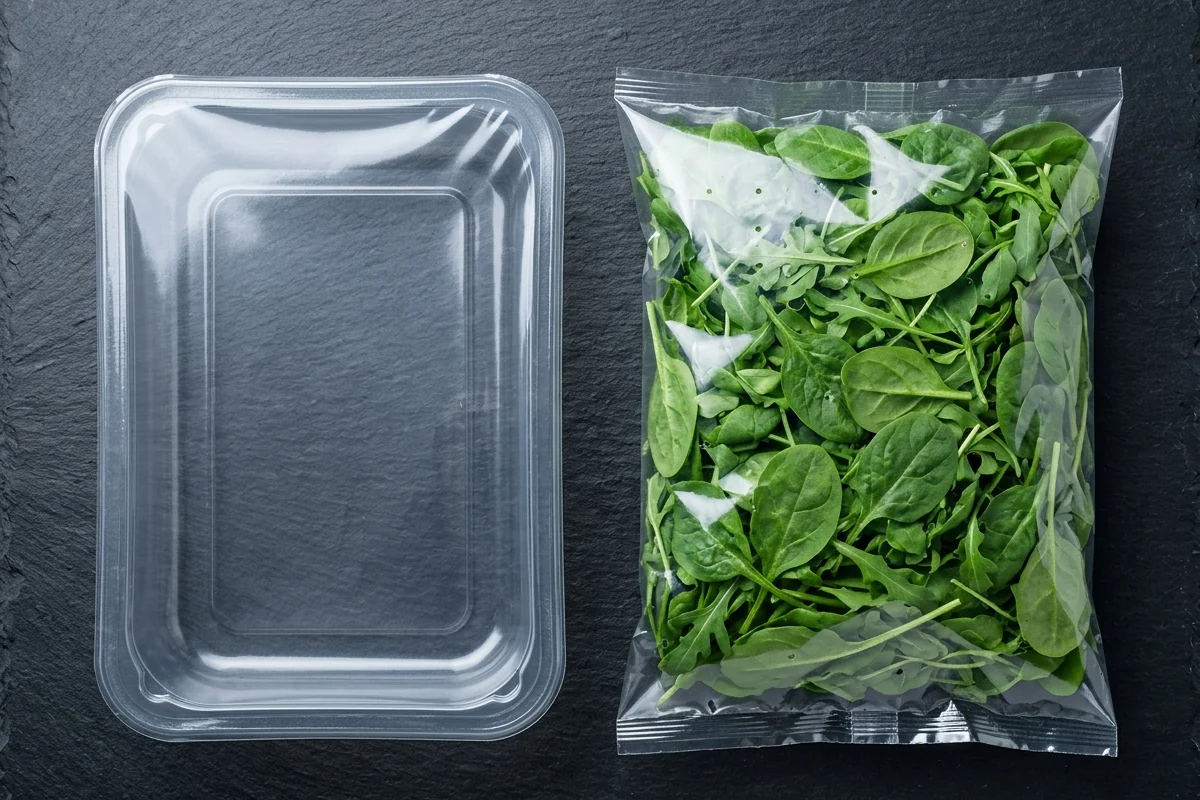
On our meat packaging guide, buyers choose vacuum, MAP, or vacuum skin packaging by the product and color goal, then validate the complete chilled system across residual gas, tray and lid barrier, flange contamination, leaks, and specified chilled storage. The Codex Alimentarius Code of Hygienic Practice for Refrigerated Packaged Foods with Extended Shelf Life also notes that packaging may need checking to confirm that it maintains a vacuum or the modified atmosphere in the container over the product shelf life. For fresh produce trials in our fresh produce packaging film guide, cut state changes respiration demand enough that applying a cut-lettuce atmosphere to an intact head, or an intact-head atmosphere to cut lettuce, fails that lot.
One numeric OTR threshold in federal guidance applies strictly to fishery products: in its March 1, 2018 letter to seafood processors, FDA states that seafood packaging with an OTR of 10,000 cc/m2/24 hours at 24°C or higher is considered oxygen-permeable and not reduced oxygen packaging, so naturally occurring aerobic spoilage organisms on the fishery product can grow and spoil the product before Clostridium botulinum toxin is produced under moderate abuse temperatures. Because film barrier measurements alone cannot establish finished-product shelf life and a rancidity or texture result cannot establish microbiological safety, packers also match the destination market, exact structure, and conditions of use under food-contact packaging regulations; FSIS notes that FDA approves food packaging materials and that materials entering a meat or poultry plant must carry a supplier guaranty of compliance with the Federal Food, Drug, and Cosmetic Act (FFDCA) stating brand name, supplier, and temperature and other use limits.
Is modified atmosphere packaging safe, and what are its limits?
Vacuum packing and modified atmospheres do not make a perishable product safe by themselves. The Codex refrigerated-foods code warns that MAP products may become unsafe without any visible signs of spoilage if they are not appropriately refrigerated or if additional hurdles are absent, because growth of aerobic spoilage microorganisms is limited, and that a modified atmosphere might inhibit spoilage organisms whose growth could otherwise indicate poor storage. Where higher concentrations of carbon dioxide are used to control spoilage flora and carbon monoxide is incorporated to reduce visual spoilage, the archived NPB/AMSA fact sheet says extreme care must be taken in determining the safe shelf life and that sell-by and use-by dating should be followed.
Retail food establishments (FDA Food Code 2026 section 3-502.12)
The FDA Food Code 2026 is a model offered for adoption by local, state, and federal governmental jurisdictions, defining reduced oxygen packaging (ROP) as controlling package oxygen below the approximately 21% level normally found at sea level for foods where Clostridium botulinum or Listeria monocytogenes require control in final packaged form. Under section 3-502.12 (Reduced Oxygen Packaging Without a Variance), a food establishment packaging time/temperature control for safety (TCS) food by ROP without a section 3-502.11 variance shall control C. botulinum growth and toxin formation and L. monocytogenes growth and shall implement a HACCP plan, except when the food is labeled with the production time and date, held at 5°C (41°F) or less during refrigerated storage, and removed from its package in the food establishment within 48 hours after packaging.
For general retail TCS packs under that HACCP plan, the food is held at 5°C (41°F) or less, carries a principal-display-panel instruction to discard within 30 calendar days, has a refrigerated shelf life of no more than 30 calendar days from packaging to consumption (excluding frozen storage time) or the original manufacturer’s sell-by or use-by date, whichever occurs first, and meets at least one hurdle: water activity (aw) of 0.91 or less, pH of 4.6 or less, meat or poultry cured at a USDA-regulated plant using substances in 9 CFR 424.21 and received intact, or high levels of competing organisms such as raw meat, raw poultry, or raw vegetables. Retail ROP of fish without a variance is limited to fish frozen before, during, and after packaging with a label stating that it is to be kept frozen until time of use. Retail cook-chill or sous vide food is placed in a package with an oxygen barrier and sealed before cooking, or sealed immediately after cooking and before the food falls below 57°C (135°F), then either cooled to 1°C (34°F) within 48 hours of reaching 5°C (41°F) and held at 1°C (34°F) until consumed or discarded within 30 days after the date of packaging, or held at 5°C (41°F) or less for no more than seven days, at which time the food must be consumed or discarded. Retail cheese ROP without a variance is restricted to commercially manufactured cheese with no added establishment ingredients meeting 21 CFR 133.150 hard cheeses, 21 CFR 133.169 pasteurized process cheese, or 21 CFR 133.187 semisoft cheeses, labeled with a use-by date not exceeding 30 days from packaging or the original manufacturer’s sell-by or use-by date, whichever occurs first.
Seafood processors (FDA March 1, 2018 letter) and Codex extended chilled shelf life
For commercial seafood processors under 21 CFR Part 123.6 (with further detail in Chapter 13 of FDA’s Fish and Fishery Products Hazards and Controls Guidance, 4th edition), FDA’s March 1, 2018 letter considers C. botulinum growth and toxin formation reasonably likely to occur in ROP fish and fishery products, including refrigerated vacuum-packed crawfish tail meat, across vacuum packaging, MAP, hermetically sealed containers, sealed plastic or laminated packaging, oil packing, and materials below the 10,000 cc/m2/24 hours at 24°C OTR threshold. Because non-proteolytic C. botulinum strains in seafood can grow at 38°F and above without apparent spoilage signs while proteolytic strains can grow at 50°F and above, the letter says that when refrigeration below 38°F is the sole control, processors should place a Time-Temperature Indicator (TTI) on each reduced-oxygen package and maintain the product below 38°F. A separate control in that letter freezes the product immediately after it is placed in a reduced-oxygen package, and each package is labeled "Important, keep frozen until used, thaw under refrigeration immediately before use."
Internationally, the Codex Alimentarius Code of Hygienic Practice for Refrigerated Packaged Foods with Extended Shelf Life addresses refrigerated packaged foods with an extended shelf life of more than 5 days whose heat or preservation treatments do not ensure commercial sterility, focusing on low-acid foods with pH greater than 4.6 and high water activity with aw greater than 0.92. Because certain C. botulinum strains can grow at 4°C or lower and specific temperature mentions such as +4°C are guidelines only, Codex calls for assessing psychrotrophic C. botulinum in reduced-oxygen refrigerated foods with a shelf life longer than 10 days when the heat process is not equivalent to 90°C for 10 minutes, citing example hurdles such as adjusting aw below 0.97, lowering pH below 5.0, or adding sodium chloride to 5% in brine.
Shelf-stable thermal rules (21 CFR Parts 113 and 114) and operational drawbacks
Refrigerated MAP is distinct from shelf-stable canned or pouch regulations. Under 21 CFR Part 113 (Thermally Processed Low-Acid Foods Packaged in Hermetically Sealed Containers), commercial sterility renders food free of microorganisms capable of reproducing under normal nonrefrigerated storage and distribution and free of viable microorganisms (including spores) of public health significance inside a hermetically sealed container secure against microbial entry, covering foods with finished equilibrium pH greater than 4.6 and aw greater than 0.85 (excluding tomatoes and tomato products with finished equilibrium pH less than 4.7, and covering scheduled-process vacuum-packed containers where vacuum maintenance is critical). Under 21 CFR Part 114 (Acidified Foods), acid foods have a natural pH of 4.6 or below, covered acidified foods have a finished equilibrium pH of 4.6 or below, and foods stored, distributed, and retailed under refrigeration are excluded from Part 114.
Even within chilled food applications, MAP has clear practical limits. FSIS says fresh meat in foam trays and shrink wrap, and opened packages of lunch meats, may be refrigerated 3 to 5 days, and that interval is not a MAP shelf life. Older literature cited by the archived NPB/AMSA sheet indicated that carbon dioxide concentrations greater than 20% result in undesirable brown color in muscle and bone, and the sheet says this was probably due to small amounts of residual oxygen. The Torry note says the storage life of herring, mackerel, salmon, trout, and smoked fish products is not extended in a modified atmosphere at 0°C. A cut-lettuce atmosphere on an intact head, or a head atmosphere on cut lettuce, fails that lot.
Checklist: respiring vs. non-respiring MAP food packaging
Before ordering film or setting gas-flushing targets, separate living respiring produce from non-respiring chilled foods across gas function, film permeability, cold-chain temperature, and pathogen hurdles.
Scroll horizontally to view all columns if needed. ↔
| Checklist Item | Respiring foods (fresh fruits and vegetables) | Non-respiring foods named in the sources below |
|---|---|---|
| 1. Gas role and published source | Harvested fruits and vegetables keep respiring: they oxidize glucose and generate carbon dioxide and water (Singh laboratory page). A cut-lettuce atmosphere on an intact head, or a head atmosphere on cut lettuce, fails that lot (fresh produce film guide). | Meat, archived NPB/AMSA sheet: 20 to 30% carbon dioxide can delay aerobic spoilage flora; nitrogen is the inert filler against collapse when carbon dioxide dissolves into meat tissue; oxygen above 5% for bright red color and below 2% for brown color; carbon monoxide 0.3-0.5% for color, with the sheet’s FDA 2002 GRAS statement up to 0.4%. Fish, FAO Torry note: 40 per cent carbon dioxide, 30 per cent nitrogen, and 30 per cent oxygen for white fish, scampi, shrimp, and scallops; 60 per cent carbon dioxide and 40 per cent nitrogen for salmon, trout, fatty herring and mackerel, and smoked fish. Cheese stays typically nitrogen and carbon dioxide, with no percentage on this page. |
| 2. Film permeability regime | The package atmosphere may change with film permeability or with respiration (FDA Food Code 2026). Respiration rate inside the pack is influenced by storage temperature and product mass (Singh laboratory page). | Torry fish packs must use a film with low gas permeability. The oxygen-barrier page says the film must hold the filled mix in. Seafood only: an OTR of 10,000 cc/m2/24 hours at 24°C or higher is oxygen-permeable and not reduced oxygen packaging (FDA March 1, 2018 letter). |
| 3. Cold-chain control | Respiration rate inside the pack changes with storage temperature and product mass (Singh laboratory page). | Torry fish packs: at or close to 0°C throughout distribution, and stored near 0°C, never above 5°C. FDA March 1, 2018 letter: if refrigeration below 38°F is the sole C. botulinum control, use a TTI and hold the product below 38°F; the frozen control freezes the product immediately and uses the frozen-until-used label. Retail Food Code 3-502.12: 5°C (41°F) or less, and the cook-chill path that holds at 1°C (34°F). |
| 4. Safety hurdle and validation | Raw vegetables are one competing-organism example in retail Food Code 3-502.12. A cut-versus-intact atmosphere mismatch fails the produce lot. |
Retail Food Code 3-502.12 controls C. botulinum and L. monocytogenes. Under that HACCP plan the food meets at least one of water activity 0.91 or less, pH 4.6 or less, meat or poultry cured at a USDA-regulated plant under 9 CFR 424.21 and received intact, or a high level of competing organisms such as raw meat, raw poultry, or raw vegetables, and refrigerated shelf life is no more than 30 calendar days. Cook-chill uses the 1°C (34°F) path until consumed or discarded within 30 days, or the seven-day path at 5°C (41°F). The 48-hour removal inside the establishment, with the production time and date and 5°C (41°F) storage, is the case that does not require a HACCP plan. Seafood processors use a written HACCP plan under 21 CFR Part 123.6. Codex foods in this code have pH greater than 4.6 and aw greater than 0.92; those cutoffs are the foods in scope, not the hurdles, and 0.92 is not the Part 113 0.85 cutoff. For a reduced-oxygen refrigerated food with shelf life longer than 10 days, assess psychrotrophic C. botulinum when the heat process is not equivalent to 90°C for 10 minutes. Example hurdles in that appendix are aw below 0.97, pH below 5.0, and 5% sodium chloride in brine. |
Sources
- U.S. FDA Food Code 2026 (Definitions and Section 3-502.12, Reduced Oxygen Packaging Without a Variance)
- U.S. FDA Letter to Seafood Processors on Reduced Oxygen Packaging (March 1, 2018)
- eCFR Title 21 Part 113: Thermally Processed Low-Acid Foods Packaged in Hermetically Sealed Containers
- eCFR Title 21 Part 114: Acidified Foods
- USDA FSIS: Meat and Poultry Packaging Materials
- Pork Information Gateway: Modified Atmosphere Packaging (MAP) Microbial Control and Quality (Archived National Pork Board / AMSA Fact Sheet)
- FAO Corporate Document Repository reprint of Torry Advisory Note, Packing Fish in a Modified Atmosphere
- Codex Alimentarius Code of Hygienic Practice for Refrigerated Packaged Foods with Extended Shelf Life
- R. Paul Singh Virtual Laboratory, Modified Atmosphere Packaging of Fruits and Vegetables
Continue reading
Related articles
Bakery Packaging Film: Keeping Bread and Cakes Fresh
Bakery packaging film explained: how staling, moisture loss and mold shape film choice for bread, cakes, cookies and tortillas, plus formats and machines.
Cheese Packaging Film: Ripening, Vacuum and MAP
Cheese packaging film explained: gas-permeable ripening films, vacuum bags for blocks, MAP for sliced and shredded cheese, reclosable packs and structures.

Flexible Cosmetic Packaging: Sachets, Refill Pouches and Wipes
Flexible cosmetic packaging explained: sample sachets, refill pouches, wet-wipe packs, chemical compatibility, premium print and typical structures.