
Seal Integrity Testing: Dye, Bubble & Vacuum Decay
Seal integrity testing finds leak paths that a peel-force pass can miss. Dye, bubble emission, and vacuum decay fit different films and headspace.
Package integrity measures whether a finished pack keeps its contents inside and blocks outside contaminants. A strong heat seal can still leak through a wrinkle or product trapped in the seal land, so passing a coupon peel check on the seal strength page does not prove a pouch is leak-free. Across packaging film performance testing, method choice follows pack structure and line needs: use dye penetration (ASTM F1929-23 for porous medical seals, ASTM F3039-23 for nonporous films) to pinpoint edge-seal channels, bubble emission (ASTM D3078-02(2021)e1 or ASTM F2096-11(2019)) for gross-leak screening, and vacuum decay (ASTM F2338-24) when tested pouches must pass nondestructive sampling or 100% on-line inspection.
What is seal integrity testing?
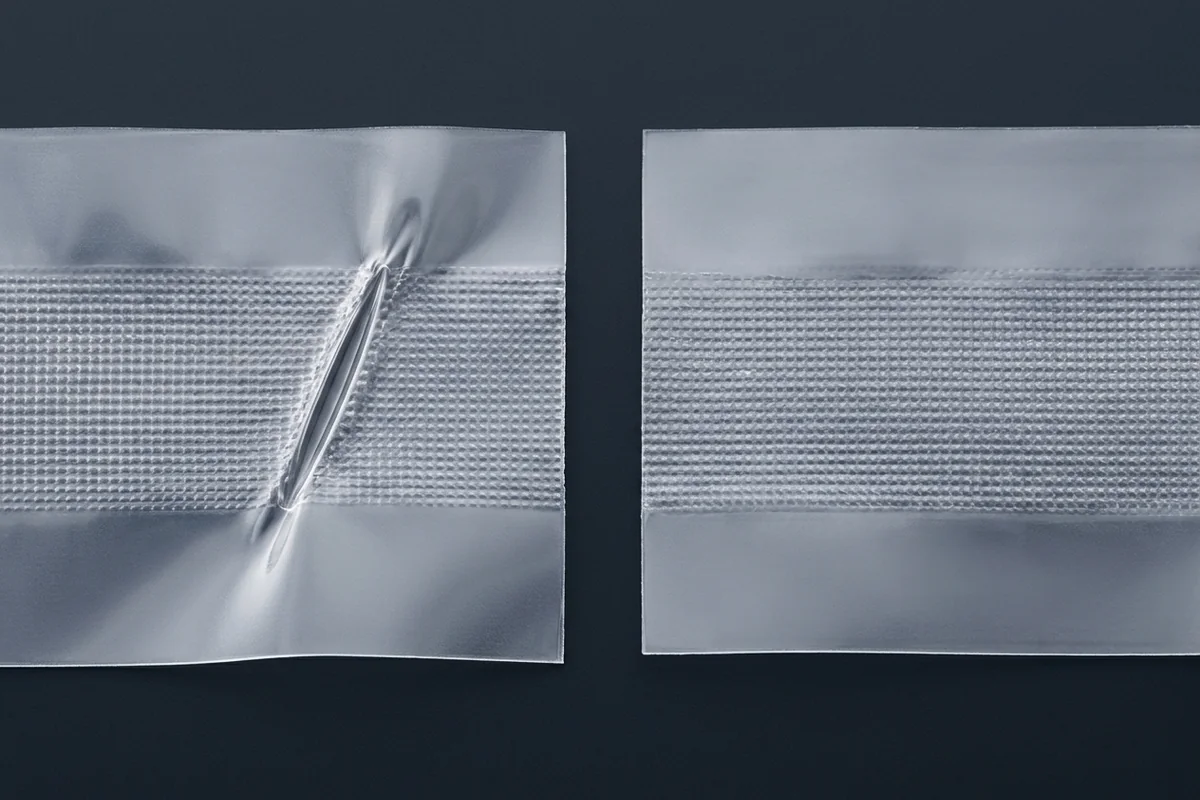
Seal integrity testing evaluates whether flaws in the package components or at the seal juncture let contained product escape or allow unwanted gases such as oxygen, harmful microbiological contaminants, or particulate matter to enter. In a 2017 flexible-pouch study by Moghimi and Park, defects such as pinholes in the material itself or micro-channels in the sealing area can affect the stability and thus the efficacy of the product contents, and a channel leak acts as a tunnel running through the two layers sealed together, with storage context on the packaging shelf life page.
Under ASTM F3039-23, there is no general agreement concerning the level of leakage likely to be deleterious to a particular package, so components that exhibit any indication of leakage in a leak test may be rejected. A 2023 hospital-pharmacy container-closure integrity paper describes probabilistic tests—such as dye ingress, which are stochastic in nature and associated with uncertainties that could affect the outcome—and deterministic tests based on physicochemical techniques that follow a predictable chain of events, citing helium leak testing from Besheer et al. as a deterministic example, while high-voltage leak detection and laser-based headspace analysis are mostly not present in hospitals and hospital pharmacies. That same 2023 paper attributes to US Pharmacopeia (USP) <1207> a tracer-liquid leak detection limit of >0.5–10.0 µm for tests like dye ingress.
Which leak test fits the seal?
Matching a leak test to a flexible pouch depends on whether a barrier face is porous or nonporous, whether headspace gas is present, and whether tested packs need to survive inspection intact.
Scroll horizontally to view all columns if needed. ↔
| Standard (Active Edition) | Package & Material Scope | Stated Detection Capability | Key Method Limits |
|---|---|---|---|
| ASTM F1929-23 | Edge seals between a transparent material and a porous sheet | Channel equal to or greater than a 50 µm (0.002 in.) wire | Pass/fail location of individual seal leaks only; porous sheet must retain dye off the seal area for a minimum of 5 seconds; uncoated papers are susceptible to leakage and wicking can discolor the porous surface |
| ASTM F3039-23 | Transparent and opaque nonporous packaging or flat flexible barrier sheets | Method A: edge-seal channel at least a 50 µm (0.002 in.) wire; Method B: flat-sheet leak at least 10 µm (0.00039 in.) diameter | Method A inspects the seal visually or on an absorbent surface for dye staining; Method B tests flat sheet with a roller on an absorbent surface rather than a sealed pouch channel |
| ASTM D3078-02(2021)e1 | Flexible packaging containing a headspace gas | Gross leaks; sensitivity limited to 1 × 10⁻⁵ atm·cm³/s (1 × 10⁻⁶ Pa·m³/s) or even less sensitive in Section 12 interlaboratory testing | Submerged in non-degrading fluid at normal room-temperature equilibrium in a transparent chamber withstanding approximately one atmosphere differential; viscoelastic effects or entrapped air may prevent passage through small openings, and positive pressure inside the pouch after the vacuum is drawn may force the product to plug small leaks |
| ASTM F2096-11(2019) | Tray and pouch packages for gross substrate holes and channels | Down to 250 µm (0.010 in.) with an 81% probability (Section 11 conditions) | Destructive because entry into the package is required to supply internal air pressure; porous-material sensitivity was evaluated for spunbonded polyolefin and for nonporous packaging, and has not been evaluated for other porous materials |
| ASTM F2338-24 | Rigid/semi-rigid non-lidded trays, porous-lidded trays/cups, rigid nonporous packs, and flexible nonporous packages | Qualitative Accept/Reject against controls; flexible nonporous gas-leak holes of at least 5 µm verified in the Table 11 pack population | Nondestructive chamber pressure-rise measurement without dye or tracer gas; any porous barrier surface has to be physically masked or blocked off to prevent rapid chamber vacuum loss |
For sterile-barrier edge seals covered in our medical device packaging guide, ASTM F1929-23 covers three local dye application methods—injection, edge dip, and eyedropper—to visually locate channel defects, without inferring leak size quantitatively or indicating the numerous small pores of the porous sheet itself. If wicking occurs over time, inspecting the porous side of the seal area shows surface discoloration, with Appendix X1 addressing false positives. ASTM F3039-23 covers transparent and opaque nonporous surfaces, and as Moghimi and Park note, ASTM F3039 was released to expand package integrity test offerings rather than to replace or augment ASTM F1929.
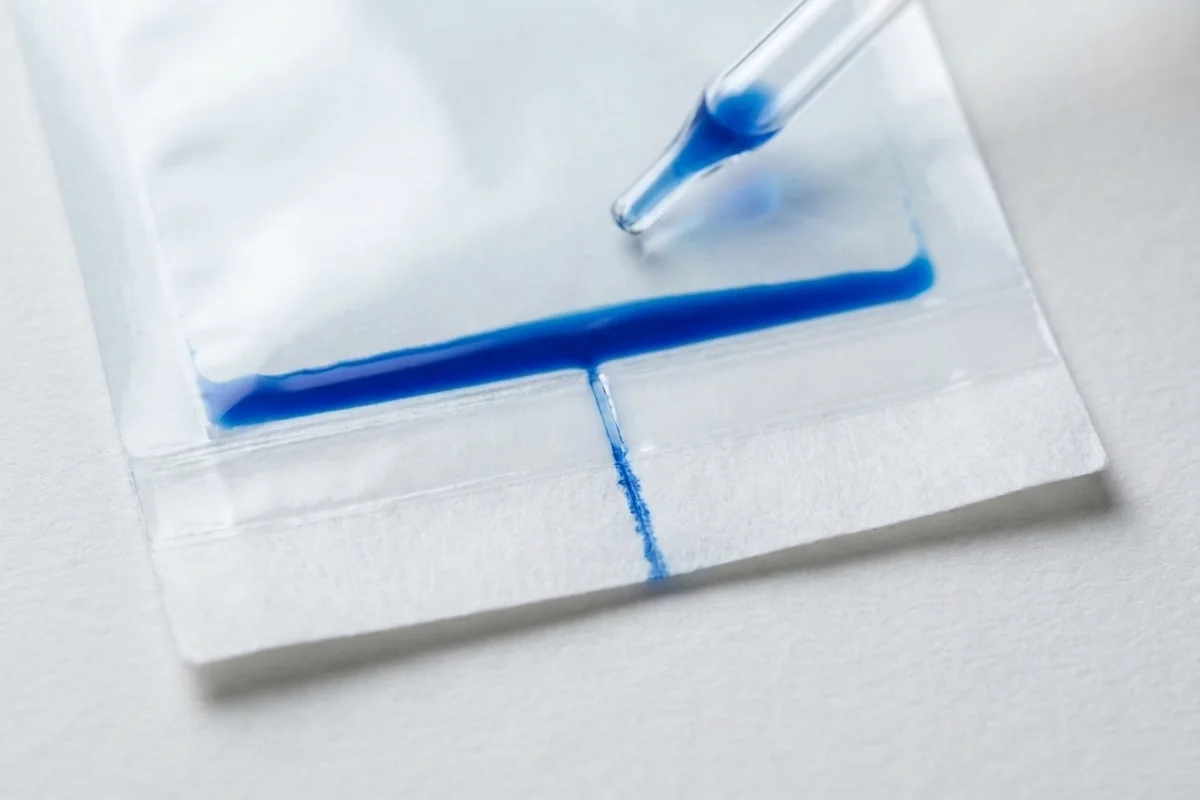
In Moghimi and Park’s 2017 experiment on optically transparent retortable pouches—a laminate context distinct from general retort pouch specifications—each test pouch used an Aluminium oxide-Polyethylene terephthalate/Nylon/cast polypropylene (AlOx-PET/Ny/CPP) structure with a 0.154 mm total thickness, a 150 mL contents volume, and artificial 5 mm micro-channels formed with 15, 25, 50, or 100 µm tungsten wires. Within that study’s pouches, negative controls and 15 µm channel units tested negative for dye penetration, 25 µm and larger micro-channels were penetrated by the dye solution, and the authors concluded from their pouch and bioaerosol results that defects larger than 15 µm caused sterility breaches in those flexible pouches.
When does a strong peel still leak?
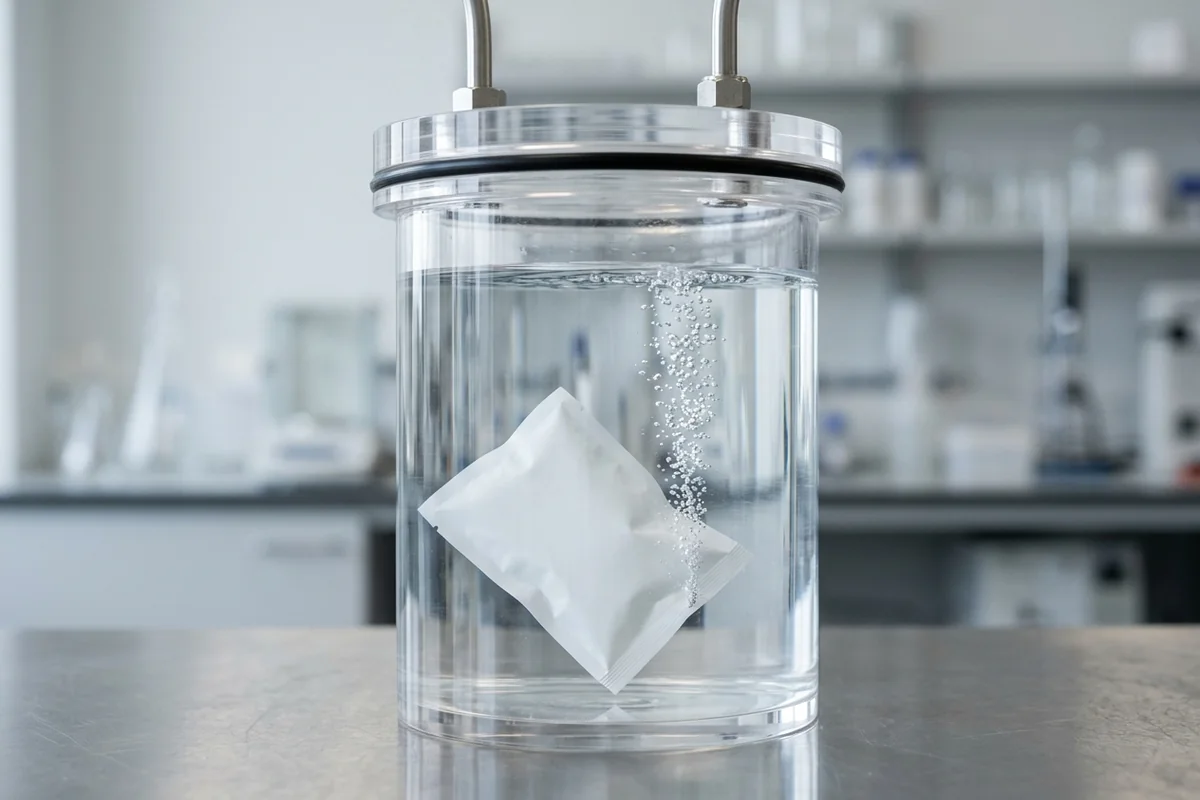
A heat seal can record high separation resistance on a sampled strip while leaking through a wrinkle or trapped product elsewhere around the perimeter. Strip peel testing measures the force a sampled coupon resists before separating in a tensile tester, whereas channel inspection evaluates continuous integrity across the package seal.
Keep these three test families separate during qualification:
- Seal separation force: Use the seal strength overview and the seal strength tester acceptance guide when specifying coupon peel resistance.
- Whole-package internal pressure loading: Use the package strength testing burst versus creep guide when the question is whole-pack loading rather than a leak path.
- Leak and channel detection: Pair strength checks with dye penetration, bubble emission, or vacuum decay so pinholes and seal micro-channels are evaluated directly.
What can vacuum decay check on the line?
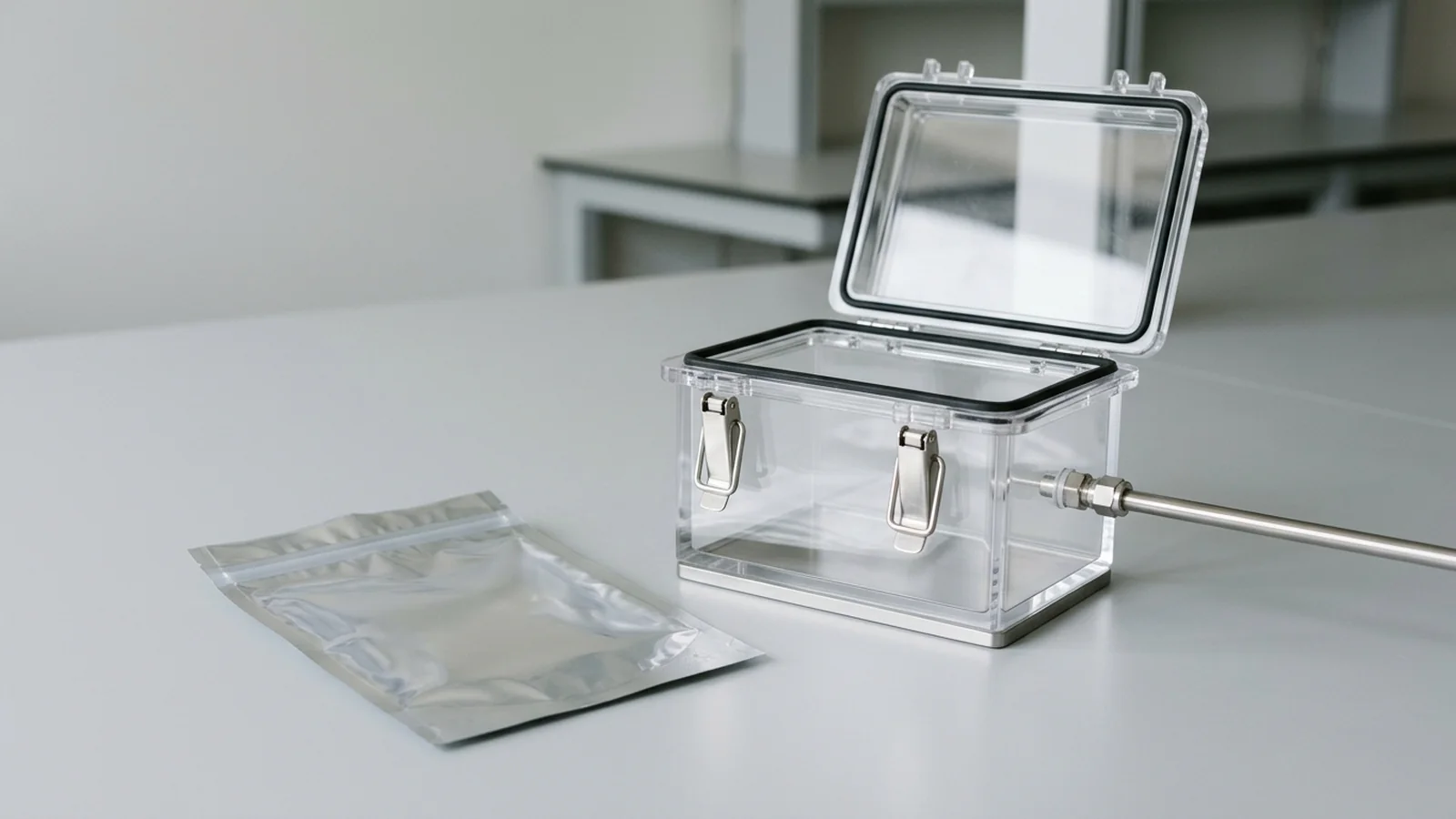
ASTM F2338-24 (superseding F2338-09(2020)) covers manual, semi-automatic, or automatic vacuum decay leak detection after initial setup and calibration. Because vacuum decay is rapid, non-invasive, and non-destructive—requiring no added dyes or tracer gases—it supports both laboratory sealing optimization and production-floor inspection via either 100% on-line testing or statistical sampling.
Inside an enclosed evacuated test chamber equipped with one or more pressure transducers, vacuum decay measures chamber pressure rise (vacuum loss) caused by escaping headspace gas or by volatilization of liquid contents in or near a leak when the chamber is evacuated below the liquid’s vaporization pressure. Test results are qualitative Accept/Reject decisions established by comparing baseline vacuum decay measurements from non-leaking control packages against leaking packages and simulated leaks introduced with a calibrated gas flow meter.
Sensitivity under ASTM F2338-24 depends on package compliance and chamber tooling, and the benchmarks published in its precision and bias studies (Table 1) apply strictly to the specific package populations evaluated:
- Flexible, nonporous pouches (gas or liquid leakage): Hole defects of at least 5 µm in diameter can be detected for gas leakages, verified on the flexible nonporous pack population in Table 11 when tested inside dedicated chamber fixtures.
- Trays or cups sealed with porous barrier lidding (headspace gas leakage): Because an unmasked porous web vents chamber vacuum immediately, the porous lidding surface must be physically masked during testing; at a target vacuum of –4 × 10⁴ Pa (–400 mbar), the study detected wall holes or cracks ≥ 100 µm, seal channels formed with 125 µm wires, and continuous or dot-matrix adhesive bonding defects (approximate airflow sensitivity 10⁻² Pa·m³/s).
- Unlidded trays and rigid nonporous containers (comparative scope): Non-lidded rigid or semi-rigid trays reached ≥ 50 µm wall-defect detection at –4 × 10⁴ Pa (–400 mbar), while rigid nonporous containers also reached 5 µm hole detection under deeper vacuum settings—highlighting why flexible pouches require package-specific restraint tooling so film expansion does not mask small pressure rises.
What does a sterile-pack test replace?
For drug products and pharmaceutical packaging, 21 CFR 211.94 requires in paragraph (b) that container closure systems provide adequate protection against foreseeable external factors in storage and use that can cause deterioration or contamination of the drug product, and requires in paragraph (d) that standards or specifications, methods of testing, and, where indicated, methods of cleaning, sterilizing, and processing to remove pyrogenic properties be written and followed for drug product containers and closures.
Under FDA’s February 2008 guidance (guidance overview and February 2008 PDF), a properly validated container and closure system integrity test may replace sterility testing in a stability program at time points other than product sterility testing prior to release:
- Pre-release sterility stays separate: Container and closure system integrity tests cannot demonstrate a product’s initial sterility and do not replace sterility testing prior to release.
- Validated method classes: FDA lists physical or chemical integrity examples—bubble tests, pressure/vacuum decay, trace gas permeation/leak tests, dye penetration tests, and seal force or electrical conductivity and capacitance tests—or microbial challenge or immersion tests, whereas preservative effectiveness tests are not acceptable alternatives for monitoring integrity or demonstrating maintenance of sterility.
- Why stability protocols use integrity tests: Sterility tests are always destructive of the samples tested and do not allow reexamining the same units after positive or negative findings, while validated integrity methods may detect a breach prior to product contamination and may be more useful than sterility testing in demonstrating contamination potential over shelf life or dating period.
- Validation and stability intervals: FDA considers a method adequately validated when scientifically accepted studies prove it can detect a breach in container and closure system integrity, and recommends conducting an appropriate integrity test annually and at expiration, or as otherwise required by applicable regulations.
Destructive vs. nondestructive test selection
Use this selection matrix to match package construction, headspace state, and sample disposition to the applicable ASTM leak method before writing a plant or laboratory test protocol.
Scroll horizontally to view all columns if needed. ↔
| Selection Check | Destructive Laboratory Route | Nondestructive Sample or Line Route |
|---|---|---|
| Porous medical edge seal (transparent film to porous sheet) | ASTM F1929-23 dye penetration by injection, edge dip, or eyedropper for individual edge-seal channels ≥ 50 µm (0.002 in.) wire where the porous sheet holds dye off the seal for at least 5 seconds; or ASTM F2096-11(2019) internal pressurization for gross leaks down to 250 µm (0.010 in.) with an 81% probability under Section 11 conditions (porous sensitivity evaluated for spunbonded polyolefin only) | ASTM F2338-24 vacuum decay applies to trays or cups sealed with porous barrier lidding only when the porous barrier surface is physically masked during chamber evacuation |
| Nonporous flexible pouch with headspace gas | ASTM F3039-23 Method A local dye penetration for edge-seal channels ≥ 50 µm (0.002 in.) wire; ASTM F2096-11(2019) internal pressurization for gross holes and channels down to 250 µm (0.010 in.) with an 81% probability; or ASTM D3078-02(2021)e1 vacuum-chamber bubble immersion for gross leaks, with sensitivity limited to 1 × 10⁻⁵ atm·cm³/s (1 × 10⁻⁶ Pa·m³/s) or less and potential product plugging of small openings | ASTM F2338-24 vacuum decay for 100% on-line inspection or statistical sampling, comparing chamber pressure rise against non-leaking controls, leaking packs, and calibrated gas-flow simulated leaks (5 µm gas-leak holes verified in the Table 11 flexible nonporous population) |
| Nonporous flat barrier web before pouch forming | ASTM F3039-23 Method B dye penetration rolled across a flat sheet over an absorbent surface for leaks ≥ 10 µm (0.00039 in.) diameter | ASTM F2338-24 tests enclosed packages in an evacuated chamber rather than unformed flat film sheets |
| Liquid near or plugging the leak path | ASTM D3078-02(2021)e1 warns that viscoelastic effects or positive pouch pressure after vacuum draw may force product to plug small leaks | ASTM F2338-24 evacuates the test chamber below the liquid’s vaporization pressure so volatilization of liquid contents in or near the leak produces measurable chamber vacuum loss |
Frequently asked questions
What is seal integrity testing?
Seal integrity testing checks whether a sealed package keeps its contained product inside and keeps potential contaminants—such as oxygen, microbes, or particulates—from entering through seal channels or material pinholes, whereas strip peel tests measure the mechanical force needed to separate a sampled coupon.
Which test finds a channel in a pouch seal?
For localized pass/fail channel verification of a leak equal to or greater than a 50 µm (0.002 in.) wire, ASTM F1929-23 covers transparent-to-porous medical edge seals and ASTM F3039-23 Method A covers nonporous edge seals; for gross channels down to 250 µm (0.010 in.) with an 81% probability, ASTM F2096-11(2019) uses destructive internal air pressurization; and for nondestructive inspection of flexible nonporous packs without dye, ASTM F2338-24 uses vacuum decay.
How does vacuum decay leak testing work?
Under ASTM F2338-24, a package sits inside an enclosed evacuated chamber fitted with one or more pressure transducers, and the system records chamber pressure rise from escaping headspace gas or volatilized liquid contents to return a qualitative Accept or Reject result against non-leaking controls, leaking packages, and calibrated simulated leaks.
When is a visual seal check enough?
ASTM F2338-24 notes that vacuum decay detects package leaks that are not visibly detectable, while ASTM F1929-23 and ASTM F3039-23 Method A add a liquid dye penetrant so edge-seal channels equal to or greater than a 50 µm (0.002 in.) wire become observable by dye migration or staining on an absorbent surface, and ASTM F3039-23 adds that any indicated leakage may be rejected because no general agreement defines a harmless leakage level.
Can a seal integrity test replace a sterility test?
Under FDA’s February 2008 stability guidance for sterile products, a scientifically validated container and closure system integrity test may replace sterility testing at stability time points—recommended annually and at expiration, or as regulations require—except that it cannot demonstrate initial sterility and does not replace product sterility testing prior to release.
Sources
- ASTM D3078-02(2021)e1: Standard Test Method for Determination of Leaks in Flexible Packaging by Bubble Emission
- ASTM F2096-11(2019): Standard Test Method for Detecting Gross Leaks in Packaging by Internal Pressurization (Bubble Test)
- ASTM F1929-23: Standard Test Method for Detecting Seal Leaks in Porous Medical Packaging by Dye Penetration
- ASTM F3039-23: Standard Test Method for Detecting Leaks in Nonporous Packaging or Flexible Barrier Materials by Dye Penetration
- ASTM F2338-24: Standard Test Method for Nondestructive Detection of Leaks in Packages by Vacuum Decay Method
- Moghimi and Park (2017): Leakage assessment of flexible pouches using dye penetration test with correlation to modeled bacterial aerosol challenge test
- European Journal of Hospital Pharmacy (2023): Container closure integrity testing and process validation of closed system transfer devices for aseptic reconstitution of drug vials connected to fluid bags
- U.S. FDA Guidance Overview: Container and Closure System Integrity Testing in Lieu of Sterility Testing as a Component of the Stability Protocol for Sterile Products
- U.S. FDA Guidance for Industry PDF (February 2008): Container and Closure System Integrity Testing in Lieu of Sterility Testing as a Component of the Stability Protocol for Sterile Products
- eCFR 21 CFR 211.94: Drug product containers and closures
Continue reading
Related articles

Hot Tack in Packaging Films: What It Is and Why It Matters
Hot tack packaging performance is the strength of a heat seal while it is still molten. Learn the ASTM F1921 test, the hot tack curve and how it affects VFFS lines.

Packaging Seal Strength: Testing and Specifying Seals
Packaging seal strength is how much force a heat seal resists before it opens. Learn ASTM F88 peel, burst and leak tests, failure modes and how to write a spec.
Puncture Resistant Film: Materials and Test Methods
Puncture resistant film explained: how puncture is tested (ASTM F1306, D1709), which materials help with sharp products, and how to specify and trial it.