
California SB 54: Plastic Packaging Producer Responsibility Explained
California SB 54 makes producers responsible for single-use packaging, with 2032 targets for recyclability, source reduction and recycling rates.
Waiting until 2027 can leave a California producer behind on steps already due in 2026. SB 54 covers single-use packaging and plastic food service ware: check material coverage, identify the legal producer, then confirm registration, application and data submission status.
What California SB 54 requires
Use this screening sequence before assigning duties to a converter or brand customer.
- Identify covered material under PRC 42041(e): single-use packaging or plastic single-use food service ware. Read the product-specific exclusions; medical or food-sector status alone is not a blanket exclusion.
- Determine the producer under PRC 42041(w), using CalRecycle’s situational screening tool. It considers manufacture, trademark ownership, California location, licensing/exclusive rights and the first seller or distributor. “The brand owner pays” is too simple for every supply chain.
- Determine the compliance route under PRC 42051(b): participation in an approved PRO, approved independent compliance, or an applicable exemption. Record approval rather than assuming eligibility is enough.
- Check exclusions and exemptions separately. CalRecycle’s guidance distinguishes excluded materials from temporary relief for covered materials or entities. The approved regulations, 14 CCR 18980.5.2, require evidence of gross California sales below $1 million in the most recent calendar year for the small-producer application. Approval does not remove producer registration or the 2032 recyclability/compostability duty.
Covered material categories
Map the complete pack to the current CalRecycle CMC list. Keep the category, determination and list version with the record; a supplier’s generic “recyclable” claim is not the agency determination.
Takeaway: Record covered-material status, legal producer and compliance route separately.
Targets and dates
Status below is at the 8 October 2026 review cutoff. Distinguish an effective rule, an expired action and a future target.
Scroll horizontally to view all columns if needed. ↔
| Date / status | Milestone and next action | Direct basis |
|---|---|---|
| 1 May 2026 / effective | Permanent regulations took effect | CalRecycle rulemaking |
| 1 June 2026 / expired initial window | 14 CCR 18980.5(a)-(d) sets registration/application within 30 days of 1 May, with 2023 supply data for PRO applicants; the June 1 reporting milestone is already past | CalRecycle deadline notice and approved text, pp. 83-84 |
| 15 June 2026 / completed PRO step | Plan submitted to the advisory board; this is not plan approval or each producer’s registration | Program news |
| 16 October 2026 / next listed meeting | Advisory-board meeting; check notice for schedule | Official agenda entry |
| 1 January 2027, or earlier plan approval | Statutory participation/sales restriction, subject to applicable routes and exceptions | PRC 42051(b) |
| 2032 / statutory targets | Covered material recyclable/compostable; plastic source reduction 25%; plastic recycling rate 65% | PRC 42050, 42057 |
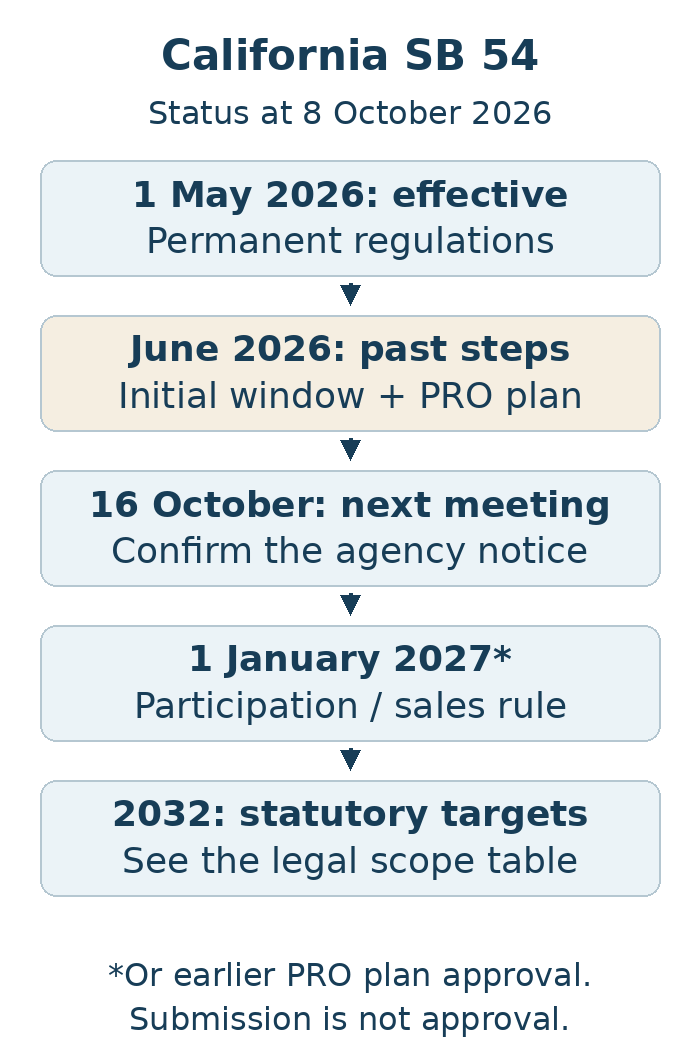
Later entrants have their own registration/application clock in 14 CCR 18980.5. Do not reuse the initial June window for every new producer. If an initial submission is missing, confirm the required correction with the PRO or CalRecycle now.
Takeaway: Resolve past submissions now; keep future targets on a separate calendar.
Status of CalRecycle’s regulations (as of October 2026)
The rules are effective, while the PRO plan and subsequent agency decisions follow their own review process. Keep registration acknowledgments, applications, supply data and exemption decisions in the SKU file. A submitted PRO plan does not prove that your business has completed its own steps.
Takeaway: Audit the existing submission record before planning future participation.
What SB 54 means for flexible packaging
Do not treat flexible film as broadly recyclable from a polymer name. Check the film and flexible rows of the official CMC list for the specific structure and retain the determination date. Collection, sorting and end-market evidence must correspond to that category.
Practical consequences:
- Assess mono-material candidates. Assess all-polyethylene or all-polypropylene candidates against the relevant category and collection evidence. See mono-material packaging, mono-PE packaging and mono-PP packaging.
- Barrier trade-offs need data. Replacing foil or a metallized layer with a thin EVOH or coated layer may keep shelf life while improving recyclability, but only validation will show it. The design for recycling page covers the main levers.
- Recycled content is not source reduction. Adding postconsumer resin may help fees or other goals, but the statute does not credit it as source reduction. See PCR packaging for the technical limits, including food-contact constraints.
- Lightweighting counts, but only if the pack still works. Thinner film that fails on a vertical form-fill-seal line or leaks in distribution is a net loss.
- Compostable is a narrow path. Compostable flexible packaging must meet the state’s labeling rules and have a realistic collection route. See compostable flexible packaging.
SB 54 also sits alongside other regimes. The EU’s PPWR and other US state laws, summarized under packaging EPR, have different definitions and evidence requirements; assess each market separately. The regulations hub lists the related pages.
Preparing flexible packs for SB 54
Copy a row for each component, keeping the same SKU and reporting period together.
Scroll horizontally to view all columns if needed. ↔
| SKU / market period | Component / structure | Weight, g per pack | CMC / list version | Evidence source / date | Owner / next action |
|---|---|---|---|---|---|
| ____ | ____ | ____ | ____ | ____ | ____ |
Record the responsible producer, registration/application reference and any exemption decision alongside this table. Confirm composition and weight with supplier documents or measurements; keep units and sales period consistent. Validate proposed changes through barrier, seal and shelf-life trials. Recheck food-contact suitability and destination-market claims before switching.
Use the design-for-recycling checklist to review alternatives and the EPR guide to create separate market records.
Takeaway: Reconcile component weights and retain the CMC determination version.
Questions and answers
Are you a producer?
Use the agency screening tool linked above for the actual chain of manufacture, trademark rights and distribution. Selling film to a customer does not by itself settle the role. Separately check whether an exemption has been granted and which duties it leaves in place.
Sources and limits
Official clauses and guidance are linked at each decision above. This is an orientation guide, not legal advice or a finding of compliance; scope, exceptions and the actual business arrangement require qualified review. The June 1 milestone describes the initial 2026 window, while the regulation itself states the 30-day rule. Last checked: 8 October 2026.
Continue reading
Related articles
Packaging EPR: How Extended Producer Responsibility Works
Packaging EPR makes producers pay for the collection and recycling of their packaging; here is how schemes, fees and reporting work in the EU and US.

EU Packaging and Packaging Waste Regulation (PPWR): What It Means for Flexible Packaging
The PPWR, Regulation (EU) 2025/40, sets EU rules on recyclability, recycled content, labeling and PFAS. See the timeline and what it means for flexible packaging.
PPWR Recyclability Requirements: Design for Recycling Grades Explained
PPWR recyclability rules require recyclable EU packaging, with performance grades and criteria still to be set. See dates and design steps for flexible packaging.