
PCR Packaging: Using Recycled Content in Flexible Films
PCR packaging uses post-consumer recycled resin in films. Learn how recycled content film is made, where it fits, and how to specify and verify claims.
Unverified recycled resin can introduce odor, film breaks or an inaccurate content claim. Specify the source, whole-film mass basis and evidence route before selecting PCR for a layer. PCR means post-consumer recycled material; this guide separates physical content, attributed content and food-contact evidence. Recyclable flexible packaging covers the separate recycling decision.
Scroll horizontally to view all columns if needed. ↔
| Distinction | Record |
|---|---|
| PCR / PIR | Post-use material / manufacturing scrap; do not relabel one as the other |
| Mechanical / chemical route | Actual recovery process; route alone does not establish quality |
| Physical / attributed content | Layer mass calculation / named mass-balance scheme and allocation |
| Food contact | Market, intended use and applicable process/material evidence |
PCR, PIR and what “recycled content” means
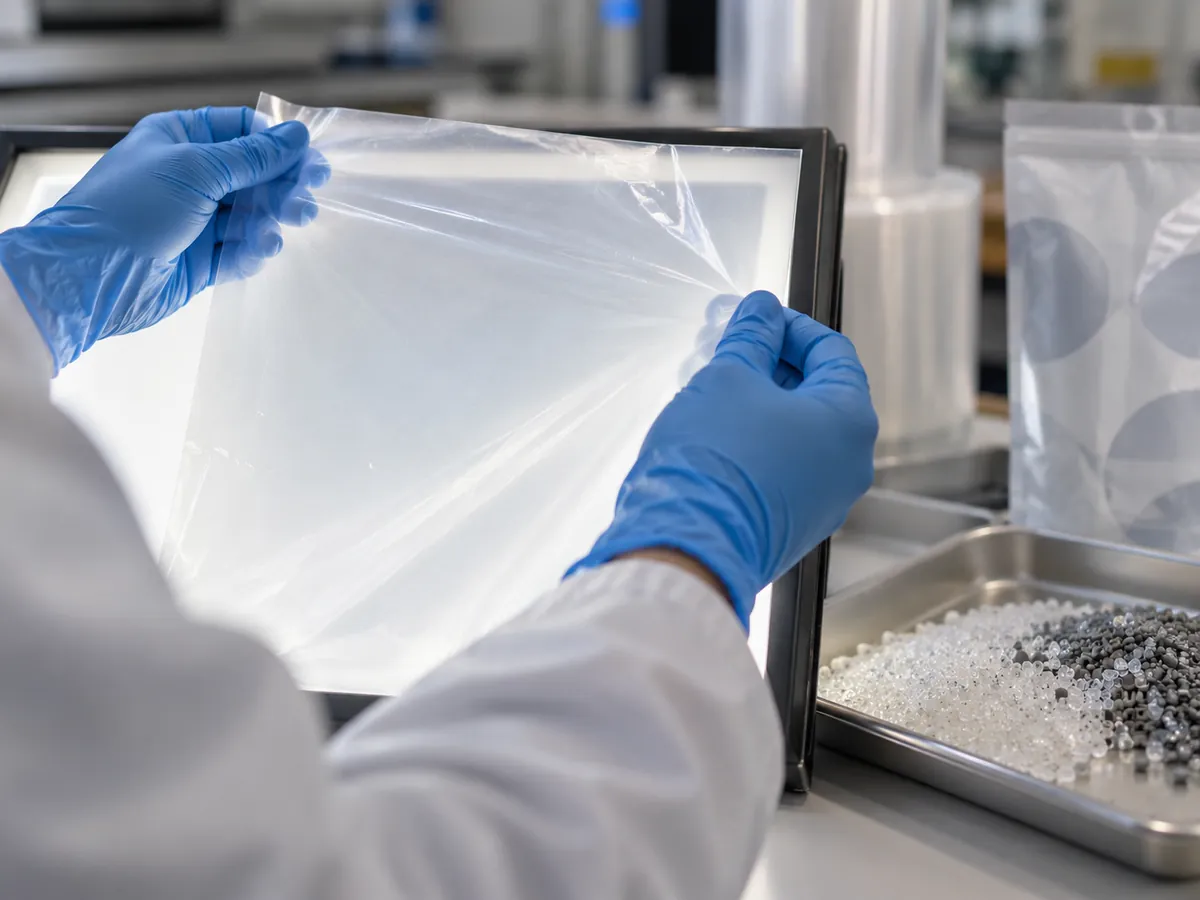
Post-consumer recycled content comes from material used by households or businesses and then collected. Post-industrial recycled (PIR) content comes from manufacturing scrap that never reached a consumer. The two have different quality and, in many markets, different weight in claims and regulations. When a supplier says “recycled content film,” ask which type it is and in what proportion. A percentage stated for one layer is not the percentage of the whole film.
Mechanical and chemical recycling
Recycled resin comes from two main routes.
Scroll horizontally to view all columns if needed. ↔
| Route | How it works | Typical effect on resin | Points to check |
|---|---|---|---|
| Mechanical recycling | Collected plastic is sorted, washed, shredded, melted and pelletized | Resin keeps its polymer type, but quality varies with feedstock and can carry odor, color and gels | Feedstock source, washing and decontamination, grade consistency |
| Chemical (advanced) recycling | Plastic is broken down by processes such as pyrolysis into feedstocks that are used to make new polymer | Output can be closer to virgin resin in properties | Process type, yield, how recycled content is attributed, local regulatory treatment |
Both routes exist at commercial scale in some markets, and availability, cost and regulatory status vary. The route alone does not tell you whether a resin is equivalent to virgin, so ask for resin data sheets and test results.
Mass-balance attribution
When certified recycled and fossil feedstocks are mixed within a defined system, mass balance can allocate a certified amount to outputs under that system’s rules. ISCC’s explanation distinguishes mass balance from physical segregation and controlled blending. Chemical recycling is a process route; mass balance is a chain-of-custody method, so the two are not synonyms.
An attributed percentage does not measure recycled molecules in each delivered film. Record the scheme, valid scope, accounting period, conversion factors and allocation separately from physical layer content. Certification does not by itself establish that the destination’s claim or recycled-content law accepts that attribution.
Where PCR fits easily
- Secondary and tertiary packaging: collation shrink film, pallet wrap, stretch film and shipping bags are not in direct contact with food and tolerate some variability in color and odor. More on shrink film.
- Non-food products: household goods, garden products and similar items where odor and color tolerance is higher. More on household products packaging.
- Core layers of coextruded films: assess PCR in a middle layer separately from the virgin skins used for printing or sealing. Virgin skins alone do not establish food-contact suitability. More on PE film and flexible packaging film.
Where PCR is hard
For food contact, check the intended use and destination’s rules. FDA considers proposed recycled-plastic uses case by case and provides informal process advice; this is not the same system as the EU rules. Regulation (EU) 2022/1616 governs recycled-plastic food-contact materials within its scope, with technology, process and compliance requirements. A virgin outer layer or generic recycling certificate does not replace the applicable evidence. Other difficult areas:
- Medical and pharmaceutical packaging, which has its own quality demands. See pharmaceutical packaging.
- High-clarity or high-gloss films, where gels and color shift show.
- Thin, high-speed films, where gels and contaminants cause breaks and seal defects.
- Fragrance-sensitive products, where odor from the resin can transfer.
Quality effects and machinability
Recycled resin tends to be more variable than virgin resin, especially mechanically recycled material. Typical issues:
- Gels and specks: small unmelted or cross-linked particles can show as defects, and in thin films can cause holes or weak points.
- Odor: residual compounds from the original use can remain. Odor is hard to measure and can be a reason for rejection.
- Color: recycled PE is often slightly gray, yellow or tinted, and varies between lots. That limits use in clear or white film or requires tinting.
- Property variability: melt flow, density and mechanical properties may vary lot to lot, which can affect film gauge control, seal behavior and tear properties.
- Seal and hot tack: if recycled content sits in or near the seal layer, seal strength and hot tack can shift. Test seal strength and hot tack.
- Gauge and puncture: film with recycled content sometimes needs a higher gauge to match puncture performance. See puncture resistant film.
On the packaging machine, watch for changes in coefficient of friction, tracking, sealing temperature and the rate of film breaks. Run the trial at production speed on a representative quantity, not as a short demonstration.
Specifying and verifying recycled content
Use this record for each film revision and lot. Keep physical content and certified attribution in separate fields.
Scroll horizontally to view all columns if needed. ↔
| Field | Requirement / record | Evidence / owner |
|---|---|---|
| Material identity | PCR/PIR, feedstock, process and resin lot: ____ | ____ / ____ |
| Physical content | Each layer mass and PCR fraction: ____ | BOM / batch record: ____ |
| Attributed content | Scheme, amount, period and allocation: ____ | Certificate / transaction record: ____ |
| Placement | Layer grades and intended contact/use: ____ | Compliance support: ____ |
| Quality | Gels, odor, colour, seal and impact criteria: ____ | Method / result: ____ |
| Food-contact market | Destination and conditions: ____ | Process/material evidence: ____ |
| Claim | Denominator and proposed wording: ____ | Review / owner: ____ |
ASTM D882-18 measures tensile properties of thin plastic sheeting; ASTM D1709-24 addresses free-falling dart impact of film. Neither verifies PCR percentage or food-contact compliance. Agree specimen preparation, conditions and acceptance criteria for the actual film.
How to calculate recycled content?
Example, assumed inputs: a 100 g film sample has a 20 g virgin outer layer, a 60 g core containing 50% physical PCR, and a 20 g virgin sealant. PCR mass = 20 × 0 + 60 × 0.50 + 20 × 0 = 30 g. Whole-film physical PCR = 30 ÷ 100 × 100 = 30%, not the core’s 50%.
Use layer mass, rather than thickness alone, where densities differ. This is arithmetic, not a measured film or a legally approved claim. It excludes any additional pouch components and does not convert certified mass-balance allocation into physical PCR content.
PCR and recyclability together
Recycled content alone does not prove recyclability. Check the complete structure, components and material quality against the chosen stream; then confirm local collection. Mono-PE packaging describes candidate structures, and the design-for-recycling checklist records their evidence.
Market rules and dates
Regulation (EU) 2025/40 has a general application date separate from its recycled-content obligations:
Scroll horizontally to view all columns if needed. ↔
| Provision | Date / baseline requirement |
|---|---|
| Article 71 | General application: 12 August 2026 |
| Article 7(1)(b) | Non-PET contact-sensitive plastic packaging, excluding beverage bottles: 10% |
| Article 7(1)(d) | Other plastic packaging outside (a) to (c): 35% |
| Article 7(1) timing | 1 January 2030 or three years after the paragraph 8 implementing act enters into force, whichever is later |
Article 7 uses post-consumer waste and a manufacturing-plant/year average by packaging type and format. Check exemptions and implementing measures before assigning an obligation to a film; a layer example is not that regulatory calculation.
Frequently asked questions
What is PIR vs PCR?
PIR refers to manufacturing scrap; PCR refers to material recovered after consumer use. Keep separate source evidence. A rule requiring post-consumer content, such as PPWR Article 7, cannot be met simply by calling PIR “PCR.”
Can recycled plastic be used in food packaging?
It may be suitable when the applicable process, material and intended-use requirements are met. Check the market-specific food-contact evidence; placing recycled material between virgin layers does not automatically establish compliance.
Sources and method
FDA’s recycled-plastics guidance, Regulations (EU) 2022/1616 and 2025/40, ISCC’s mass-balance explanation and the dated ASTM editions are linked above; reviewed October 9, 2026. Official scopes and scheme guidance support the distinctions, not a film approval. The mass example uses assumed inputs and contains no laboratory content measurement.
Continue reading
Related articles
Design for Recycling: A Checklist for Flexible Packaging
Design for recycling means building a pack to fit a recycling stream. Use this checklist for polymers, barriers, inks, adhesives, fitments and testing.
Recyclable Flexible Packaging: What Makes a Pouch Recyclable
Recyclable flexible packaging explained: design factors, collection reality, verification protocols, claim rules and a checklist for converting a laminate.
Compostable Flexible Packaging: Materials, Standards and Limits
Compostable flexible packaging breaks down under defined composting conditions. Learn the standards, common materials, barrier limits and when it makes sense.