
Flexible Packaging for Household Products: Detergents, Refills and Wipes
Flexible packaging for household products: detergent pouches, refill pouches and wipes, chemical resistance, stress cracking, drop strength and structures.
A refill pouch can pass a material check and still leak at a stressed joint. Separate formula compatibility, filled-pack strength and detergent-packet child access before selecting the structure.
Scroll horizontally to view all columns if needed. ↔
| Product / route | Candidate to qualify | Separate validation tasks |
|---|---|---|
| Powder / stand-up pouch | Barrier laminate and closure | Moisture entry, granule puncture and handling |
| Liquid refill / spout | Formula-qualified sealant, adhesive and fitment | Compatibility, spout / gusset loads and drop leaks |
| Laundry packets / outer pouch | Barrier and documented closure system | Moisture protection, optical properties and child-access testing separately |
| Wipes / reclose pack | Formula-qualified barrier film and label | Solvent retention and repeated contaminated reclose |
| Concentrated cleaner | Grade-specific chemical-resistant system | Formula aging plus stressed joints and transport |
What goes wrong with household products
- Chemical attack and stress cracking: surfactants, solvents, bleach, enzymes and fragrance can soften or crack plastics, especially where the film is under stress at folds, seals and spout fitments.
- Leakage: liquids leak at weak seals, pinholes or fitments, and a leaking bag in a delivery box becomes a customer complaint.
- Heavy fills and drops: a filled pouch can drop from shelf height, a trolley or a delivery vehicle. Seal strength and film toughness decide whether it survives.
- Moisture and caking: powders absorb water vapor and can lump, so moisture barrier matters for powders and pods in humid climates.
- Odor and fragrance: fragrance should stay in and outside odors should stay out.
- Child access: detergent pods and capsules are a known child-safety concern, and packaging rules differ by market, so confirm requirements locally.
- Shelf look: pouches compete with bottles, so the pack has to stand, print well and be easy to pour.
Detergent pouches: powders and pods
For powders, test moisture barrier, granule puncture and closure use with wet or powdery hands. For liquid laundry packets, separate outer-pack moisture protection from optical properties and prevention of child access. A metallized laminate or ordinary zipper establishes none of these by itself.
For the US, CPSC’s liquid laundry packet page identifies ASTM F3159 as a voluntary safety standard. ASTM F3159-15(2022) covers household liquid laundry packet safety, including packaging and labeling. It is not blanket approval for every detergent or pouch. Record the applicable destination requirements, exact closure/pack test report and labeling review separately from WVTR and light-transmission results. Do not call a zipper child-resistant from its appearance.
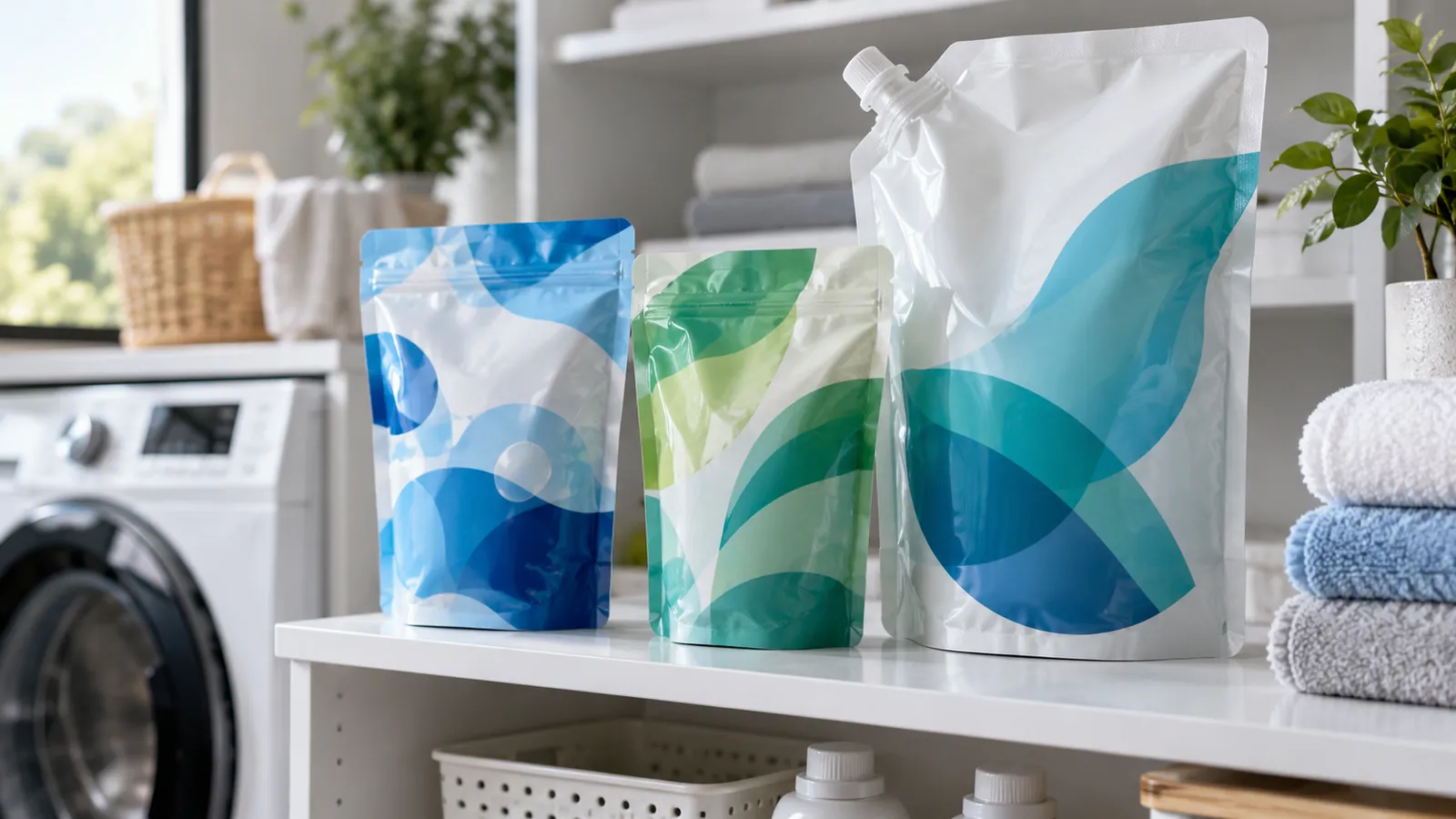
The stand-up pouch and zipper pouch pages explain formats; premade pouch materials covers line fit.
Refill pouches for liquids
Refill pouches for hand wash, dish soap, laundry liquid and cleaners let the consumer top up a bottle. They are usually a stand-up pouch with a spout, often with a cap, or a pouch with a cut corner or tear notch. Heavy liquid fills put the stress on the side seals, the bottom gusset seal and the spout seal. Corner geometry, seal width and film toughness all affect whether the pouch passes a drop test. Use actual fill mass, geometry and handling results to select gauge; no volume-to-thickness rule is established here. The spouted pouch page covers the format.
Recyclable-design refills usually move toward mono-material PE structures. Mono-PE packaging covers the trade-offs, and recyclable flexible packaging gives the wider picture.
Chemical resistance and stress cracking
A film that holds liquid soap may not hold a bleach cleaner. Strong surfactants and some solvents can cause environmental stress cracking in polyethylene, where a film or fitment under strain cracks faster in contact with the chemical than it would in air. Cracking is most likely at folds, seal edges and spout bases, where stress concentrates.
Chemical resistance is also a lamination question: some adhesives deteriorate in contact with surfactants or solvents, which shows up as delamination or tunneling. To check this, test the real product in the real pack, store it at room and elevated temperature, and inspect seals, adhesive layers and fitments over time. Repeat the test if the formula changes. A resistance chart is a starting point, not an approval.
Heavy fills, drop strength and handles
ASTM F88/F88M-23 measures seal separation force on sampled strips. ASTM F1140/F1140M-13(2025) evaluates unrestrained packages under internal pressure, including burst or creep. ASTM F2054/F2054M-13(2024) addresses seal burst with restraining plates. None is a filled-pouch drop test or child-access test.
Use seal strength to define the force test separately from leak integrity. Select film and fitment grades, including any LLDPE sealant, using the formula and complete-pack trial. Record handle tearing and spout loading when relevant.
Wipes
Household wipes come in resealable flow-wrapped packs or pouches with a label or lid. The film has to keep the lotion from drying out and resist disinfectant chemicals, and the reseal has to survive many openings. Metallized or coextruded barrier films help hold water and alcohol (see WVTR). The reclose label must adhere to the film surface despite lotion contact. The package shape is covered in flow wrap packaging.
Household packaging structures
Confirm all values with supplier data, and ask for the test conditions behind OTR and WVTR figures.
Scroll horizontally to view all columns if needed. ↔
| Product | Common structure | Why it is used |
|---|---|---|
| Laundry powder, large stand-up pouch | PET / PE or BOPP / PE, sometimes PET / PA / PE | Strength, moisture barrier, printability, tear and puncture resistance |
| Liquid detergent refill | PET / PA / PE or PA / PE with spout | Toughness and heavy fill, seal performance, chemical resistance |
| Laundry packets | Candidate barrier pouch with documented closure system | Validate moisture and optical properties separately from child-access performance |
| Dish soap, hand wash refill | Candidate PET / PE or PE-based structure with spout | Confirm formula compatibility, handling and recycling claims separately |
| Wipes | Metallized BOPP / PE or coextruded PE with a reclose label | Moisture and solvent barrier |
| Concentrated cleaners | Chemical-resistant PE-rich structure with tested adhesive | Resists solvents and stress cracking |
The main film families are PE film and PET film.
What to check before specifying a household product pack
Scroll horizontally to view all columns if needed. ↔
| Check | Record for each sample / time point | Result / action |
|---|---|---|
| Identity / formula | Batch, formulation, film / adhesive grades, fitment, actual fill mass | Link to compatibility record |
| Conditioning / aging | Temperature, time, storage orientation; cracks, delamination and leaks | Retain failed samples |
| Mechanical trial | Drop height / orientation / count; handling sequence; burst or creep settings | Record result and failure location |
| Affected joints | Spout, side seal, bottom fold and handle; before / after aging results | Distinguish film attack from joint failure |
| Formula change | Changed solvent, surfactant, bleach or fragrance; affected components | Retest compatibility, bonds, seals, retention and aged-pack handling |
| Laundry-packet safety | Destination; closure/pack report; optical and barrier results; labeling review | Assess each task separately |
Use the first-order risk checklist to record missing documents before approving a structure.
Method and sources
The US references establish scope, not certification of a closure. Other destinations require their own review; the record does not prescribe pass thresholds. Standards and the CPSC page reviewed 2026-10-08; this guide reports no closure or pouch-test results.
Continue reading
Related articles
Pet Food Packaging Film: Structures, Formats and Machines
Pet food packaging film explained: structures for dry kibble, wet food and treats, grease and puncture needs, bag formats, machines and recyclable options.
Spice Packaging Materials: Aroma, Moisture and Contact-Layer Checks
The best spice packaging depends on whole or ground form, climate and how spice oils meet the inner layer. Compare the risks, then copy a sample record.
Bakery Packaging Film: Keeping Bread and Cakes Fresh
Bakery packaging film explained: how staling, moisture loss and mold shape film choice for bread, cakes, cookies and tortillas, plus formats and machines.