
Pet Food Packaging Film: Structures, Formats and Machines
Pet food packaging film explained: structures for dry kibble, wet food and treats, grease and puncture needs, bag formats, machines and recyclable options.
Choosing a bag for the wrong storage process can cause leaks or loss of shelf life. Match the film to dry kibble, treats or the specific wet-food process; the wet-food discussion here covers shelf-stable, hermetically sealed, thermally processed products, not refrigerated, frozen or other preservation routes.
Product and structure quick check
These are common construction directions, not approved recipes. Record actual pack mass, fat content and storage conditions before comparing supplier grades.
Scroll horizontally to view all columns if needed. ↔
| Product | Pack mass and fat input | Storage route | Layer roles / candidate direction | Validation record |
|---|---|---|---|---|
| Dry kibble | Actual filled mass; recipe fat and fines | Declared dry-storage climate and shelf life | Printable PET or BOPP outer web / PE sealant; barrier layer if required | Contaminated seals, grease-exposed bond, filled-bag drops, OTR/WVTR conditions |
| Shelf-stable wet food | Actual fill; recipe and processing inputs | Hermetic thermal process; actual cycle | Retort-qualified barrier structure and sealant; PP-based options exist | Post-process seals, bond and integrity; product/process-authority approval |
| Treats or semi-moist food | Actual fill; fat and moisture sensitivity | Product-specific storage instructions | Printable outer web / barrier if needed / sealant; compatible zipper | Shelf life, contaminated seals, closure function |
Manufacturer public documentation describes PP-based retort pouches for wet pet food; it does not validate every PP grade or this table’s candidate structures. Refrigerated, frozen and aseptically packed products require their own process assessment.
What goes wrong with pet food
Pet food is bulky, oily and often sold in large quantities, so mechanical failure matters as much as shelf life.
- Fat oxidation: kibble is often coated with fat for palatability. Oxygen drives that fat toward rancidity, which owners notice as smell and pets notice as refusal. Oxygen barrier and a clean seal both matter.
- Grease migration: oil can wick toward the seal area and weaken the bond. It can also show through poorly protected outer layers as stains.
- Moisture pickup: dry kibble that absorbs water goes soft and can grow mold. The film needs a water vapor barrier suited to the sales climate.
- Weight and impact: bags of several kilograms are dropped, stacked on pallets and dragged over rough surfaces. The film needs tear, drop and puncture resistance, and the seals need real strength.
- Odor: strong food smells attract pests and bother shoppers. The film should hold aroma in, and a pinhole-free structure helps.
- Pests: some pests can chew or gain entry through weak points. Seal quality and film toughness reduce this risk.
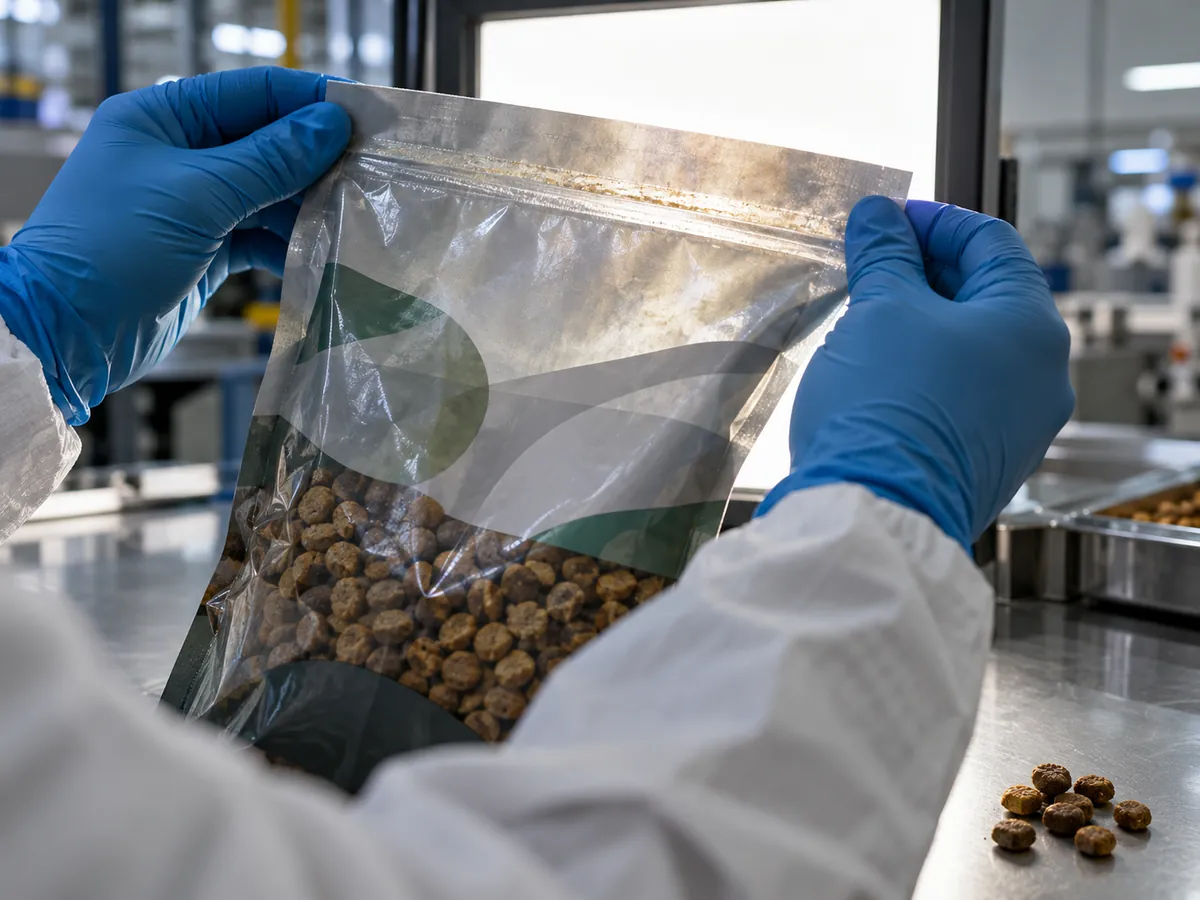
Pet food packaging materials
Use the quick check above to separate protection, sealant and mechanical roles. PE film, PET film and barrier film explain those roles. Compare OTR and WVTR with temperature and humidity recorded.
Dry kibble
Evaluate the sealant and jaw settings against the actual fill mass and contamination. Do not assume that adding thickness makes a seal tolerate fat and food fines. Check hot tack and seal strength on the actual product, because a clean sample will not show how it behaves with fat and fines.
Lamination bond strength also matters. Fat can creep into the laminate and reduce adhesion over time, so ask the converter how bond strength holds under grease exposure.
Wet food
For wet food processed in a sealed retort pouch, qualify the entire structure against the actual thermal cycle. 21 CFR Part 113, including the definitions in §113.3, concerns thermally processed low-acid foods in hermetically sealed containers and explicitly includes pet food processors. FDA’s pet-food guidance links canned pet food to these rules. “Wet” alone does not establish that scope or mean a refrigerated or frozen product needs a retort pouch; aseptic processing is another route defined in Part 113.
Treats
Treats are often premium products sold in stand-up pouches with zippers. The zipper must work with the film and stay closed after repeated use, and the barrier needs to protect fat-containing treats. A window or matte finish may be requested for shelf appeal, which changes the outer film choice.
Pet food bag formats
- Quad seal bags have four sealed corners and large panels, which make a stable, printable bag for medium to large dry food.
- Flat bottom pouches have a flat base and five printable panels, which gives good shelf presence for premium kibble and treats.
- Side gusset bags are a common choice for larger dry food bags, often with a handle or a zipper.
- Stand-up pouches are used for treats, wet food and smaller dry packs.
- Retort pouches and qualified lidded trays are options for the shelf-stable thermal route discussed above.
Machines for pet food packaging
Small to medium dry food bags are typically formed, filled and sealed on vertical machines fed by a multihead or linear weigher. Larger bags of heavy kibble may use heavier-duty vertical or specialized bagging machines. The film must hold shape and track under the weight of the product, and the vertical and cross seals must cope with fines and grease. Coefficient of friction affects how the film travels over the forming collar, so ask for coefficient of friction data for both film faces. The VFFS film guide explains the line-side checks.
Premade pouches for treats and wet food go on premade pouch fillers, where pouch dimensions, zipper type and seal bar settings matter. See premade pouch materials.
Recyclable and mono-material options
Many pet food bags are PET / PE laminates, which mix polymers and are hard to recycle in most systems. Mono-PE structures, where the outer film and sealant are both polyethylene, are the common route for dry food bags, including heavy ones, because PE is naturally tough and sealable. The trade-off is barrier. Changing the barrier layers can change oxygen and light protection; confirm shelf life for the replacement structure rather than assuming equivalence. Verify any recyclability claim against the guideline you design to (for example RecyClass or APR) and the collection in your market. See mono-PE packaging and recyclable flexible packaging.
Filled-bag trial record
Copy these fields into the project record; set acceptance criteria before testing.
Scroll horizontally to view all columns if needed. ↔
| Check | Record inputs | Record result and decision |
|---|---|---|
| Seal contamination | Lot, fill mass, actual fat/fines challenge, jaw temperature/pressure/dwell | Clean vs contaminated seal strength and leak results; failure location; accept/retest |
| Lamination bond | Layer grades, adhesive lot, cure release, grease exposure and storage conditions | Bond result before/after exposure, separation location, photographs |
| Whole-bag distribution | Filled mass, bag geometry, drop/stack protocol and handling conditions | Seal splits, gusset damage, punctures and delamination; disposition |
| Line and shelf life | Machine, speed, friction, barrier test conditions, storage route | Trial rejects, integrity and product shelf-life evidence |
After opening: A zipper is a reclosure feature; do not use unopened shelf-life evidence as proof of storage life after opening. Follow the product label. FDA advises promptly refrigerating or discarding unused canned or pouched pet food.
Use the first-order risk checklist to organize the trial and supporting records.
Sources
Scope and storage guidance reviewed 8 October 2026: 21 CFR Part 113, FDA pet food and FDA pet-food storage. Construction directions require product-specific supplier documentation; the public manufacturer retort example is recorded in the editorial evidence log, not a supply recommendation.
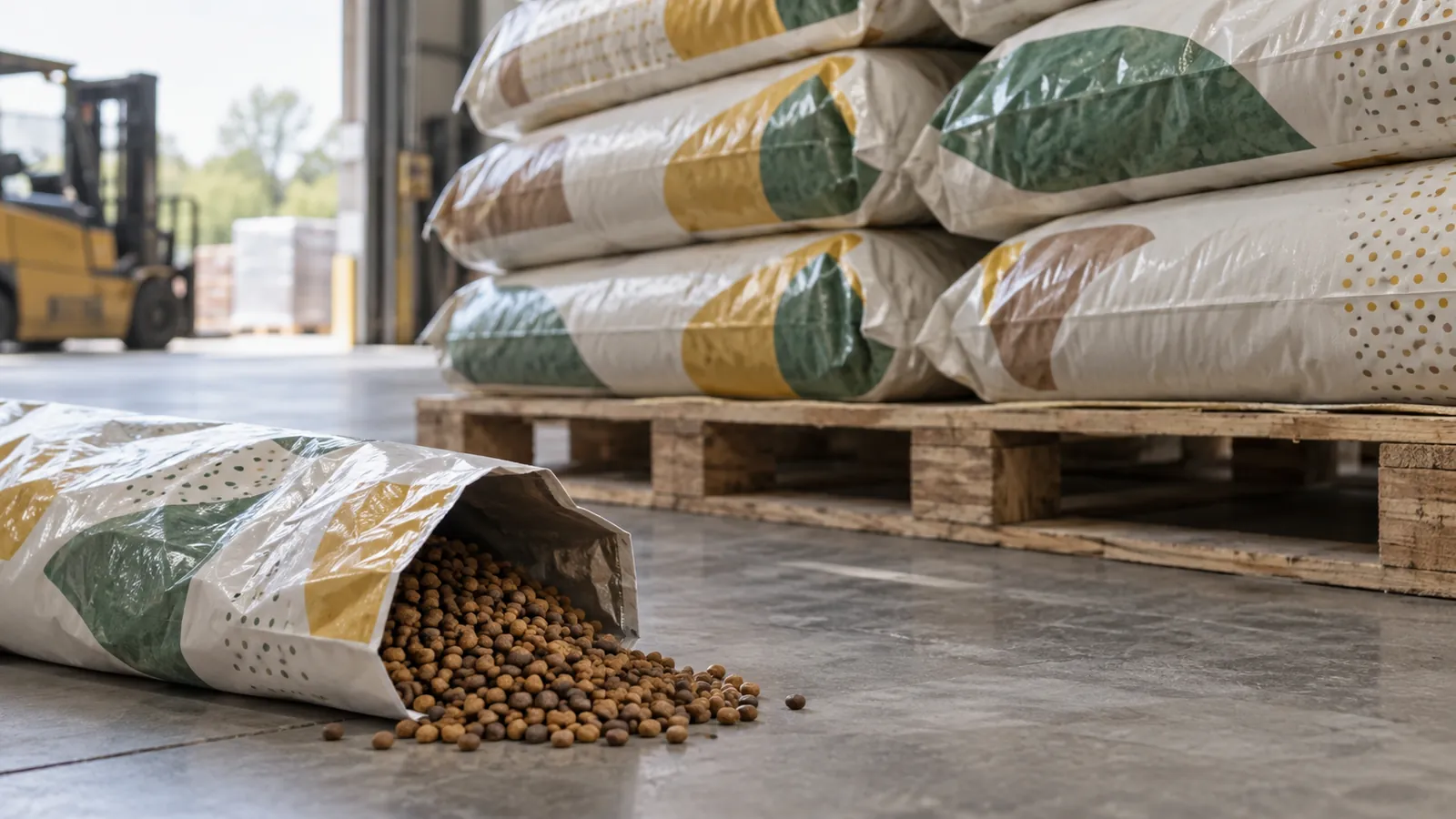
Continue reading
Related articles
Bakery Packaging Film: Keeping Bread and Cakes Fresh
Bakery packaging film explained: how staling, moisture loss and mold shape film choice for bread, cakes, cookies and tortillas, plus formats and machines.
Cheese Packaging Film: Ripening, Vacuum and MAP
Cheese packaging film explained: gas-permeable ripening films, vacuum bags for blocks, MAP for sliced and shredded cheese, reclosable packs and structures.
Coffee Packaging Materials: Barrier, Valves and Pouch Formats
Coffee packaging materials explained: oxygen and aroma barrier, one-way degassing valves, nitrogen flushing, pouch formats and machine fit.