
PPWR Recyclability Requirements: Design for Recycling Grades Explained
PPWR recyclability rules require recyclable EU packaging, with performance grades and criteria still to be set. See dates and design steps for flexible packaging.
Treating a mono-material pouch as an automatic PPWR grade can produce a weak compliance file. Article 6 and Annex II fix the grade thresholds, but the harmonized assessment needs the relevant secondary acts; save component and method evidence now rather than claiming an unearned grade.
Fixed rules, pending methods and today’s evidence
Scroll horizontally to view all columns if needed. ↔
| Status | Rule or gap | Keep now |
|---|---|---|
| Fixed | A/B/C thresholds and later-of commencement rules | Legal clause and packaging category |
| Method-dependent | Detailed design criteria and weighting under Article 6(4) | Full component BOM and assessment protocol/version |
| Method-dependent | Recycled-at-scale assessment under Article 6(5) | Collection, sorting and recycling evidence |
| Current design work | Interim guideline assessment is not the future harmonized grade | Region, test results, limitations and conclusion |
Basis: Article 6 and Annex II. The thresholds concern a weighted assessment per packaging unit, not the local recycling rate.
Takeaway: Separate existing duties from the method still to be specified.
How PPWR design for recycling is set up
Article 6 works in layers.
- A general rule. Article 6(1) says packaging must be recyclable. The Commission’s guidance reads this as applying from 12 August 2026, but without a measurable test yet.
- Design-for-recycling criteria. A delegated act under Article 6(4), due by 1 January 2028, will set criteria and the assessment method for each packaging category. The Commission describes it as fully harmonizing design-for-recycling requirements.
- Performance grades. The regulation defines recyclability performance grades A, B and C. Packaging has to reach at least a minimum grade once the requirement applies.
- “Recycled at scale”. A second condition, set through implementing acts under Article 6(5), asks whether the packaging is in practice collected, sorted and recycled in meaningful volume in installed infrastructure, outside the laboratory.
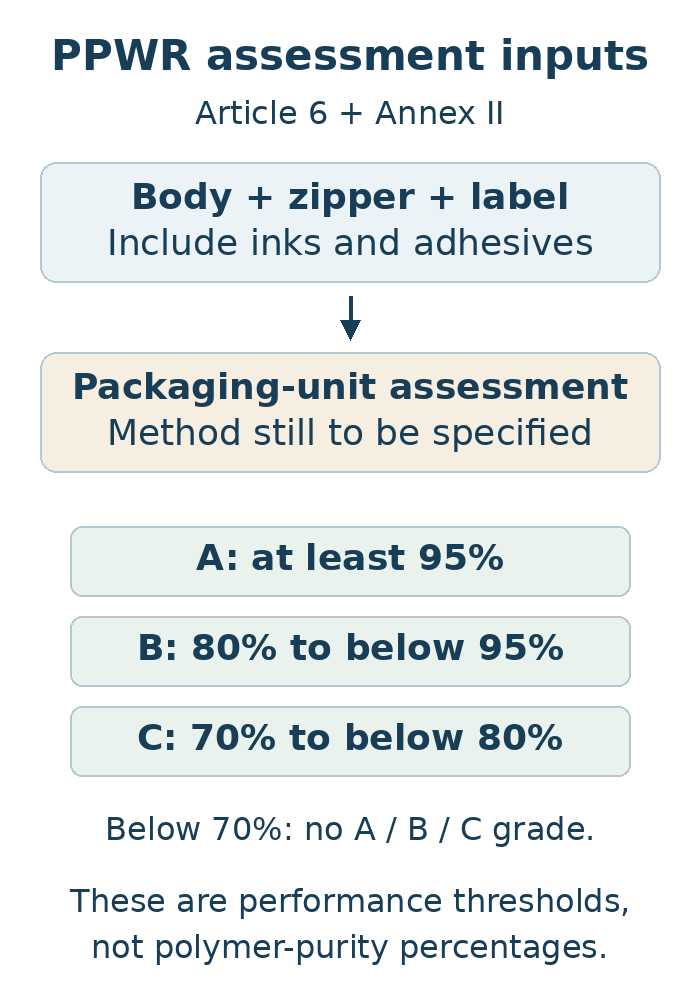
- Components count. Under Article 6(9), integrated components are included in the unit assessment; separate components are assessed separately. Integrated components that can separate under transport or sorting stress also need a separate assessment. Components must not hinder the main body’s recyclability.
For interim use, the Commission’s guidance says manufacturers must comply with the older Packaging Directive requirements and related standards until the design-for-recycling rule applies. It also says the formal conformity assessment for recyclability is not needed until the delegated act is in force.
Takeaway: Assess the complete unit and identify components that need separate assessment.
Recyclability performance grades
Annex II Table 3 and Article 6(3)-(4) set the thresholds directly:
Scroll horizontally to view all columns if needed. ↔
| Grade | Design-for-recycling assessment threshold |
|---|---|
| A | ≥95% |
| B | ≥80% and below A |
| C | ≥70% and below B |
| Below C | <70%; technically non-recyclable under this grade system |
The assessment basis is the packaging unit, in terms of weighting, for its Annex II category. These percentages are not a formula for dividing pure-polymer mass by total mass or for local collection rates. Article 6(4) leaves material-specific criteria, sorting efficiency and weighting methodology to the delegated acts. Record component weights, but do not invent a denominator or count every same-polymer component as recyclable.
Annex II Table 4 includes additives, labels, closures and adhesives among assessment inputs. An interim guideline result should name the protocol and its version; it does not establish a harmonized legal grade.
Takeaway: Preserve the protocol, version and weighted assessment basis with the letter grade.
Recyclability timeline and verified dates
Scroll horizontally to view all columns if needed. ↔
| Date or formula | Requirement / legal basis |
|---|---|
| 11 February 2025 / 12 August 2026 | Entry into force / general application: Article 71 |
| 1 January 2028 | Commission adoption deadline for design-for-recycling delegated acts: Article 6(4) |
| max(1 January 2030, relevant Article 6(4) act entry into force + 24 months) | Design-for-recycling condition and minimum A/B/C grade: Article 6(2)(a), 6(3) |
| 1 January 2035 | Separate collection and sorting condition: Article 6(2)(b) |
| max(1 January 2035, relevant Article 6(5) implementing act entry into force + 5 years) | Recycled-at-scale condition: Article 6(2)(b) |
| 1 January 2038 | Only A/B permitted, subject to Article 6 exceptions: Article 6(3) |
Source: Article 6. Adoption and entry into force are different events: use the latter in the formulas, even if adoption meets its statutory deadline.
Takeaway: Retain the later-of formula and use the secondary act’s entry-into-force date.
What is still pending
At this page’s review cutoff, the detailed design criteria, weighting and recycled-at-scale methods require the relevant secondary acts. Track their status through the Commission implementation page and Official Journal; record the act’s entry-into-force date when published. Pending methods do not cancel other current packaging duties.
Article 6(10)-(11) contains innovative-packaging provisions and specified exceptions; those are separate applicability checks, not an automatic exemption for a difficult-to-recycle pouch. See the PPWR overview for related obligations.
What flexible packaging designers can do now
Flexible packaging is exposed here because high-barrier structures often combine several polymers, foil or paper. Such a structure can run well on the line and still be hard to sort and recycle.
- Move toward one polymer family where the product allows. Mono-PE packaging and mono-PP packaging are the common routes. See mono-material packaging for the trade-offs, and mono PE vs multilayer film for a direct comparison.
- Use the established checklist. The practices in design for recycling (compatible sealants, limited barrier layers, wash-off or compatible inks and adhesives, matched closures and labels) already align with the direction of Article 6.
- Test barrier trade-offs before committing. Moving away from foil or PET can change shelf life. Check oxygen barrier packaging and packaging and shelf life data on the real product.
- Design every component. Look at the cap, spout, zipper, label and adhesive as well as the film. A spouted pouch or zipper pouch has fitments that change the assessment.
- Document your basis. Store the guideline name, version and date you assessed against, plus supplier declarations.
- Plan for fees. EPR fees are expected to follow recyclability grades; see packaging EPR.
What to document for a recyclability-ready pouch
Copy this assessment record and one component row per item.
Scroll horizontally to view all columns if needed. ↔
| Component / integrated or separate | Polymer / coating / adhesive | Weight / thickness | Supplier evidence / version |
|---|---|---|---|
| ____ | ____ | ____ | ____ |
Scroll horizontally to view all columns if needed. ↔
| Assessment field | Entry |
|---|---|
| Packaging category / unit being assessed / destination region | ____ |
| Protocol / version / assessment date | ____ |
| Collection / sorting / recycled-at-scale evidence | ____ |
| Conclusion / limitations / responsible person | ____ |
| Relevant secondary act / entry-into-force date / next check | ____ |
Use the design-for-recycling checklist to complete the component review before assigning a conclusion.
Takeaway: Keep the component inventory and assessment version with the conclusion.
Questions and answers
What is mono-material packaging?
It describes a structure built mainly around one polymer family; see the mono-material guide. It is not a PPWR performance grade. Components, sorting, recycling compatibility and the applicable assessment method still determine the result; design assessment and actual recycling evidence are separate checks.
Sources
- Regulation (EU) 2025/40 on packaging and packaging waste, EUR-Lex
- Packaging waste, European Commission, DG Environment
- Guidance document on the PPWR, European Commission
- FAQ on the Packaging and Packaging Waste Regulation, European Commission
Last checked: 8 October 2026. This is technical orientation, not legal advice for an individual product; confirm scope and exceptions in the current text.
Continue reading
Related articles
EU Packaging and Packaging Waste Regulation (PPWR): What It Means for Flexible Packaging
The PPWR, Regulation (EU) 2025/40, sets EU rules on recyclability, recycled content, labeling and PFAS. See the timeline and what it means for flexible packaging.
California SB 54: Plastic Packaging Producer Responsibility Explained
California SB 54 makes producers responsible for single-use packaging, with 2032 targets for recyclability, source reduction and recycling rates.
Packaging EPR: How Extended Producer Responsibility Works
Packaging EPR makes producers pay for the collection and recycling of their packaging; here is how schemes, fees and reporting work in the EU and US.