
Fin Seal vs Lap Seal: Film Layers, Web Width & Back-Seam Fit
Fin seal vs lap seal on form-fill-seal film: compare film layer mating, outer-face sealability, web width, crossover stack, and ASTM checks.
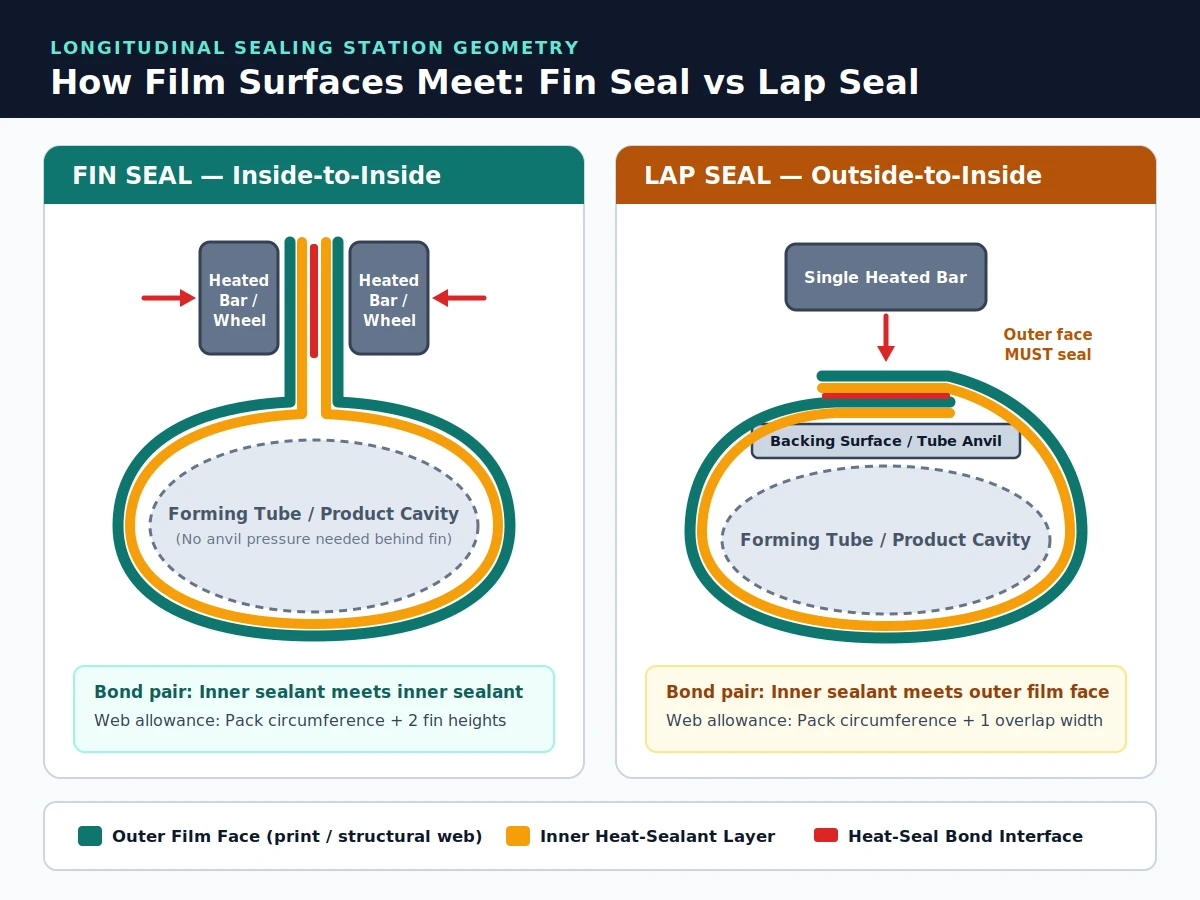
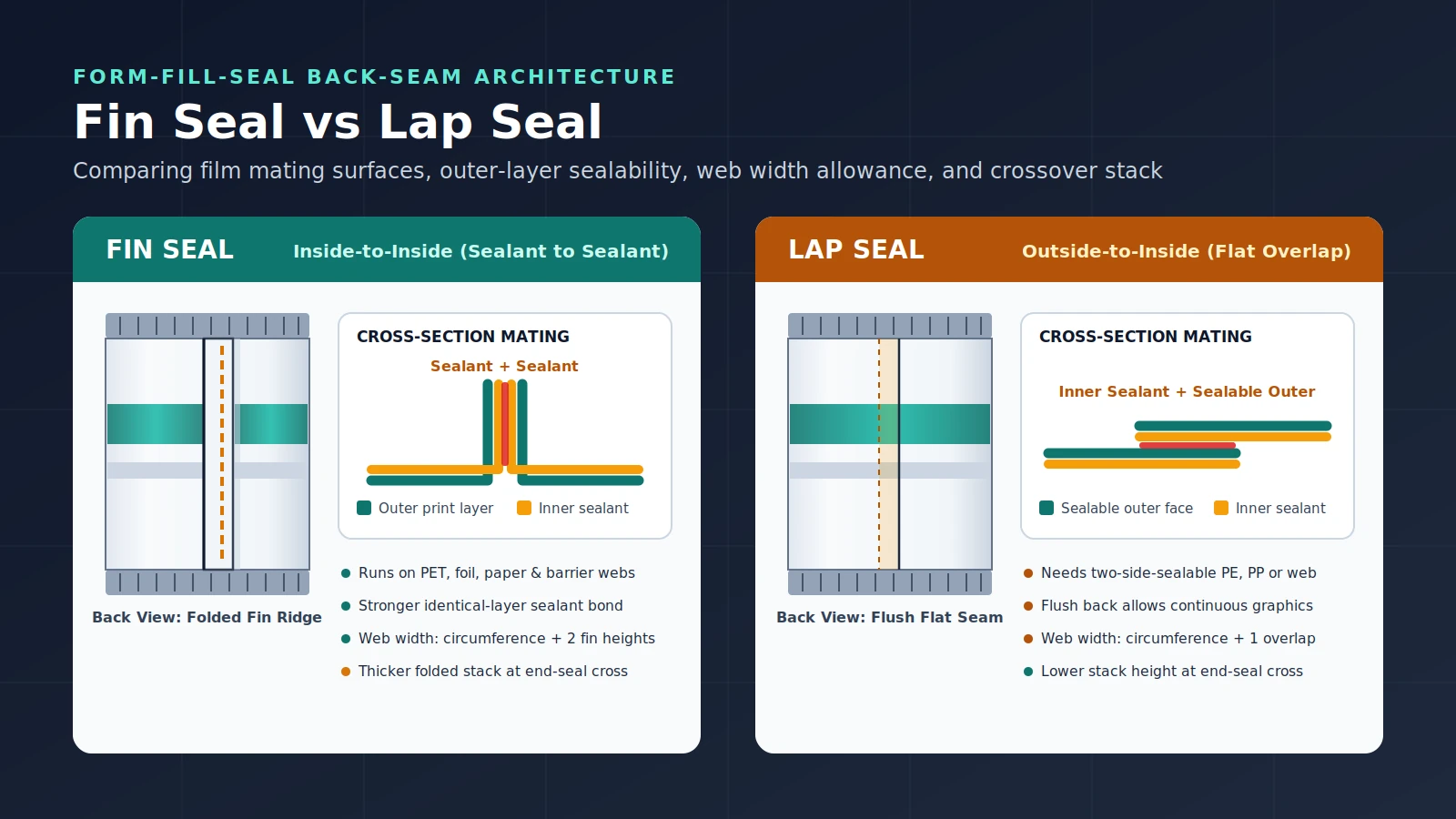
A fin seal joins two film edges inside face to inside face so the inner sealant bonds to itself and folds flat as a back ridge, whereas a lap seal overlaps one edge flat over the other, bonding the inside face to the outside face. Fin seals run on any inside-sealable laminate; lap seals require a sealable outer face.
What is a fin seal bag?
A fin seal bag is a form-fill-seal pouch or wrap closed along its spine by bringing the two longitudinal film edges outward and welding their inner faces together. After sealing, the raised seam is folded flat against the back on most packs, although some bag designs leave the fin standing upright.
Both vertical baggers and horizontal wrappers form this longitudinal back seal directly after shaping flat rollstock into a tube. On a vertical form-fill-seal machine, the flat film wraps around a hollow conical forming tube while a pair of heated bars closes on the two edges standing off the tube. On a horizontal wrapper, a pair of heated fin wheels pinches the two edges together beneath the product as the web moves continuously through the machine.
Thermal bars, ultrasonic horns, or adhesives can bond the mated film edges under controlled contact pressure and dwell time. Excess film along the protruding ridge is often trimmed or folded neatly along the package spine. For an overview of the complete horizontal pack style built around this seam, see flow wrap packaging and pillow bag formats.
What is a lap seal?
A lap seal is a longitudinal back seam formed by laying one edge of the film web flat over the opposite edge and bonding the inside face of the upper edge to the outside face of the lower edge. The finished seam sits flush with the back panel, leaving only a single visible film edge line across the print.
Rather than pinching two outward-turned flanges in midair, a lap-seal station uses a single heated bar pressing the overlapped edges against a solid backing surface. On a vertical form-fill-seal line, the forming tube itself serves as the anvil beneath the heated bar. On a horizontal flow wrapper, a backing plate or roller beneath the film supports the overlap during sealing.
Because the seal lies flat without folded flaps, a lap seal eliminates the protruding center ridge found on fin-sealed packs. That flush geometry makes lap sealing attractive for retail bags where clean back-panel presentation or reduced seam bulk matters, provided the film structure is engineered to weld on both faces.
What is the difference between a fin seal and a lap seal?
Fin seals and lap seals differ in mating surfaces, compatible film structures, seal strength, web width consumption, back-panel graphics, machine tooling, and end-seal crossover thickness. Where a two-side-sealable film permits either option, lap sealing uses less film and creates a flat printable back, whereas fin sealing produces the stronger longitudinal bond.
Scroll horizontally to view all columns if needed. ↔
| Comparison factor | Fin seal | Lap seal | Engineering impact on rollstock and line |
|---|---|---|---|
| Mating surfaces | Inside face to inside face | Outside face to inside face | Decides whether the outer web must carry heat-seal capability |
| Seam profile on back panel | Protruding fin, folded flat on most packs | Flush single-line overlap | Fin hides graphics inside the fold; lap keeps back print continuous |
| Longitudinal sealing hardware | Pair of heated bars (VFFS) or heated fin wheels (HFFS) | Single heated bar pressing against a forming tube, plate, or roller | Converting between styles requires changing forming and back-seal tooling |
| Compatible film families | Any film that seals on its inside face, including most laminates | Monolayer or coextruded PE, two-side-sealable PP, or custom sealable-outer laminates | Non-sealable PET, paper, or barrier outer webs are fin-seal only |
| Longitudinal seal strength | Stronger identical sealant-to-sealant bond | Depends on outer-layer sealability against the inner sealant | Approximates fin strength on true two-side-sealable films; weaker if outer web is print-oriented |
| Film web width allowance | Pack circumference plus two fin heights | Pack circumference plus one overlap width | Lap uses narrower rollstock for the same finished pack circumference |
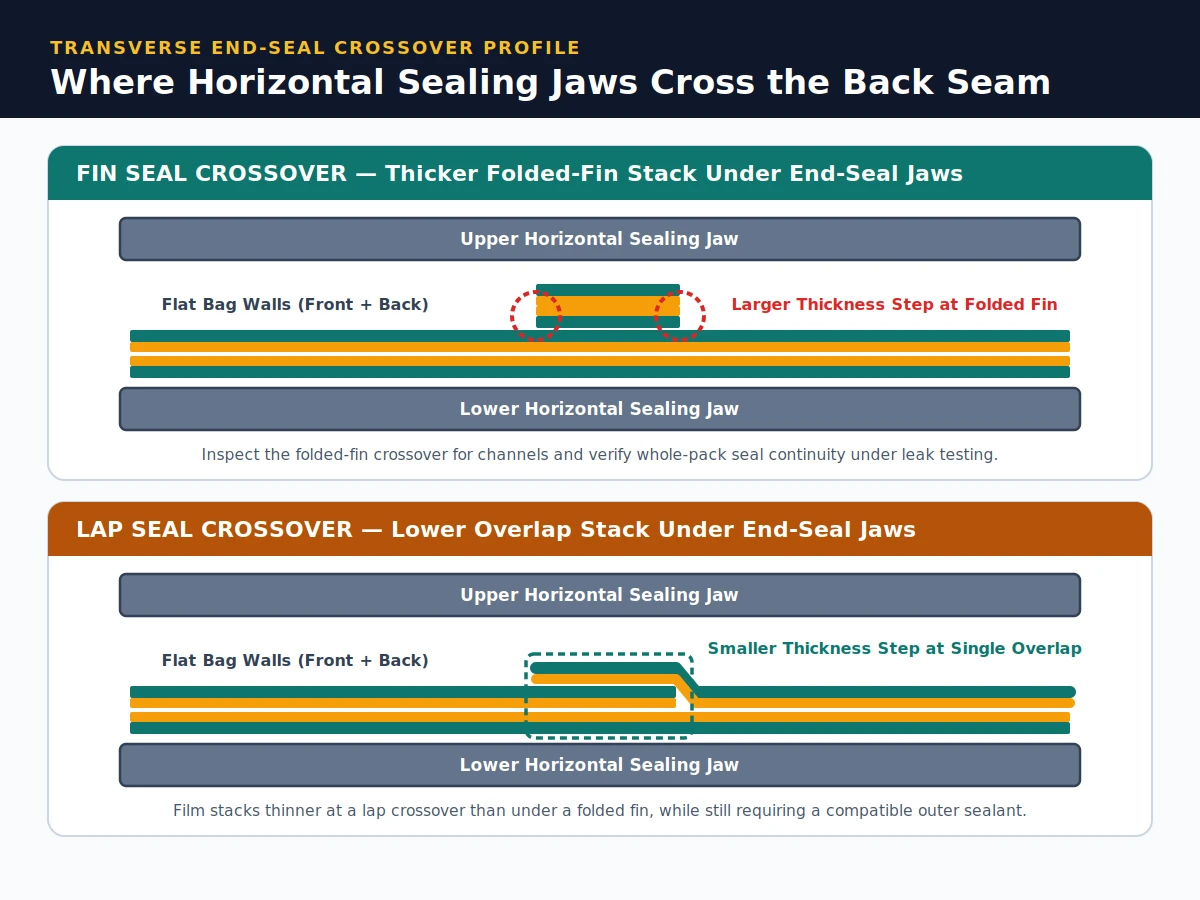
| End-seal crossover thickness | Stacks thicker beneath horizontal jaws where folded fin crosses | Stacks thinner beneath horizontal jaws across single overlap | Folded fin step requires careful jaw pressure and whole-pack leak verification |
| Machine default configuration | Default on horizontal flow wrappers | Default on VFFS lines running polyethylene film | Specify seam style and film build together before ordering forming sets |
Which form-fill-seal film layers work with a fin seal vs a lap seal?
Film construction—not product category—decides whether a line can run a lap seal or must run a fin seal. Any form-fill-seal film with a heat-sealable inner layer forms a fin seal, whereas a lap seal only bonds reliably when the outside film face is formulated to seal to the inside face.
Why multilayer laminates require a fin seal
Most multilayer barrier laminates used on vertical form-fill-seal and horizontal flow-wrap lines are strictly fin-seal structures. In a structure such as PET/AL/PE, the polyethylene inner layer provides the heat-seal surface while the outer PET film serves as the heat-resistant print layer and does not fuse to the sealant.
The same restriction applies to any laminate whose outside surface is a non-sealable print web, paper layer, or barrier substrate. Attempting to run a non-sealable outer laminate on a lap-seal forming set prevents the outer face from bonding cleanly, and pushing sealing heat higher to force fusion risks distorting the film. For wider rollstock structure selection by machine type, compare VFFS packaging film and flow wrap film.
Which films allow a lap seal
A lap seal requires a web that seals on both sides. Common lap-capable structures include monolayer or coextruded PE film, polypropylene webs carrying heat-seal skins on both faces, and custom laminates where the converter builds a dedicated sealable outer layer specifically for lap sealing.
Because the film structure governs seam eligibility, the exact same snack or dry good runs as a fin seal when packaged in a foil laminate and as a lap seal when packaged in plain polyethylene film. On any true two-side-sealable web, either longitudinal seal geometry will form once matched to the right forming set.
Why seal strength differs between fin and lap
A fin seal produces the stronger longitudinal weld because identical sealant layers meet face to face at the same melting temperature. Both mating surfaces share the same polymer formulation, giving consistent fusion when time, temperature, and pressure are held steady on clean film.
In a lap seal, the inner sealant must bond to the outer film surface, so joint strength is limited by how well the outer layer seals. On a balanced two-side-sealable monolayer or coextrusion, lap seal strength comes close to a fin seal; on a web whose outer face was optimized primarily for printability or stiffness, the lap bond is weaker. Overall film construction and total thickness also influence heat transfer through the web, so thicker gauges demand longer dwell time or higher pressure without overheating the outer surface.
How does fin seal vs lap seal change film width, crossover thickness, and back graphics?
Switching from a fin seal to a lap seal reduces rollstock web width, lowers the thickness step where the back seam meets the horizontal end seals, and opens the back panel for continuous printing. Every one of those geometric differences affects forming-collar sizing, artwork layout, and downstream case packing.
Web width calculation: two fin heights vs one overlap
Film width differences follow straight from cross-sectional geometry. To form a fin seal, both longitudinal edges stand off the pack body by the height of the fin before sealing, so the flat rollstock web is wider than the pack circumference by two fin heights.
A lap seal folds neither edge outward; one edge simply overlaps the other by a single seam width. As a result, a lap-sealed web equals the pack circumference plus one overlap width, reducing total film width per bag compared with a fin seal of equivalent seam width.
End-seal crossover stack under horizontal jaws
On both VFFS machines and horizontal flow wrappers, a horizontal sealing bar or rotary crimper closes across the tube to form the bottom seal of one bag and the top seal of the preceding bag, operating either at a fixed height in an intermittent cycle or moving downward with the bag in a continuous cycle. Wherever those transverse jaws cross the longitudinal back seam, the film thickness jumps abruptly.
Because a folded fin lays both outward edges flat against the back wall, the film stacks thicker under a fin seal crossover than under a single lap overlap. That sharper step makes the crossover zone the primary location to inspect for wrinkles, incomplete fusion, or micro-channels during setup and quality checks.
Back-panel print continuity and fulfillment handling
A lap seal lies flush against the rear panel so typography, nutrition tables, and graphic bands run straight across the back seam with only a single edge line visible. A fin seal creates a folded ridge down the spine, hiding any print located on the two inner faces of the fold and splitting the rear layout.
In automated fulfillment and case packing, a raised fin adds localized stiffness along the bag spine, but an untrimmed or poorly folded fin can snag on conveyor guides or neighboring packs during transit and palletizing.
How do fin seal and lap seal affect film cost and machine tooling?
Lap sealing saves film width per pack, but it only lowers total packaging cost when your existing film structure is already two-side-sealable. If a product requires a barrier laminate, adding a custom sealable outer layer just to run a lap seal increases material complexity, whereas converting an existing machine between fin and lap requires new forming and back-seal hardware.
Buyers evaluating film cost should weigh two opposite drivers together:
- Web width savings on lap-capable films: On monolayer or coextruded PE and two-side-sealable PP webs, lap sealing trims web width by eliminating the second fin allowance while keeping back graphics flat.
- Unnecessary outer-sealant spend on fin-seal lines: Only a lap seal needs a heat-sealable outside face. Tell your film converter which back seal the machine runs so you do not pay for a sealable outer layer on a fin-seal line.
- Display value vs pack orientation: For a pack sold face-up inside a tray or carton, back-seam appearance adds little commercial value. For peg-hung retail packs or display bags where consumers inspect the rear panel, a flat printed back is usually the main reason to pay for a two-side-sealable film.
Machine compatibility follows tooling geometry rather than touchscreen settings. Both vertical baggers and horizontal flow wrappers can run either back seam, yet changing from fin to lap on an installed line is a tooling change—replacing the forming tube and shoulder collar on a VFFS machine, or the forming box on a flow wrapper, along with the back-seal station behind it—not a parameter adjustment.
Each machine family also has a standard default. Horizontal flow wrappers default to fin seals because fin wheels pinch the edges cleanly beneath the product with no backing anvil and accommodate any inside-sealable laminate. VFFS machines running polyethylene film default to lap seals, using the forming tube directly as the sealing anvil. Because every forming set is cut to one specific web width determined by the back-seam style, state both the seal type and the complete film structure together before ordering tooling or rollstock.
How should you qualify fin seal and lap seal film before production?
Qualifying a fin or lap back seam requires separating laboratory heat-seal screening from production-line verification of both the longitudinal seam and the transverse crossover. Reliable heat seals depend on controlled time, temperature, and pressure applied to clean, compatible materials, often using release-lined hot bars or cooled impulse jaws so molten film does not stick to tooling.
Start with laboratory heat-seal curves prepared under ASTM F2029-16(2021), which covers hot-bar and impulse sealing of homogeneous or multilayer webs and notes that overall construction and thickness influence sealability alongside the sealant layer. Treat laboratory curves strictly as starting points for full-scale production equipment, because ASTM F2029-16(2021) does not validate commercial line scale or cover seal continuity tests such as air-leak or dye penetration.
Verify finished-bag performance across four complementary checks:
- Cooled peel strength and failure mode: Test strip samples cut across the back seam and end seals under ASTM F88/F88M-23, which measures separation force and identifies specimen failure mode. Keep the tail-support fixture consistent—Technique A, Technique B, or Technique C—across an entire comparison series so bending forces do not skew results. See seal strength testing and the ASTM F88 acceptance guide.
- Warm-seal hot tack: On high-speed form-fill lines where product drop or web tension loads freshly made seals before cooling, screen thermoplastic sealants under ASTM F1921/F1921M-12(2023) to prevent hot-seal breakage. See hot tack and the ASTM F1921 jaw-window guide.
- Whole-pack burst and creep resistance: Evaluate overall seal strength under ASTM F1140 internal pressurization testing, including creep tests held at about 80% of minimum burst pressure until seal failure or a defined hold time.
- Crossover leak continuity: Pair routine visual checks with vacuum bubble emission testing under ASTM D3078 or pressure-decay leak checks, focusing directly on the folded-fin or lap crossover intersections.
Scroll horizontally to view all columns if needed. ↔
| Pre-order checklist item | What to specify to converter and OEM | Why it prevents line failure |
|---|---|---|
| Back-seam geometry | State fin seal or lap seal explicitly on both film spec and machine PO | Forming tube, collar, or forming box is cut to one exact web width |
| Outer-face sealability | Confirm non-sealable print/barrier outer (fin only) vs two-side-sealable build (lap eligible) | Prevents unbonded lap seams or wasted spend on unneeded outer sealants |
| Web width basis | Document pack circumference plus two fin heights (fin) or one overlap width (lap) | Keeps print registration, back-seam alignment, and tracking on center |
| Back-panel artwork zone | Reserve fold zone for fin seals or specify single overlap edge line for lap seals | Stops nutrition panels or barcodes from disappearing inside a folded fin |
| Crossover verification plan | Record ASTM F88/F88M-23 peel technique, ASTM F1921/F1921M-12(2023) hot tack, and ASTM D3078 leak checks | Confirms transverse jaws seal cleanly across the longitudinal seam step |
| Handling and folding spec | Define fin fold direction or trim requirements for conveyor guides and case packing | Prevents protruding fins from catching on transfer guides during fulfillment |
Frequently asked questions
What is the main difference between a fin seal and a lap seal?
A fin seal joins the two film edges inside face to inside face so the inner sealant bonds to itself and folds flat as a ridge along the back of the pack. A lap seal overlaps one edge flat over the other, bonding the inner face to the outer face for a flush seam.
Can you run a lap seal on PET/AL/PE or foil barrier laminates?
No, standard multilayer laminates such as PET/AL/PE are fin-seal only because the outer PET print surface does not heat-seal to the inner polyethylene layer. Running a lap seal requires a monolayer or coextruded film that seals on both faces, or a laminate engineered with a dedicated sealable outer layer.
Does a lap seal always use less film than a fin seal?
Yes, for the same finished pack circumference and seam width, a lap seal requires narrower rollstock. A fin seal adds two fin heights to the pack circumference so both edges can turn outward, whereas a lap seal adds only one overlap width.
Is a fin seal stronger than a lap seal?
Generally yes, because a fin seal bonds identical inner sealant layers face to face at the same sealing temperature. A lap seal relies on the outer film surface’s sealability; it approaches fin strength on true two-side-sealable films but is weaker when the outer layer is prioritized for print or stiffness.
Can an existing VFFS machine or flow wrapper switch from fin seal to lap seal by changing settings?
No, switching between fin sealing and lap sealing is a tooling change rather than a parameter adjustment. Both VFFS baggers and horizontal flow wrappers require changing the forming set—forming tube and collar or forming box—plus the longitudinal back-sealer hardware behind it.
Sources
- ASTM F88/F88M-23: Standard Test Method for Seal Strength of Flexible Barrier Materials — scope, peel separation force, specimen failure mode, and Techniques A, B, and C.
- ASTM F1921/F1921M-12(2023): Standard Test Methods for Hot Seal Strength (Hot Tack) of Thermoplastic Polymers and Blends Comprising the Sealing Surfaces of Flexible Webs — scope and form-fill hot-seal disruptive load resistance.
- ASTM F2029-16(2021): Standard Practices for Making Laboratory Heat Seals for Determination of Heat Sealability of Flexible Barrier Materials as Measured by Seal Strength — laboratory heat-seal curves, construction and thickness effects, and continuity testing limits.
- Wikipedia: Heat sealer — heat-sealing process parameters, hot-bar release tooling, ASTM F1140 burst and creep testing, and ASTM D3078 bubble leak testing.
- Wikipedia: Vertical form fill sealing machine — conical forming tube geometry, vertical fin-seal bar, and intermittent versus continuous horizontal sealing bars.
Continue reading
Related articles
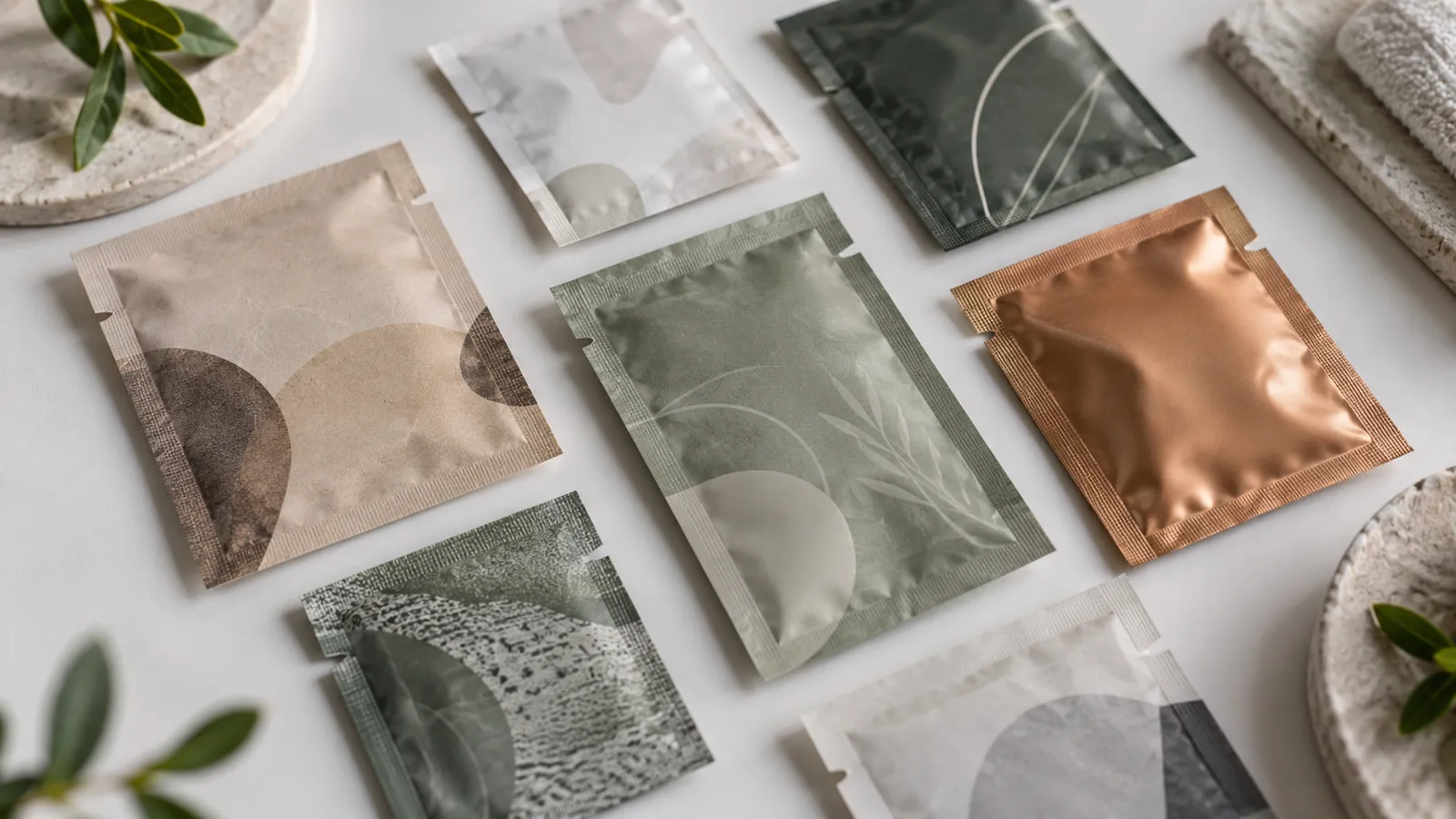
Define Sachets in Flexible Packaging: 3-Side vs 4-Side Seal Formats, Laminate Stiffness, and Laser Scoring
Define sachets in flexible packaging: compare 3 side seal vs 4 side seal sachet geometry, PET/AL/PE sachet packaging film stiffness, CO2 laser scoring, and slitting.
Doypack Stand-Up Pouch Structure and Gussets
Compare round-bottom, K-seal and plow doypack structures, then match gusset stiffness, product volume and opening clearance to the filler.
Flow Wrap Packaging: How It Works and What It Suits
Flow wrap packaging forms a film tube around the product with a fin or lap seal and two end seals. See variants, suitable products and trade-offs.