
Define Sachets in Flexible Packaging: 3-Side vs 4-Side Seal Formats, Laminate Stiffness, and Laser Scoring
In flexible packaging engineering, engineers define sachets as flat, non-gusseted unit-dose packets formed from heat-sealable rollstock laminate and sealed along either three perimeter edges with one plow-folded crease (3-side seal) or all four perimeter edges (4-side seal). Qualifying a sachet packaging film requires balancing outer 12 µm BOPET tensile modulus against 7 to 9 µm aluminum foil dead-fold stiffness, controlling CO2 laser score ablation depth within ±2 µm so 2 to 4 µm of residual PET remains above the barrier layer, and holding multi-lane parent roll slitting width within ±0.5 to ±1.0 mm and eye-mark repeat registration within ±0.15 mm.
A unit-dose flexible packet fails on the packaging line when a sharp folding plow cracks its aluminum foil core or when an un-scored outer film causes the tear notch to stall and spill the dose. To define sachets in flexible packaging engineering, a sachet (also called a packet or packette in North American converting standards) is a flat, zero-gusset, unit-dose flexible container formed inline from heat-sealable rollstock laminate on vertical or horizontal form-fill-seal (VFFS or HFFS) machinery and hermetically sealed along either three perimeter borders with one folded edge (3-side seal) or all four perimeter borders (4-side seal). Unlike multi-serving pouches, a sachet holds a single pre-measured dose of 0.5 to 100 mL for liquids and pastes or 0.5 to 100 g for powders, granules, and saturated non-woven substrates.
Selecting between a 3 side seal vs 4 side seal sachet and qualifying the matching sachet packaging film governs line speed, rollstock consumption, barrier survival at folded edges, and consumer tear opening. When an outer 12 µm biaxially oriented polyester (BOPET) layer, a 7 to 9 µm aluminum foil core, and a 32 to 50 µm polyethylene or ionomer sealant pass through a multi-lane machine, small deviations in folding radius, CO2 laser score depth, or rotary slitting width produce flex-crack pinholes, un-tearable headers, or channel leaks across parallel sealing lanes. For a high-level orientation across all flexible pack shapes, see the flexible packaging formats hub and our general sachet packaging overview.
How packaging engineers define sachets vs stick packs and stand-up pouches
Packaging engineers define sachets by three structural boundaries that separate them from tubular stick pack packaging and gusseted stand-up pouches: zero bottom or side gussets, perimeter-only flat heat seals without a rear longitudinal fin or lap seam, and a low aspect ratio (length-to-width ratio typically 1:1 to 2.5:1) that presents two uninterrupted billboard panels.
In the Glenroy Pouch and Sachet Film Laminations overview and the Glenroy Stick Pack Film Laminations technical comparison, tubular stick packs (length-to-width ratio 3:1 to 6:1, typical width 17 to 45 mm) consume 10% to 40% less rollstock film area than an equivalent-volume rectangular sachet because forming a cylinder around a vertical filling tube requires only one narrow rear fin or lap seal plus two short cross seals. Flat sachets remain mandatory whenever the product is a flat folded substrate (such as an alcohol prep pad, disinfecting wet wipe, or transdermal medical patch), when high-viscosity cosmetic creams or condiment pastes must be squeezed cleanly from a wide flat cavity, or when regulatory labeling demands wide front and back display panels. By contrast, a stand-up pouch (Doypack) adds a W-folded bottom gusset (see doypack bottom structure and gusset stiffness) to support 100 g to 2.5 kg multi-serving retail weights.
Scroll horizontally to view all columns if needed. ↔
| Format parameter | Flat sachet (3-side or 4-side seal) | Tubular stick pack (fin or lap back seal) | Stand-up pouch (Doypack with bottom gusset) |
|---|---|---|---|
| Primary geometric definition | Flat rectangular, square, or die-cut packet with 3 or 4 perimeter seals and zero gussets | Slender cylindrical tube with 1 longitudinal rear fin/lap seal and 2 transverse end seals | Three-dimensional pouch with front panel, back panel, and W-folded round, K-seal, or plow base |
| Typical finished dimensions and L:W ratio | Width 35 to 120 mm, length 45 to 180 mm; aspect ratio 1:1 to 2.5:1 |
Width 17 to 45 mm, length 60 to 170 mm; aspect ratio 3:1 to 6:1 |
Width 85 to 260 mm, height 130 to 350 mm, bottom gusset 40 to 120 mm |
| Typical single-unit dose capacity | 0.5 to 100 mL liquids/gels or 0.5 to 100 g powders, granules, and folded wipes |
1 to 20 g free-flowing powders/granules or 2 to 35 mL nutritional gels and liquids |
100 g to 2.5 kg dry food, roasted coffee, pet food, or 150 mL to 2 L liquids |
| Rollstock surface area efficiency | Baseline reference (2 × W_pouch web width per lane; wide perimeter seal flanges) |
Uses 10% to 40% less film area than an equivalent-volume sachet (Glenroy benchmark) |
Highest film area per gram due to 3-panel body plus folded bottom gusset web |
| Compatible product physical states | Powders, viscous creams, sauces, 70% IPA swabs, folded non-woven wet wipes, patches |
Free-flowing drink mixes, sugar, electrolytes, liquid honey/syrup, oral gel shots | Whole-bean/ground coffee, snacks, retort meals, granules, multi-serve liquids |
| Primary forming equipment | Intermittent or continuous VFFS and HFFS (1 to 12+ lanes; plate or rotary sealers) |
Multi-lane vertical tubular VFFS (2 to 20+ lanes around individual forming tubes) |
Horizontal HFFS from rollstock or rotary/inline premade pouch filling lines |
3 side seal vs 4 side seal sachet geometry and machine web paths
Evaluating a 3 side seal vs 4 side seal sachet starts with how the parent web is unwound, folded or slit, and clamped between the sealing jaws. As documented in the OMAG 3-Side-Seal Sachets engineering specification and the OMAG 4-Side-Seal Sachets machine documentation, the two formats differ in web feed topology, rollstock width consumption, front-to-back laminate symmetry, and mechanical bending strain along the unsealed edge.
In a 3-side-seal sachet, a single flat web of width W_strip = 2 × W_pouch unwinds over a triangular forming plow (on horizontal HFFS machines such as the OMAG CO series or vertical VFFS machines such as the Landpack LD480G/LD720G/LD960G series), folding 180° along the machine centerline. The folded crease forms one complete edge of the packet without a heat seal, while heated bars or rotary rollers fuse the two opposing side borders and the final closure edge. Replacing one 6 to 10 mm heat-sealed flange with a zero-width fold saves 12 to 20 mm of parent rollstock width per lane (14% to 18% film area reduction on narrow packets) and guarantees that the folded edge cannot fail by heat-seal contamination. However, creasing a stiff laminate through a tight 180° radius over the forming plow subjects the 7 to 9 µm aluminum foil or 12 µm metallized film core to localized tensile and compressive bending strain. Under ASTM F392/F392M-23 Gelbo flex conditioning, a sharp fold crease is the primary site for foil pinhole nucleation and adhesive stress cracking when packed with volatile alcohols or essential oils.
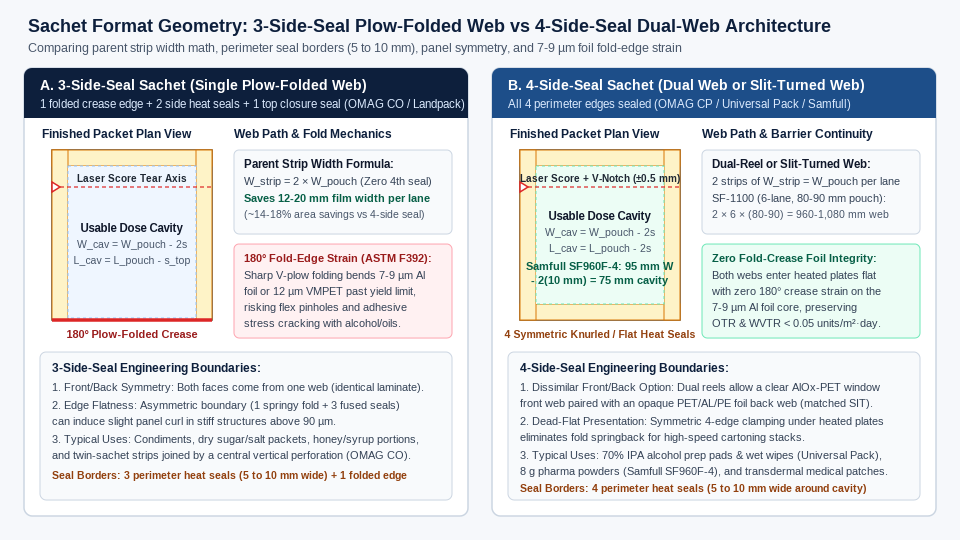
In a 4-side-seal sachet, the packet is sealed around all four outer edges (5 to 10 mm border width on every side), leaving usable internal cavity width W_usable = W_pouch - (2 × s) and usable cavity length L_usable = L_pouch - (2 × s). Production lines feed the film via one of two web paths:
- Single parent reel slit inline into
2 × Ndiscrete ribbons and turned face-to-face without a180°fold edge in the finished packet, the standard configuration on high-speed continuous multi-lane wet-wipe and swab lines (Universal Pack wet-wipe sachet machines and Samfull SF-1100 6-lane liquid sachet machines). - Dual independent parent reels (one front print web and one back barrier web) unwound into vertical heated sealing plates (
OMAG CPseries) or intermittent servo auger lines (Samfull SF960F-4 4-lane pharmaceutical powder machine).
Because neither web undergoes a 180° plow crease, the 7 to 9 µm aluminum foil layer stays completely flat through the heated sealing plates, preserving an intact gas barrier (OTR < 0.05 cm³/[m²·day], WVTR < 0.05 g/[m²·day]) and producing dead-flat sachets that stack cleanly in automatic pharmaceutical cartoners. Dual-reel 4-side-seal machines also permit asymmetric front and back substrates, such as pairing a transparent 12 µm AlOx-PET / PE front window web with an opaque PET / AL / PE foil backing web, provided both inner sealants share a matched seal initiation temperature (SIT) window.
Scroll horizontally to view all columns if needed. ↔
| Engineering parameter | 3-side-seal sachet format | 4-side-seal sachet format |
|---|---|---|
| Web feed and forming path | Single web folded 180° over a V-shaped forming plow (1 folded crease + 2 side seals + 1 top seal) |
Dual independent webs (Front + Back) or 1 parent web slit into 2N flat ribbons sealed on all 4 edges |
Usable internal cavity width (W_usable) |
Asymmetric: W_usable = W_pouch - s_top along fold axis, or W_pouch - 2s across side-sealed width |
Symmetric across both axes: W_usable = W_pouch - 2s (e.g., 95 mm - 2[10 mm] = 75 mm on Samfull SF960F-4) |
| Rollstock film consumption | Saves 12 to 20 mm of strip width per lane (14% to 18% savings on narrow packs) by omitting the 4th seal flange |
Requires full 5 to 10 mm heat-seal border on all 4 perimeter edges (2 × W_pouch active web per lane) |
| Front-to-back substrate pairing | Strictly identical front and back laminate because both panels originate from one folded web | Supports dissimilar front and back webs on dual-reel lines (e.g., clear AlOx-PET window front + foil back) |
| Foil barrier integrity at edges | 180° plow fold concentrates bending strain on 7 to 9 µm foil, risking ASTM F392 flex pinholes |
Zero fold crease; flat web path through sealing plates preserves 100% intact foil continuity |
| Finished panel flatness and cartoning | Springback at the folded crease can cause slight wedge pillowing in stiff laminates above 90 µm |
Symmetric 4-edge constraint clamps both webs flat under heated plates for high-speed cartoning |
| Primary industrial applications | Condiments, dry sugar/salt packets (Landpack LD series), honey portions, twin-perforated sample strips |
70% IPA antiseptic wipes (Universal Pack), 8 g pharma powders (Samfull SF960F-4), cosmetic serums |
Sachet packaging film structures: PET/AL/PE stiffness, barrier, and chemical compatibility
Specifying a commercial sachet packaging film requires coordinating five functional layers from the outer print surface to the product-contact sealant. In multi-lane machine datasheets from Landpack (LD480G / LD720G / LD960G) and Samfull (SF960F-4), total composite laminate thickness is standardized at 70 to 100 µm (0.07 to 0.10 mm). Within that gauge budget, panel bending stiffness (flexural rigidity D) scales with the tensile modulus (E, measured per ASTM D882-18) and the cube of the distance from the neutral bending axis (D ∝ E · t³).
Placing a 12 µm biaxially oriented PET (BOPET) layer (E ≈ 3,800 to 4,500 MPa, melting point 250°C to 260°C) on the outer skin and a 32 to 50 µm (1.25 to 2.0 mil) linear low-density polyethylene (LLDPE) or ionomer sealant (E ≈ 180 to 300 MPa) on the inner skin around a central 7 to 9 µm annealed O-temper aluminum foil core (E ≈ 68,000 to 70,000 MPa, defined as 0.285 to 0.35 mil = 7.24 to 8.89 µm in the Glenroy Flexible Packaging Technical Glossary) creates a rigid structural I-beam. Increasing total laminate gauge from a 60 µm metallized film (PET 12 / VMPET 12 / LLDPE 36) to a 90 µm foil laminate (PET 12 / LDPE 15 / AL 9 / EAA 15 / LLDPE 39) increases panel bending stiffness by 2.8× to 3.5×, while the O-temper aluminum foil provides plastic yield (dead-fold) so individual sachets lie flat on collating conveyors rather than springing open.
As detailed in the Glenroy ExpressWeb Narrow Web and Sachet Foil Laminations specification table and the Glenroy Barrier Film Laminations engineering guide (Feb 20, 2026), aggressive unit-dose fills such as 70% isopropyl alcohol (IPA) sanitizing wipes, essential oils, terpenes, salicylic acid, benzoyl peroxide, and acetic acid condiments permeate rapidly through inner polyolefin sealants. If those permeating molecules reach a standard two-component polyurethane (PU) adhesive layer, they swell or hydrolyze the urethane bond and delaminate the sealant from the foil core. Commercial sachet converters prevent chemical delamination and powder seal-through failures using three targeted resin architectures:
- Extruded ethylene acrylic acid (
EAA) or high-performance copolymer (HPC) inner tie layers (Glenroy White EAA 032,White EAA Plus 129,White HPC 174, andSilver HPC Plus 226), whose polar carboxyl groups form hydrogen and ionic bonds directly with the native aluminum oxide surface on the7.2 to 8.9 µmfoil core. - Zinc or sodium neutralized ethylene-methacrylic acid ionomer (
Surlyn®) inner sealants (Glenroy White Ready Seal 225andPremium-Tear), which deliver a low seal initiation temperature (85°C to 95°C), high hot tack perASTM F1921, resistance to alcohol and oils, and hermetic sealing directly through airborne pharmaceutical dust or liquid droplets. - Vapor-deposited transparent oxide films from the TOPPAN GL BARRIER lineup (
12 µm AlOx-PET GL-AEandGX-P-F, or recyclable mono-material32 µm SiOx-HDPE GL-HE), selected when food or medical sachets must pass through inline metal detectors or meet mono-polyethylene recycling rules.
Scroll horizontally to view all columns if needed. ↔
| Commercial sachet laminate grade or family | Layer architecture and typical gauge stack | Published OTR and test climate (ASTM D3985) | Published WVTR and test climate (ASTM F1249) | Inner tie and sealant chemistry | Target unit-dose product and chemical resistance profile |
|---|---|---|---|---|---|
| Glenroy Value-Barrier White 662 | PET 12 µm / White LDPE tie / Al Foil 7.2 to 8.9 µm / Adhesive tie / 2.0 mil (50.8 µm) LLDPEF |
< 0.05 cm³/(m²·day·atm) at 23°C, 0% RH |
< 0.05 g/(m²·day) at 38 to 40°C, 90% RH |
Adhesive tie + heavy 50.8 µm metallocene LLDPEF sealant |
Dry nutrition powders, electrolytes, non-aggressive creams requiring high drop burst strength |
| Glenroy White / Silver HPC 174 & HPC Plus 226 | PET 12 µm / White or Clear LDPE / Al Foil 7.2 to 8.9 µm / HPC tie / 1.25 mil (31.8 µm) or 1.5 mil (38.1 µm) LLDPEF |
< 0.05 cm³/(m²·day·atm) at 23°C, 0% RH |
< 0.05 g/(m²·day) at 38 to 40°C, 90% RH |
High-performance copolymer (HPC) tie + 31.8 or 38.1 µm LLDPEF |
Personal care lotions, shampoos, cosmetic serums, and mild surfactant gels |
| Glenroy White EAA 032 & White EAA Plus 129 | PET 12 µm / White LDPE tie / Al Foil 7.2 to 8.9 µm / EAA copolymer tie / 1.25 mil (31.8 µm) or 2.0 mil (50.8 µm) LLDPEF |
< 0.05 cm³/(m²·day·atm) at 23°C, 0% RH |
< 0.05 g/(m²·day) at 38 to 40°C, 90% RH |
Polar ethylene acrylic acid (EAA) copolymer tie bonded to foil |
70% IPA antiseptic wet wipes, alcohol swabs, acidic sauces (acetic acid), and topical analgesics |
| Glenroy White Ready Seal 225 (Ionomer) | PET 12 µm / White LDPE tie / Al Foil 7.2 to 8.9 µm / Ionomer (Surlyn®) sealant (35 to 45 µm) |
< 0.05 cm³/(m²·day·atm) at 23°C, 0% RH |
< 0.05 g/(m²·day) at 38 to 40°C, 90% RH |
Direct ionomer (Surlyn®) tie/sealant (SIT 85 to 95°C) |
Essential oils, motor/lubricant oils, salicylic acid, and dusty 8 g pharma powders (Samfull SF960F-4) |
Metallized Polyester (PET / VMPET / LLDPE) |
BOPET 12 µm / PU adhesive / VMPET 12 µm (OD 2.2 to 2.8) / PU adhesive / LLDPE 35 to 50 µm |
0.5 to 1.0 cm³/(m²·day) at 23°C, 0% RH |
0.3 to 1.0 g/(m²·day) at 38°C, 90% RH |
Solventless or solvent-borne PU adhesive + LLDPE |
Dry seasoning mixes, hotel sugar/salt packets, and short-rotation dry promotional samples |
TOPPAN GX-P-F or GL-AE (AlOx-PET Clear Barrier) |
AlOx-PET 12 µm (GX-P-F or GL-AE) / PU adhesive / LLDPE 40 to 50 µm |
0.10 cc/(m²·day·atm) (GX-P-F) to 0.50 cc (GL-AE) at 30°C, 70% RH |
0.05 g/(m²·day) (GX-P-F) to 1.0 g (GL-AE) at 40°C, 90% RH |
Aliphatic/aromatic PU adhesive + LLDPE or CPP sealant |
Metal-detector-compatible food condiments, visible liquid doses, and soluble coffee packets (high-barrier coffee laminate benchmarks) |
Recyclable Mono-PE (TOPPAN GL-HE / Universal Pack PE) |
BOPE or HDPE 20 to 25 µm / GL-HE 32 µm SiOx-HDPE / low-SIT mLLDPE 35 to 45 µm |
0.50 cc/(m²·day·atm) at 30°C, 70% RH |
0.50 g/(m²·day) at 40°C, 90% RH |
PE coextrusion or <= 2.5 wt% PU adhesive + mLLDPE |
Mono-material polyethylene sachets for non-solvent wipes and dry granules targeting RecyClass PE streams |
When packaging dusty pharmaceutical powders such as the 8 g medicine dose on the Samfull SF960F-4 4-lane 4-side-seal machine (bulk density 0.607 g/mL, 33 cuts/min = 132 sachets/min), resin selection must be paired with mechanical dust control. As documented in the SF960F-4 technical specification and our sachet film machine compatibility guide, maintaining hermetic 10 mm perimeter seals requires static eliminator bars along the film unwind path, sponge-tube expulsion clamping above the fill zone, and a vacuum dust-collection manifold at the auger nozzle, followed by verification of both peel strength (ASTM F88/F88M-23 on our seal strength testing page) and whole-sachet internal pressurization bubble leak integrity (ASTM F2096-11(2019), which detects seal channels down to 250 µm with 81% probability).
CO2 laser scoring depth control and tear-notch registration
A common field defect in PET / AL / PE sachets is tear arrest: the user pinches the mechanical V-notch in the side seal, starts a tear through the fused border, and watches the tear tip deflect upward or stall as soon as it hits the un-scored 12 µm BOPET body panel. Because biaxially oriented PET carries a high tensile strength (180 to 240 MPa per ASTM D882-18) and balanced machine-direction (MD) and transverse-direction (TD) orientation, a mechanical edge notch alone cannot propagate a straight cross-web tear through an intact 12 µm BOPET + 7 to 9 µm Al foil + 40 µm LLDPE wall without spilling liquid or powder.
Converters solve tear arrest by adding inline machine-direction (MD) or cross-direction (CD) CO2 laser scoring, documented in the Glenroy Custom Finishing, Slitting, and In-House Laser Scoring capabilities sheet. Sealed-tube CO2 lasers operating at far-infrared wavelengths of 10.6 µm (or 10.2 µm / 9.3 µm) focus a narrow beam (40 to 80 µm kerf width) onto the outer 12 µm BOPET print layer before the rollstock reaches the packaging line:
- Outer
BOPETablation budget: in a12 µm BOPET / tie / 7 to 9 µm Al Foil / EAA tie / 32 to 50 µm LLDPElaminate, the10.6 µmlaser beam vaporizes8 to 10 µminto the12 µmouterBOPETlayer under closed-loop power control (±2 µmdepth tolerance), leaving an un-cut residualBOPETbridge of2 to 4 µmat the root of the groove. - Optical reflection off the aluminum foil core: metallic aluminum reflects more than
95%of10.6 µmfar-infrared radiation and dissipates heat laterally across the web. The7 to 9 µmaluminum foil layer acts as an intrinsic optical and thermal backstop so the laser beam ablates the outer polyester skin without puncturing the foil barrier or thinning the inner32 to 50 µmsealant. - Non-foil laminate precaution: on
PET 12 µm / VMPET 12 µm / PEor clearAlOx-PET / PElaminates, the vacuum-deposited aluminum (~40 nm) or oxide coating (~10 to 20 nm) is too thin to reflect excess infrared energy. Laser duty cycle must be slaved tightly to web encoder speed so ablation stops inside the outer12 µm PETweb (2 to 4 µmresidualPETplus the2 to 3 µmadhesive layer) before reaching the vapor-deposited barrier. - Notch-to-score registration tolerance: on the
VFFSorHFFSmachine, the mechanical die-cut V-notch, I-slit, or diamond notch (1.5 to 2.5 mmcut depth inside a6 to 10 mmside seal, leaving>= 4.0 to 7.5 mmof intact hermetic seal land between the notch tip and the product cavity) must register with the pre-scored laser line within±0.5 mm.
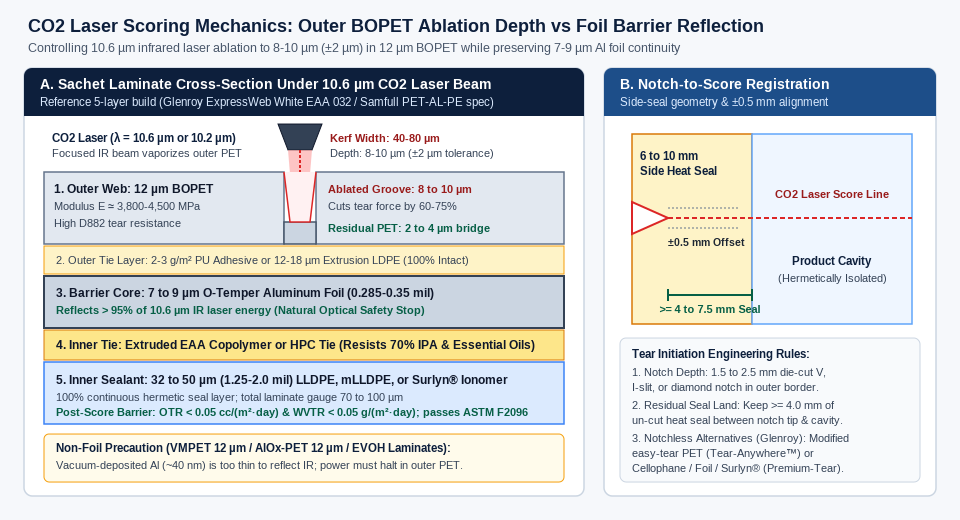
Because the 7 to 9 µm foil core and 32 to 50 µm sealant remain 100% continuous beneath the ablated outer groove, a properly scored sachet retains its flat-sheet OTR (< 0.05 cm³/[m²·day]), WVTR (< 0.05 g/[m²·day]), and internal pressurization burst integrity (ASTM F2096-11[2019]), while reducing hand-tear propagation force by 60% to 75%. Where line registration drift exceeds ±0.5 mm or where consumers must tear the packet open at any height without hunting for a notch, converters specify modified polymers documented in the Glenroy Stick Pack and Sachet Easy-Tear Laminations sheet:
Scroll horizontally to view all columns if needed. ↔
| Easy-opening engineering method | Outer and barrier layer construction | Depth or geometric tolerance | Impact on OTR, WVTR, and ASTM F2096 leak integrity | Best-fit sachet application |
|---|---|---|---|---|
| Mechanical V-notch or I-notch only | Standard 12 µm BOPET / VMPET or Foil / PE (no laser score) |
1.5 to 2.5 mm notch cut into 6 to 10 mm side seal (>= 4 mm intact seal margin) |
Zero impact on body barrier; high risk of diagonal tear arrest once tear exits the heat-sealed flange | Thin BOPP / CPP or paper-faced dry sugar and salt sachets |
CO2 laser scoring + registered V-notch (Glenroy Value-Tear) |
12 µm BOPET (or PCR-PET) / 7 to 9 µm Al Foil / mLLDPE or EAA + LLDPE |
Ablate 8 to 10 µm (±2 µm) into 12 µm PET (2 to 4 µm residual); notch aligned ±0.5 mm to score |
Preserves < 0.05 OTR and WVTR (foil reflects 10.6 µm IR); passes ASTM F2096 bubble test |
Liquid condiment spouts, cosmetic serums, 70% IPA wipes, and 8 g pharma unit doses |
Modified easy-tear polyester (Glenroy Tear-Anywhere™) |
Proprietary modified easy-tear PET / White LDPE tie / Al Foil / mLLDPE |
No laser score required; optional V-notch or serrated end cut initiates tear anywhere | Full foil barrier (OTR and WVTR < 0.05) with isotropic low-force hand tear across panel |
On-the-go hydration powders, pediatric medicines, and wet wipes opened with wet hands |
Cellophane + ionomer laminate (Glenroy Premium-Tear) |
Regenerated cellulose (Cellophane) outer / Al Foil / Surlyn® ionomer sealant |
Zero notch or laser score required; hand-tears straight from any edge or serrated seal | Full foil barrier (< 0.05 units) plus Surlyn® seal-through-contamination performance |
High-speed dusty pharmaceutical powders and oily single-dose packets |
Multi-lane VFFS and HFFS rollstock slitting, COF, and eye-mark tolerances
High-volume sachet production runs on multi-lane VFFS and HFFS machines (4, 6, 8, 10, or 12+ parallel lanes) that unwind a single wide master roll and slit it inline with rotary shear or razor knives into individual lane ribbons. As standardized in the Glenroy Horizontal Pouch and Multi-Roll Web Layout engineering drawing specifications and our stick pack multi-lane film guide, total parent rollstock width W_parent for an N-lane sachet machine producing packets of finished width W_pouch with outer edge trim allowance W_trim (typically 0 to 15 mm per side depending on whether outer lanes are edge-trimmed) follows the conservation equation:
W_parent = (2 × N × W_pouch) + (2 × W_trim)
Whether each lane folds a strip of width 2 × W_pouch in half (3-side seal) or slits two flat ribbons of width W_pouch (4-side seal), each lane consumes 2 × W_pouch of transverse master roll width. Published OEM machine datasheets illustrate how tightly parent roll width is locked to lane geometry:
- On the Samfull SF-1100 6-lane 4-side-seal liquid detergent sachet machine (
20 to 100 mLpiston fill at30 to 35 cycles/minper lane), a finished sachet width ofW_pouch = 80 to 90 mmrequiresW_parent = 2 × 6 × (80 to 90 mm) = 960 to 1,080 mm, matching the machine’s published960 to 1,080 mmparent roll specification with zero edge waste. - On the Landpack LD480G, LD720G, and LD960G multi-lane 3/4-side-seal sachet machines (
70 to 100 µmcomposite film,PIDjaw temperature control±1°C,35 cycles/min), the6-lane LD480Gunwinds a480 mmmaster roll (40 mmsachet width), the10-lane LD720Gunwinds a720 mmmaster roll (36 mmsachet width), and the12-lane LD960Gunwinds a960 mmmaster roll (40 mmsachet width). - On the Samfull SF960F-4 4-lane 4-side-seal pharmaceutical powder machine, four lanes of
W_pouch = 95 mmsachets consume2 × 4 × 95 mm = 760 mmof active web width across the960 mmframe, with10 mmvertical and horizontal perimeter seals leaving a75 mmwide interior powder pocket.
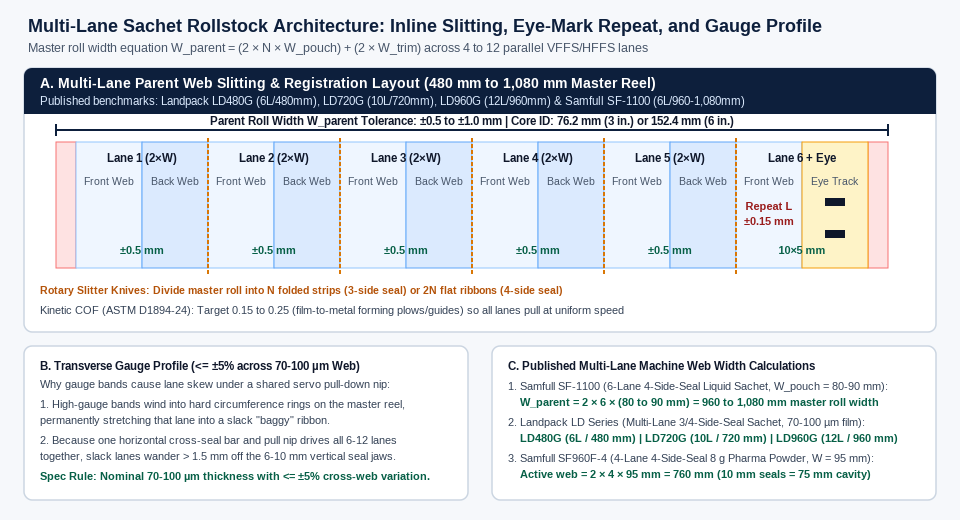
Because a single servo pull-down nip and one shared cross-seal bar drive all 4 to 12 lanes simultaneously, individual lanes cannot adjust cut-off registration or web tension independently. Preventing outer-lane seal walk, slack-lane wrinkling (bagginess), and cut-off drift requires enforcing five rollstock converting tolerances on every master reel:
Scroll horizontally to view all columns if needed. ↔
| Rollstock specification parameter | Target engineering tolerance | Measurement standard or converter method | Multi-lane machine failure mode if out of specification |
|---|---|---|---|
Slit strip and parent roll width (W_strip, W_parent) |
±0.5 mm on narrow rolls (38.1 to 300 mm); ±0.5 to ±1.0 mm on wide multi-lane master reels (480 to 1,200 mm) |
Inline optical edge micrometers during converter slitting (Glenroy slitting spec) | Shifts outer lanes (Lanes 1 and 12) off the 6 to 10 mm vertical heat-seal lands, narrowing one side seal below 3 mm and causing channel leakers |
| Transverse thickness (gauge) profile across web | Nominal 70 to 100 µm laminate gauge with <= ±5% cross-web variation |
Cross-web capacitance or beta/X-ray gauge scan across full parent width | High-spot gauge bands wind into hard circumference rings and stretch that lane into a slack “baggy” ribbon that wrinkles inside the cross-seal jaws |
| Print repeat length and eye-mark registration | ±0.15 mm per single repeat; <= ±1.0 to ±1.5 mm cumulative over 10 repeats; 10 × 5 mm high-contrast mark in clear track |
Inline vision repeat scanner on press/slitter + machine photoelectric cursor sensor | Cross-seal knife drifts into printed lot codes or severs the packet more than ±0.5 mm away from the CO2 laser score line and V-notch |
Kinetic coefficient of friction (COF) |
0.15 to 0.25 kinetic COF (outer BOPET to stainless steel plows/guides and sealant to sealant) |
ASTM D1894-24 (200 g sled at 150 mm/min; see packaging film COF diagnostics) |
COF > 0.35 causes stick-slip drag over turning bars and 180° plows; COF < 0.12 causes drive-roller slip and erratic sachet cut lengths |
| Core ID, roll build, and edge weave (telescoping) | Core ID 76.2 mm (3 in.) or 152.4 mm (6 in.) (±0.5 mm flush to film edge); edge weave <= ±1.0 mm; OD 300 to 813 mm |
Mandrel chuck fit check and straight-edge check on wound roll face; flagged butt splices only | Telescoped winds (> 1.0 mm step) or crushed cores induce cyclic tension spikes across all lanes, stretching the web and shifting eye-mark registration |
FAQ
How do packaging engineers define sachets compared to stick packs?
Packaging engineers define sachets as flat, non-gusseted unit-dose packets (0.5 to 100 mL or 0.5 to 100 g, aspect ratio 1:1 to 2.5:1) formed from rollstock laminate and sealed along three or four flat perimeter edges without a rear seam. By contrast, a stick pack is a slender cylindrical tube (aspect ratio 3:1 to 6:1, typical width 17 to 45 mm) formed around a vertical filling tube with a rear longitudinal fin or lap seal plus two end seals. While stick packs use 10% to 40% less film area for free-flowing powders and liquids, flat sachets are required for folded wet wipes, alcohol swabs, transdermal patches, viscous creams, and wide-panel retail graphics.
When should a line run a 4-side-seal sachet instead of a 3-side-seal sachet?
A 3-side-seal sachet folds a single web 180° over a forming plow, saving 12 to 20 mm of rollstock width per lane by replacing the fourth perimeter seal with an unsealed crease. However, a 4-side-seal sachet is required when packing 70% isopropyl alcohol wet wipes (Universal Pack), hygroscopic 8 g pharmaceutical powders (Samfull SF960F-4), or high-value cosmetics (OMAG CP/CO plate sealers) because sealing two flat webs across all four edges (5 to 10 mm border width) eliminates 180° fold-crease flex cracking in 7 to 9 µm aluminum foil (ASTM F392), prevents panel curl in high-speed cartoners, and allows pairing a clear front window web with an opaque foil back web.
How does CO2 laser scoring make PET/AL/PE sachets easy to tear without hurting barrier?
An un-scored 12 µm BOPET outer layer has high ASTM D882 tensile strength (180 to 240 MPa) that arrests or deflects a thumb tear as soon as it leaves the side-seal V-notch. Inline CO2 laser scoring (10.6 µm infrared wavelength) vaporizes an 8 to 10 µm deep groove into the 12 µm outer BOPET layer (±2 µm tolerance), leaving 2 to 4 µm of residual PET while reflecting off the underlying 7 to 9 µm aluminum foil barrier layer. Because the foil core and the inner 32 to 50 µm sealant remain 100% intact, oxygen and moisture transmission stay below 0.05 units per square meter per day and whole-sachet bubble leak resistance (ASTM F2096) is preserved.
Why do 70% isopropyl alcohol wet wipes and essential oil sachets delaminate standard foil laminates?
Low-molecular-weight solvents such as 70% isopropyl alcohol (IPA), terpenes in essential oils, salicylic acid, and acetic acid diffuse rapidly through standard LLDPE sealant layers and attack conventional polyurethane laminating adhesives at the aluminum foil interface, causing blistering and foil-to-sealant delamination. Qualifying a sachet laminate for alcohol wipes or aggressive oils requires replacing the inner polyurethane adhesive with an extruded ethylene acrylic acid (EAA) copolymer tie layer (Glenroy White EAA 032 / EAA Plus 129) or a zinc/sodium neutralized ionomer (Surlyn®, Glenroy White Ready Seal 225) that forms chemical-resistant ionic bonds directly to the aluminum oxide surface.
Method and sources
Format geometry definitions, multi-lane parent web equations, commercial foil and oxide laminate constructions, CO2 laser scoring depth budgets, and rollstock converting tolerances in this guide are grounded in the following published equipment datasheets, converter specifications, and ASTM test standards:
- OMAG S.r.l. 3-Side-Seal Sachets Packaging Machines and OMAG S.r.l. 4-Side-Seal Sachets Vertical (CP) and Horizontal (CO) Machines: single-web plow-folded
3-side-sealgeometry versus dual-web and slit-turned4-side-sealheated-plate configurations. - Universal Pack S.r.l. Continuous-Motion Multi-Lane 4-Side-Seal Sachet Machines for Wet Wipes and Swabs: multi-lane inline parent reel slitting, tissue folding, alcohol/lotion dosing, and
PAP/ALU/PE,PET/ALU/PE, and mono-materialPP/PElaminate families. - Foshan Samfull Packaging Machinery SF960F-4 4-Lane 4-Side-Seal 8 g Medicine Powder Sachet Specification and Samfull SF-1100 6-Lane 4-Side-Seal Detergent Liquid Sachet Specification:
7 to 9 µmaluminum foil barrier spec,95 mmsachet width with10 mmperimeter seals (75 mmusable cavity), static/vacuum dust mitigation, and6-lane × 2 × (80 to 90 mm) = 960 to 1,080 mmparent roll width math. - Foshan Land Packaging Machinery LD480G / LD720G / LD960G Multi-Lane 3/4-Side-Sealed Sachet Data Sheet:
6-lane (480 mm),10-lane (720 mm), and12-lane (960 mm)parent web widths,70 to 100 µm(0.07 to 0.10 mm) composite film thickness, and±1°CPIDsealing control. - Glenroy, Inc. ExpressWeb Narrow Web and Sachet Foil Laminations Table, Pouch and Sachet Film Laminations, Stick Pack Film Laminations (
10% to 40%film savings,Value-Tear,Premium-Tear Surlyn®,Tear-Anywhere™), Custom Film Slitting and In-House Laser Scoring (38.1 to 1,829 mmwidths), Barrier Film Laminations Explained (Feb 20, 2026), Flexible Packaging Technical Glossary, and Horizontal Pouch Web Layout Specification PDF. - TOPPAN Inc. GL BARRIER Film Product Lineup: published
OTR(ASTM D3985at30°C, 70% RH) andWVTR(ASTM F1249at40°C, 90% RH) benchmarks for12 µm AlOx-PET(GL-AE,GX-P-F) and recyclable32 µm SiOx-HDPE(GL-HE). - ASTM International Test Standards: ASTM D882-18 (Tensile Properties and Modulus of Thin Plastic Sheeting), ASTM F392/F392M-23 (Gelbo Flex Durability Conditioning), ASTM D1894-24 (Static and Kinetic Coefficients of Friction), ASTM F88/F88M-23 (Seal Strength of Flexible Barrier Materials), ASTM F2096-11(2019) (Gross Leak Detection by Internal Pressurization Bubble Test), ASTM D3985-24 (Coulometric Oxygen Gas Transmission Rate), and ASTM F1249-25 (Modulated Infrared Water Vapor Transmission Rate).
Continue reading
Related articles
Doypack Stand-Up Pouch Structure and Gussets
Compare round-bottom, K-seal and plow doypack structures, then match gusset stiffness, product volume and opening clearance to the filler.

Stand-Up Pouch: Types, Materials and Features
A stand up pouch has a bottom gusset that lets it stand on shelf. Learn gusset styles, closures, laminate structures and filling considerations.
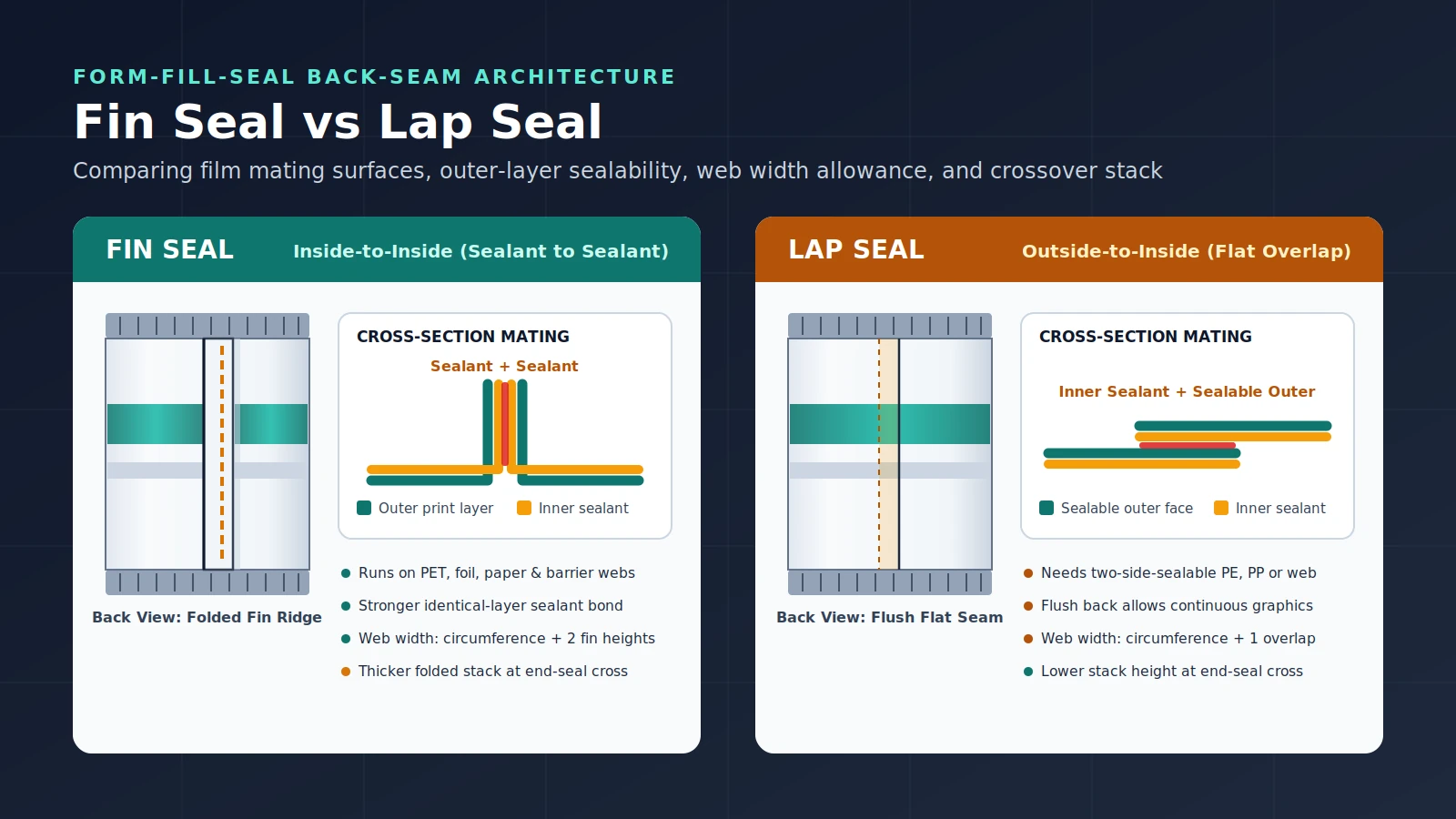
Fin Seal vs Lap Seal: Film Layers, Web Width & Back-Seam Fit
Fin seal vs lap seal on form-fill-seal film: compare film layer mating, outer-face sealability, web width, crossover stack, and ASTM checks.