Coffee Bag Packaging Materials: Foil vs AlOx and EVOH Mono-PE Barrier and Valve Comparison
Selecting coffee bag packaging between a traditional PET/AL/PE foil laminate and a recyclable mono-material PE pouch requires matching four parameters simultaneously: oxygen and water-vapor transmission rates at stated temperature and relative humidity, CO2 degassing valve opening and closing pressures (typically 2 to 6 mbar opening and at least 0.5 to 1 mbar closing), ultrasonic or impulse valve-to-film sealing windows, and destination PE recycling stream thresholds such as RecyClass and APR limits of 5 wt% or less EVOH.
A sealed coffee bag packaging structure fails when post-roast carbon dioxide bursts the heat seal or when permeating oxygen turns coffee lipids rancid. Freshly roasted beans evolve 4 to 12 L of carbon dioxide per kilogram of coffee from pyrolysis and Maillard reactions, building internal gauge pressure that must vent through a one-way degassing valve while the barrier web blocks external oxygen and moisture from driving cup scores below the 80.0-point specialty threshold.
Moving from a legacy triplex aluminum foil laminate (PET / AL / LLDPE) to a recyclable monomaterial pe coffee pouch changes every engineering boundary on the packaging line. A polyolefin barrier structure built around ethylene-vinyl alcohol (EVOH), vapor-deposited silicon or aluminum oxide (SiOx or AlOx), or vacuum-metallized biaxially oriented polyethylene (BOPE) shifts the flat-sheet oxygen transmission rate (OTR), alters moisture sensitivity in humid distribution lanes, narrows the thermal sealing window around the rigid degassing valve ring, and imposes strict mass-fraction limits under European and North American polyethylene recycling protocols. For broader format and filling line context, see the coffee packaging materials hub.
Barrier architecture comparison: PET/AL/PE foil vs AlOx and EVOH mono-PE
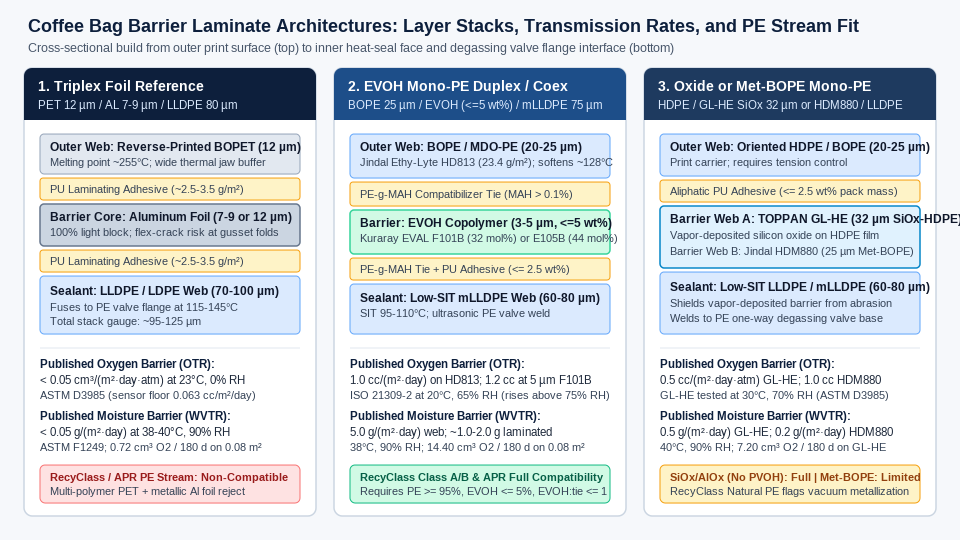
Evaluating high barrier film candidates for roasted whole-bean or ground coffee requires reading each datasheet at its exact test temperature, relative humidity (RH), and standard method. An intact 7 to 9 µm aluminum foil core blocks light completely and holds both oxygen and water-vapor transmission below 0.05 units per square meter per day, near the 0.063 cc/(m²·day) coulometric detection baseline reported in the scope of ASTM D3985-24. However, thin 7 µm foil develops pinholes and flex cracks along side gussets and flat-bottom folds when subjected to ASTM F392 conditioning, and the multi-polymer PET / AL / PE build is rejected by polyethylene recycling streams.
Clear oxide-coated polyester films such as the TOPPAN GL BARRIER lineup eliminate the metallic layer while retaining a high-temperature PET outer printing web (GL-AE at 0.5 cc/[m²·day·atm] and GX-P-F at 0.1 cc/[m²·day·atm] at 30°C and 70% RH), but they remain multi-polymer laminates when bonded to a polyethylene sealant. True mono-PE packaging replaces the PET outer web with BOPE, machine-direction oriented polyethylene (MDO-PE), or oriented HDPE, pairing it with one of three barrier layers documented in the Jindal Films Europe May 2026 Flexible Packaging Portfolio, the Kuraray EVAL F101B datasheet, and TOPPAN’s polyolefin series.
Scroll horizontally to view all columns if needed. ↔
| Laminate architecture | Typical layer stack and gauges | Published OTR and test climate | Published WVTR and test climate | Light block and flex behavior | PE recycling stream status |
|---|---|---|---|---|---|
| Triplex aluminum foil reference | Reverse-printed PET 12 µm / adhesive / Al foil 7 to 9 µm (or 12 µm) / adhesive / LLDPE 70 to 100 µm | Below 0.05 to 0.1 cm³/(m²·day·atm) at 23°C, 0% RH (ASTM D3985) | Below 0.05 to 0.1 g/(m²·day) at 38 to 40°C, 90% RH (ASTM F1249) | 100% opaque (0% light transmission); 7 µm foil susceptible to gusset pinhole flex cracking | Non-compatible in RecyClass and APR PE film streams (mixed PET + metallic Al) |
| Clear AlOx-PET high-barrier laminate | AlOx-PET 12 µm (TOPPAN GL-AE or GX-P-F) / adhesive / LLDPE 70 to 90 µm | 0.5 cc/(m²·day·atm) on GL-AE; 0.1 cc/(m²·day·atm) on GX-P-F at 30°C, 70% RH (ASTM D3985) | 1.0 g/(m²·day) on GL-AE; 0.05 g/(m²·day) on GX-P-F at 40°C, 90% RH (ASTM F1249) | Transparent (requires opaque ink or white sealant to shield coffee lipids from UV); oxide layer sensitive to excessive web strain | Non-compatible in PE streams due to PET substrate |
| Metallized PET (VMPET) laminate | PET 12 µm / VMPET 12 µm / LLDPE 70 to 90 µm | 0.5 to 1.0 cc/(m²·day) at 23°C, 0% RH (ICPE coffee packaging baseline) | 0.3 to 1.0 g/(m²·day) at 38°C, 90% RH | Below 1% light transmission (optical density 2.2 to 2.8); vacuum aluminum layer vulnerable to collar abrasion | Non-compatible in PE streams (PET polymer + metallization) |
| EVOH mono-PE duplex or coextrusion | BOPE 25 µm (Jindal Ethy-Lyte HD813 EVOH-coated BOPE, 23.40 g/m²) or MDO-PE / PE-g-MAH tie + 3 to 5 µm EVOH (Kuraray EVAL F101B 32 mol%) / low-SIT mLLDPE 60 to 80 µm | 1.0 cc/(m²·day) on Jindal HD813; 1.2 cm³/(m²·day·atm) for 5 µm EVAL F101B at 20°C, 65% RH (ISO 21309-2 Annex C) | 5.0 g/(m²·day) on 25 µm HD813 base web alone; 1.0 to 2.0 g/(m²·day) when laminated to 75 µm PE sealant | Transparent unless paired with white-pigmented PE sealant; high flex resistance, but OTR rises when ambient RH exceeds 75% to 85% | Full compatibility (RecyClass Class A/B and APR) when PE is at least 95%, EVOH is 5 wt% or less, and EVOH:tie ratio is 1 or less |
| SiOx or metallized BOPE mono-PE | Route A: HDPE / TOPPAN GL-HE (32 µm SiOx-HDPE) / LLDPE; Route B: BOPE 25 µm / Jindal Ethy-Lyte HDM880 (25 µm metallized BOPE, 23.40 g/m²) / PE sealant | 0.5 cc/(m²·day·atm) at 30°C, 70% RH on TOPPAN GL-HE; 1.0 cc/(m²·day) on Jindal HDM880 | 0.5 g/(m²·day) at 40°C, 90% RH on TOPPAN GL-HE; 0.2 g/(m²·day) on Jindal HDM880 | GL-HE is transparent; HDM880 provides metallic light block and 0.2 g/(m²·day) moisture protection for humid climates | RecyClass grants Full Compatibility to SiOx/AlOx without PVOH primer (Route A); metallization (Route B) is flagged Non-Compatible in natural PE streams |
Oxygen budget and moisture arithmetic for a 250 g coffee pouch
Comparing flat-sheet OTR and WVTR numbers requires converting them into cumulative package gas ingress over the target distribution window. Steady-state oxygen volume Q permeating through the pouch wall over storage duration t follows the standard area-time product:
Q = OTR × A × t
For a homogeneous EVOH film core, oxygen transmission scales inversely with barrier layer thickness d (in micrometers) relative to the 20 µm reference thickness printed on copolymer datasheets:
OTR(d) = OTR_20µm × (20 / d)
In the Kuraray EVAL F101B (32 mol% ethylene) datasheet, cast film at 20 µm reports an OTR of 0.3 cm³·20µm/(m²·day·atm) at 20°C and 65% RH per ISO 21309-2 Annex C (density 1.19 g/cm³, melting point 183°C). Scaling F101B to a 5 µm coextruded layer yields 0.3 × (20 / 5) = 1.2 cm³/(m²·day·atm). By contrast, the higher-ethylene Kuraray EVAL E105B (44 mol% ethylene) datasheet (density 1.14 g/cm³, melting point 165°C) reports 1.9 cm³·20µm/(m²·day·atm) at 20°C and 65% RH, which scales at 5 µm to 1.9 × (20 / 5) = 7.6 cm³/(m²·day·atm), or 6.33 times higher oxygen permeation than the 32 mol% grade.
Consider a conditional engineering calculation for a 250 g retail stand-up or flat-bottom coffee pouch with permeable surface area A = 0.08 m² (800 cm²), free headspace gas volume V_hs = 200 cm³, and storage time t = 180 days (6 months). Nitrogen flushing to a specialty residual target of 0.5% O2 leaves 200 cm³ × 0.005 = 1.0 cm³ of initial headspace oxygen at sealing, whereas an under-flushed line at 2.0% residual O2 seals 4.0 cm³ of oxygen inside the pack on day zero.
Scroll horizontally to view all columns if needed. ↔
| Laminate candidate | Published OTR basis | 180-day film O2 ingress (Q = OTR × 0.08 m² × 180 d) |
Total O2 exposure (1.0 cm³ initial flush + Q) |
Published WVTR basis | 180-day moisture ingress (WVTR × 0.08 m² × 180 d) |
|---|---|---|---|---|---|
| PET 12 / AL 9 / LLDPE 80 (Triplex Foil) | 0.05 cc/(m²·day·atm) at 23°C, 0% RH | 0.72 cm³ O2 | 1.72 cm³ O2 | 0.05 g/(m²·day) at 38°C, 90% RH | 0.72 g H2O |
| TOPPAN GX-P-F (12 µm AlOx-PET laminate) | 0.10 cc/(m²·day·atm) at 30°C, 70% RH | 1.44 cm³ O2 | 2.44 cm³ O2 | 0.05 g/(m²·day) at 40°C, 90% RH | 0.72 g H2O |
| TOPPAN GL-HE (HDPE / 32 µm SiOx-HDPE / LLDPE) | 0.50 cc/(m²·day·atm) at 30°C, 70% RH | 7.20 cm³ O2 | 8.20 cm³ O2 | 0.50 g/(m²·day) at 40°C, 90% RH | 7.20 g H2O |
| Jindal Ethy-Lyte HDM880 (25 µm Met-BOPE laminate) | 1.00 cc/(m²·day) at 23°C, 0% RH | 14.40 cm³ O2 | 15.40 cm³ O2 | 0.20 g/(m²·day) at 38°C, 90% RH | 2.88 g H2O |
| Jindal Ethy-Lyte HD813 (25 µm EVOH-BOPE + PE sealant) | 1.00 cc/(m²·day) at 23°C, 50% RH | 14.40 cm³ O2 | 15.40 cm³ O2 | 1.50 g/(m²·day) laminated (5.0 g base web) | 21.60 g H2O |
| Coex Mono-PE with 5 µm EVAL F101B (32 mol% EVOH) | 1.20 cm³/(m²·day·atm) at 20°C, 65% RH | 17.28 cm³ O2 | 18.28 cm³ O2 | 1.50 g/(m²·day) at 38°C, 90% RH | 21.60 g H2O |
| Coex Mono-PE with 5 µm EVAL E105B (44 mol% EVOH) | 7.60 cm³/(m²·day·atm) at 20°C, 65% RH | 109.44 cm³ O2 | 110.44 cm³ O2 | 1.50 g/(m²·day) at 38°C, 90% RH | 21.60 g H2O |
These permeation figures reflect pure 1 atm oxygen test differentials per ASTM D3985-24 and ASTM F1249-25; ambient air at 21% oxygen exerts roughly one-fifth the partial-pressure driving force, while gusset folds and valve welds add point-source influx. As documented in the ICPE Coffee and Tea Packaging chapter, moisture control is equally decisive for soluble and ground products, where instant coffee cakes once moisture rises from an initial 2% to 4% to 7% to 8%. For single-serve soluble coffee packets and unit-dose foil laminates, compare 3-side vs 4-side seal sachet formats.
CO2 degassing kinetics and one-way valve cracking and closing pressures
Because roasted coffee beans release 4 to 12 L of CO2 per kilogram over several weeks, and grinding fractures the microporous cellular wall to release 40% to 70% of that trapped gas within the first few hours, high-barrier coffee pouches require a pressure-relief valve that opens outward without admitting ambient air. Detailed mechanical specifications in the Goglio One-Way Degassing Valves brochure (9435_Ed_08_2020) and the Goglio specialty valves technical portal divide valve operation into three sequential states:
- Closed starting state, where a flexible polymer membrane is held tightly against the sealable valve base by the capillary interfacial tension of a thin food-grade silicone oil layer.
- Outward degassing state, triggered when internal headspace CO2 overpressure surpasses the opening threshold, lifting the elastic membrane perimeter so gas escapes through base channels, cap slots, and a pierced pinhole in the pouch wall.
- Re-seated closed state, where headspace pressure drops back to the closing threshold and the silicone oil layer immediately re-seals the membrane against the base before external oxygen can diffuse inward.
For catalog reference baselines, see our analysis of published coffee valve pouch baselines, which records the Syntegon VAP and VAP-N internal valve parameters alongside Wipf WICOVALVE thermal and ultrasonic series.
Scroll horizontally to view all columns if needed. ↔
| Valve parameter or configuration | Published engineering specification | Functional role and coffee failure mode prevented |
|---|---|---|
| Opening pressure band (Syntegon VAP / VAP-N baseline) | 2 to 6 mbar (200 to 600 Pa); specialty coffee valves typically target 2.5 to 5.5 mbar (250 to 550 Pa) | Releases evolved CO2 before internal pressure balloons flat-bottom panels or peels fin and lap seals |
| Closing (re-seating) pressure threshold | At least 1 mbar (100 Pa) on VAP/VAP-N; at least 0.5 mbar (50 Pa) on low-opening-pressure specialty grades | Re-establishes the silicone capillary seal while positive internal pressure still exists, preventing air backflow |
| Valve body dimensions and mass (VAP / VAP-N) | 22.95 mm diameter × 4.6 mm height; mass approximately 1.0 g | Rigid circular flange that must be hermetically welded to the inner pouch sealant layer |
| Base polymer family (Goglio Recyclable / Syntegon) | Polyethylene (PE) for mono-PE pouches; polypropylene (PP) for mono-PP structures | Matches the melt phase and recycling stream of the pouch inner sealant web |
| Underside particulate protection (Goglio Extra Filter / TNT) | Integrated food-grade mesh or non-woven TNT filter bonded across the base intake | Blocks ground coffee fines and roast surface oils from migrating into the membrane seat and holding the valve open |
| Applicator cycle rate (Ultrasonic / MUSS series) | Up to 100 valves/min via ultrasonic horn welding | Minimizes dwell time and eliminates outer-web heat distortion on high-speed VFFS and pouch lines |
Ultrasonic vs thermal impulse valve sealing on mono-material PE pouches
Attaching a 22.95 mm polyethylene degassing valve to a mono-PE vs multilayer film structure exposes a fundamental thermal conduction bottleneck. In a traditional PET 12 µm / AL 9 µm / LLDPE 80 µm laminate, the biaxially oriented PET outer layer melts at 250°C to 260°C, whereas the inner LLDPE sealant and PE valve flange fuse at 115°C to 145°C. A heated conduction ring bar pressing from the outside of the pouch enjoys a 100°C+ thermal buffer and can run at 165°C to 190°C without distorting the print web.
In a recyclable mono-PE coffee pouch (BOPE or MDO-PE outer web laminated to a low-seal-initiation-temperature mLLDPE inner web), both the outer print carrier and the inner sealant belong to the polyethylene family. High-density BOPE outer films soften and lose biaxial orientation at 125°C to 135°C, while metallocene LLDPE sealants initiate fusion at 95°C to 115°C (see seal initiation temperature for heat-seal curve qualification). That leaves only a 15°C to 25°C temperature differential (ΔT) across the laminate wall. Driving conductive heat through the outer BOPE layer to melt the heavy 1.0 g valve flange softens the outer film around the valve ring, producing radial necking, print registration shift, and capillary channel leaks across the weld seam.
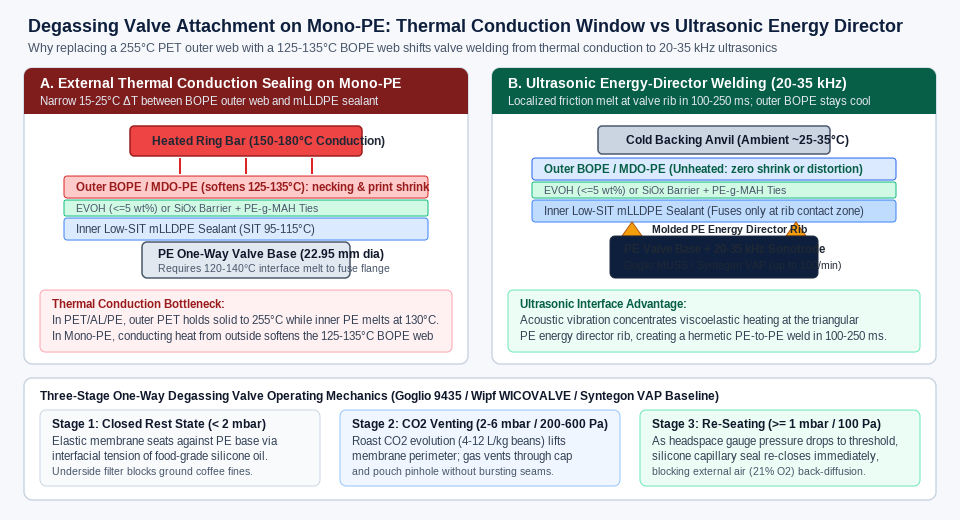
Ultrasonic valve welding resolves this thermal bottleneck. Applicators running Goglio Ultrasonic or MUSS (smallest ultrasonic valve) units, Wipf W1xy/W2xy valves, or Syntegon VAP series clamp the pouch wall between a cold backing anvil on the printed BOPE exterior and a 20 to 35 kHz ultrasonic sonotrode engaging the valve inside the web. High-frequency mechanical vibration concentrates viscoelastic friction exclusively at the triangular molded energy director rib on the PE valve base. The rib melts into the inner mLLDPE sealant within 100 to 250 ms while the outer BOPE layer remains cool against the anvil, preserving film flatness and whole-pack seal strength.
Shelf-life flavor retention: headspace oxygen, volatile oxidation, and cupping scores
The chemical and sensory consequences of oxygen permeation and moisture uptake are quantified in two peer-reviewed coffee storage studies. In a 12-month gas chromatography-mass spectrometry (GC-MS/MS SPME) and cupping investigation published in Nature Scientific Reports (Sci Rep 2023, 13, 6447, PMC10119118), roasted and green coffee was tracked at 3, 6, 9, and 12 months across storage temperatures of -10°C, 10°C, and 20°C. In roasted beans stored at 20°C, the steepest drop in flavor quality occurred within the first 3 months as residual and permeated oxygen drove lipid autoxidation and Strecker degradation. Specifically, oxygen exposure elevated hexanal (CAS 66-25-1, primary lipid rancidity marker), methional (boiled-potato off-note generated via oxygen-mediated degradation), and 5-methylfurfural, while depleting fresh sulfurous and pyrazine aroma volatiles.
A second peer-reviewed trial in MDPI Foods (Foods 2026, 15, 2756, PMC13465152) evaluated specialty coffee (50% Geisha, 25% Caturra, 25% Pache, medium-roasted at 185°C to 210°C for 10.5 min and rested 12 hours) packed in 200 g units across eight packaging-product configurations (PPC) under accelerated storage at 40°C, 50°C, and 60°C at 85% RH. Certified Q-Graders scored cup quality and flavor descriptors over 12 days:
Scroll horizontally to view all columns if needed. ↔
| Packaging configuration in Foods 2026 (PMC13465152) | Product state | Initial SCA cup score (Day 0) | Day 6 SCA cup score (40°C, 85% RH) | Day 9 to 12 SCA score trajectory | Dominant sensory descriptor shift |
|---|---|---|---|---|---|
| Pressed cardboard carton (PPC E) | Roasted ground coffee | 82.90 ± 0.54 | 79.67 (dropped below 80-point specialty cutoff) | 78.04 ± 1.27 at Day 12 (-4.86 points total) | Rapid loss of floral, caramel, and brown sugar notes; replaced by cardboard, stale, and astringent defects |
| Bilaminate bag without valve (PPC F) | Roasted whole bean / ground | ~82.90 baseline | Intermediate drop vs trilaminate valve pack | Accelerated aroma flattening under 85% RH | Trapped CO2 swelling alongside moisture-assisted volatile oxidation |
| Bilaminate bag with degassing valve and zipper (PPC G) | Roasted coffee | ~82.90 baseline | Retained specialty tier longer than non-valve bilaminate | Outperformed by trilaminate high-barrier valve pouch | Partial barrier slows lipid oxidation but permits humidity transfer at 85% RH |
| Trilaminate high-barrier bag with degassing valve and zipper (PPC H) | Roasted coffee | ~82.90 baseline | 81.42 ± 0.61 (held specialty grade) | 80.71 ± 0.71 at Day 9 (maintained above 80.0 specialty line) | Preserved chocolate, sweet, and fruity descriptors through high barrier plus one-way CO2 venting |
| Vacuum-packed high-barrier pouch (PPC D) | Roasted whole bean | ~82.90 baseline | Above 82.0 | 82.67 ± 0.30 at Day 12 | Whole-bean cellular matrix plus zero-oxygen barrier minimized volatile degradation |
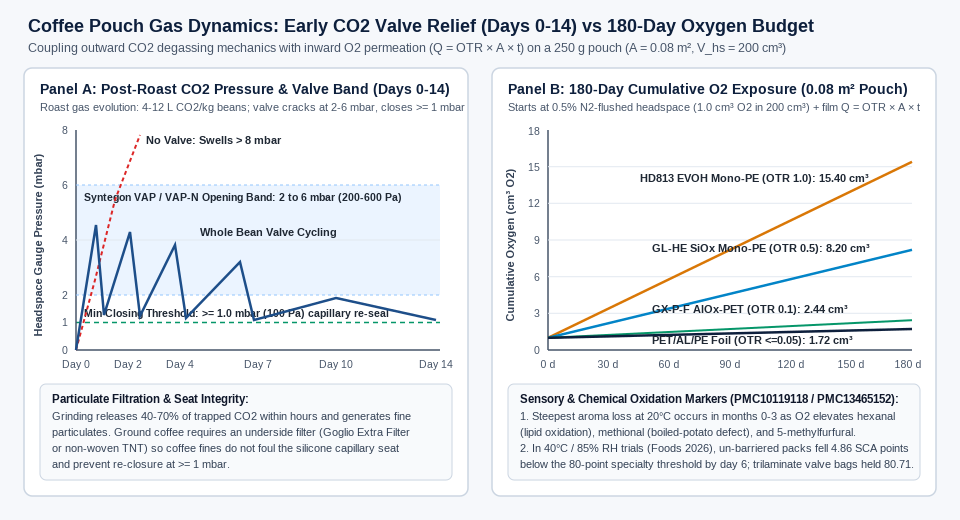
The combined evidence from PMC10119118 and PMC13465152 establishes a clear specification rule: for whole-bean retail rotations of 3 to 6 months in temperate distribution (20°C, 50% to 65% RH) with nitrogen flushing below 0.5% O2, a recyclable mono-PE laminate with SiOx (OTR 0.5 cc/[m²·day]) or 32 mol% EVOH (OTR 1.0 to 1.2 cc/[m²·day]) and an ultrasonically welded PE valve holds cumulative oxygen ingress to 7.2 to 17.3 cm³. For ground coffee or 9-to-12-month distribution through tropical high-humidity lanes (30°C to 40°C, 80% to 90% RH), either a moisture-resistant SiOx mono-PE structure (WVTR 0.5 g/[m²·day]), an ultra-high-barrier metallized film BOPE (WVTR 0.2 g/[m²·day], where mixed polyolefin recycling rules permit), or a conventional PET / AL / PE laminate is required to prevent humidity-induced EVOH barrier collapse.
PE recycling stream thresholds: RecyClass and APR rules for EVOH, coatings, and valves
Designing a monomaterial pe coffee pouch that qualifies for circular polyethylene collection requires auditing every component in the bill of materials against the RecyClass Design for Recycling Guidelines for Natural PE Flexible Films (April 2026) and the APR Design Guide for PE Flexible Packaging. See our design for recycling guide for full mass-share accounting and film specification comparison for supplier sign-off templates.
Scroll horizontally to view all columns if needed. ↔
| Pouch component or parameter | RecyClass Natural PE / APR PE Flexible threshold | Compatibility rating and engineering requirement |
|---|---|---|
| Total polyethylene mass share (base film + PE valve + PE zipper) | Class A: at least 95 wt% PE; Class B: 80% to 95 wt%; Class C: 70% to 80 wt%; below 70 wt% is Non-Recyclable | Target at least 95 wt% total PE (BOPE / MDO-PE + LLDPE / HDPE) to achieve Class A Full Compatibility |
| EVOH oxygen barrier layer | Maximum 5.0 wt% of total packaging weight paired with PE-g-MAH tie layers (MAH > 0.1%, and EVOH : tie layer ratio of 1 : 1 or less) |
Full Compatibility when EVOH <= 5 wt% and EVOH:tie <= 1; EVOH:tie > 1 drops one class to Limited Compatibility; EVOH > 5 wt% is Non-Compatible |
Inorganic oxide coatings (SiOx / AlOx) |
Vapor-deposited SiOx or AlOx plasma coatings without PVOH primer layers |
Full Compatibility in natural PE streams; adding a PVOH primer coat downgrades the film to Non-Compatible |
| Aluminum foil and vacuum metallization | Foil (7 to 12 µm) or vacuum-metallized aluminum layers (such as metallized BOPE) |
Non-Compatible in RecyClass natural (clear) PE film streams due to melt filtration loss and gray recyclate discoloration |
| Laminating adhesives | Aliphatic polyurethane (PU) adhesives at 2.5 wt% or less of total pack weight |
Compatible up to 2.5 wt%; acrylic adhesives or polyurethane loads above 2.5 wt% incur recyclability penalties |
| One-way degassing valve and reclosable zipper | Molded from LDPE, LLDPE (including PE plastomers), or HDPE |
Full Compatibility; polypropylene (PP) valves/zippers receive Limited Compatibility, while PET, PVC, or metallic inserts are Non-Compatible |
FAQ
Can a mono-material PE coffee pouch match the shelf life of an aluminum foil bag?
For whole-bean coffee flushed with nitrogen below 0.5% residual oxygen and distributed within 3 to 6 months in temperate climates (20°C to 25°C, 50% to 65% RH), a mono-PE pouch built with a 32 µm SiOx-HDPE barrier web (OTR 0.5 cc/[m²·day], WVTR 0.5 g/[m²·day]) or a 32 mol% EVOH layer (OTR 1.0 to 1.2 cc/[m²·day]) maintains specialty cup scores above 80 points. For ground coffee or 12-month storage in hot, humid tropical warehouses (35°C to 40°C, 85% RH), PET/AL/PE foil (OTR and WVTR below 0.05) still provides superior protection because aluminum foil does not lose oxygen barrier at high humidity and blocks 100% of UV and visible light.
Why do mono-PE coffee bags require ultrasonic degassing valve sealing instead of heat bars?
In a mono-PE laminate, the oriented polyethylene outer print web (BOPE or MDO-PE) begins to soften and shrink at 125°C to 135°C, only 15°C to 25°C above the fusion temperature of the inner mLLDPE sealant and polyethylene valve base. Conducting heat from an external metal bar through the pouch wall over-softens the outer layer around the rigid 22.95 mm valve ring, causing film puckering and channel leaks. Ultrasonic welding at 20 to 35 kHz vibrates the valve’s molded energy director rib directly against the inner sealant for 100 to 250 ms, melting only the internal PE-to-PE interface while the outer print web remains cool.
What is the maximum EVOH percentage allowed in a recyclable PE coffee bag?
Both the RecyClass Design for Recycling Guidelines for Natural PE Flexible Films (April 2026) and the APR PE Flexible Design Guide cap EVOH content at 5.0% or less of total package weight for Full Compatibility. RecyClass also requires the EVOH core to be bonded with maleic-anhydride grafted polyethylene (PE-g-MAH) compatibilizer tie layers containing more than 0.1% maleic anhydride at an EVOH-to-tie mass ratio of 1 or less, alongside a polyethylene degassing valve and aliphatic polyurethane adhesive below 2.5 wt%.
What opening and closing pressures should a coffee one-way degassing valve have?
Published catalog baselines such as Syntegon’s VAP and VAP-N internal coffee valves specify an opening (cracking) pressure of 2 to 6 mbar (200 to 600 Pa) and a minimum closing (re-seating) pressure of at least 1 mbar (100 Pa), while specialty coffee valve grades typically operate at 2.5 to 5.5 mbar opening and at least 0.5 mbar closing. For ground coffee, the valve base must also include an underside particulate filter (such as Goglio’s Extra Filter or non-woven TNT mesh) so fine coffee grounds cannot contaminate the silicone oil capillary seat and hold the membrane open to air.
Method and sources
Barrier specifications, copolymer scaling equations, valve pressure bands, sensory cup-score trajectories, and recyclability thresholds in this guide are drawn from the following technical datasheets, standards, and peer-reviewed studies:
- TOPPAN Inc. GL BARRIER Film Product Lineup: published
OTR(ASTM D3985 at 30°C, 70% RH) andWVTR(ASTM F1249 at 40°C, 90% RH) values forGL-AEandGX-P-F(12 µm AlOx-PET) and recyclableGL-HE(32 µm SiOx-HDPEin anHDPE / GL-HE / LLDPElaminate). - Jindal Films Europe Flexible Packaging Portfolio (May 2026 edition): technical specifications for
Ethy-Lyte HD813(25 µmEVOH-coatedBOPE,23.40 g/m²,OTR 1 cc/[m²·day],WVTR 5.0 g/[m²·day]) andEthy-Lyte HDM880(25 µmultra-high-barrier metallizedBOPE,OTR 1 cc/[m²·day],WVTR 0.2 g/[m²·day]). - Kuraray America EVAL F101B (32 mol% EVOH) Technical Data Sheet and EVAL E105B (44 mol% EVOH) Technical Data Sheet: cast-film
OTRvalues (0.3vs1.9 cm³·20µm/[m²·day·atm]at 20°C and 65% RH per ISO 21309-2 Annex C), densities (ISO 1183-3), and thermal transitions (ISO 11357). - Goglio S.p.A. One-Way Degassing Valves Brochure (9435_Ed_08_2020) and Goglio Specialty Valves Overview: three-stage membrane + silicone oil seal mechanics, underside fine-powder filtration (
Extra FilterandTNT), recyclable monomaterial PE valves, and ultrasonic (MUSS) sealing configurations. - RecyClass Design for Recycling Guidelines: Natural PE Flexible Films (April 2026) and APR Design Guide for Plastics Recyclers: PE Flexible Guidance: Class A/B/C PE composition rules,
<= 5 wt% EVOHandPE-g-MAHtie-layer requirements,SiOx/AlOxvs metallization rules, and PE valve compatibility. - MDPI Foods (2026, 15, 2756, PMC13465152): Q-Grader sensory descriptor text mining and SCA cup-score retention across eight coffee packaging configurations stored at 40°C to 60°C and 85% RH.
- Nature Scientific Reports (2023, 13, 6447, PMC10119118): 12-month
GC-MS/MS SPMEvolatile oxidation marker tracking (hexanal,methional,5-methylfurfural) in roasted and green coffee at -10°C, 10°C, and 20°C. - Indian Centre for Plastics in the Environment (ICPE) Beverage Packaging Chapter, ASTM D3985-24, and ASTM F1249-25: standard coffee laminate baselines and coulometric/infrared gas permeation test scopes.
Continue reading
Related articles
Modified Atmosphere Packaging: Gas Mix and Film Permeability
Modified atmosphere packaging places an atmosphere different from air that may change with film permeability or food respiration, pairing gas and film to food.
Bakery Packaging Film: Keeping Bread and Cakes Fresh
Bakery packaging film explained: how staling, moisture loss and mold shape film choice for bread, cakes, cookies and tortillas, plus formats and machines.
Cheese Packaging Film: Ripening, Vacuum and MAP
Cheese packaging film explained: gas-permeable ripening films, vacuum bags for blocks, MAP for sliced and shredded cheese, reclosable packs and structures.