
BOPP vs CPP: Oriented vs Cast Polypropylene Film
BOPP vs CPP compared: oriented versus cast polypropylene film on stiffness, clarity, sealing, heat resistance, barrier, recyclability and where each is used.
Overheating can wrinkle an oriented web; excessive tension can stretch a cast web. BOPP is stretched polypropylene and CPP is unstretched. Choose BOPP when you need a stiff, clear, dimensionally stable film for printing, wrapping or an outer web. Choose CPP when you need a softer film with a grade-specific sealing skin, often as the inner sealant layer of a laminate or for a clear bag. Both are polypropylene, so they pair well in all-PP structures. Each has its own page, BOPP film and CPP film, and the family overview is in polypropylene packaging film.
BOPP vs CPP at a glance
This is a selection comparison compiled from public manufacturer descriptions, not this site’s testing. A manufacturer’s April 2026 film portfolio and a manufacturer’s public cast-film guide distinguish actual grade roles; compare seal curves at the same settings.
Scroll horizontally to view all columns if needed. ↔
| Decision | BOPP | CPP |
|---|---|---|
| Process | Biaxially oriented PP | Cast PP without biaxial orientation |
| Role | Print web or grade-specific sealable wrap | Bag film or grade-specific sealant |
| Sealing | Non-sealable and sealable grades exist | Sealing behavior depends on skin/grade |
| Machine risk | Check shrink/wrinkle at jaw heat | Check extension under web tension |
| Heat treatment | Verify the selected grade and laminate | Ordinary and retort grades are distinct |
| PP recovery goal | Assess the full pack and local stream | Assess the full pack and local stream |
How the process changes the film
BOPP is stretched in both the machine and transverse directions at controlled temperatures. That aligns the polymer chains, which raises stiffness, tensile strength and clarity and allows thin gauges. CPP is not stretched. The melt leaves a slot die and is cooled quickly on a chill roll, which keeps crystals small and gives a cast film whose softness and sealing depend on formulation. Orientation changes bulk properties; a lower-melting sealing skin is a formulation choice, not a consequence of leaving the film unoriented.
Barrier
Both films resist moisture well, as polyolefins do, and both are poor oxygen barriers. For oxygen-sensitive products neither works alone. Metallized versions of each exist, and adhesion depends on the selected surface and metallizing process. Barrier values depend on the metal layer, the base film and the test conditions, so compare WVTR and OTR only at matching temperature and humidity. Metallized film covers the metal layer.
Sealing
Choose a sealant grade from its measured seal curve. Its sealing layer, usually a lower-melting copolymer or terpolymer, forms a seal at moderate temperatures while the film’s core stays intact. That gives a usable window and makes CPP a standard sealant for BOPP/CPP laminates. Record seal strength, hot tack and laboratory seal-making methods with their versions and settings; see the film specification comparison guide. The concept is explained in seal initiation temperature.
BOPP can also seal, using coextruded skin layers or cold-seal coatings, but the stretched core shrinks and wrinkles if the jaws run too hot, so determine the usable window from the actual film and settings. Many BOPP grades are non-sealable and rely on a laminated sealant.
Heat resistance
Polypropylene melts at a higher temperature than polyethylene, so both films tolerate different thermal conditions, but polymer family alone does not qualify either film for a process. For hot-fill or retort, select a qualified grade and validate the complete laminate and process. BOPP sits on the outside of the laminate, away from the product but exposed to the jaws, so its sealing temperature limit still matters.
Stiffness and handling
BOPP is stiffer, which helps on high-speed wrappers and baggers and gives a crisp pack feel. CPP is softer and more flexible, which some bags and wrappers want. On the machine, the finished structure’s stiffness, slip and curl matter more than either single web (see coefficient of friction and flow wrapper film).
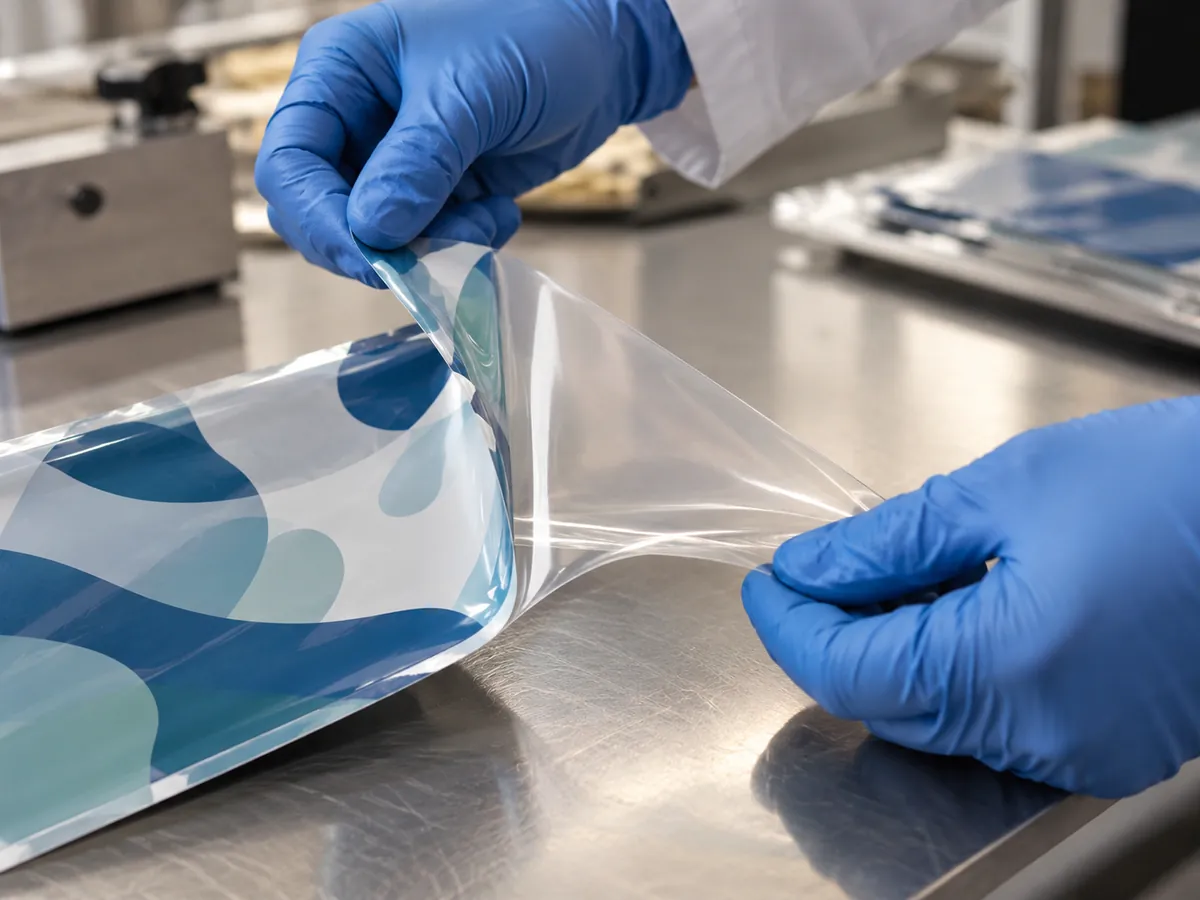
BOPP is the more common print web because of its stiffness and dimensional stability, and it can be surface printed or reverse printed with proper treatment. CPP is usually corona treated on one side so inks, adhesives or metal will bond, and is more often the inner, unprinted web. Matte, white and pearlized versions exist for BOPP.
Machinability
BOPP’s stiffness runs well on high-speed lines but is sensitive to jaw temperature. CPP can stretch under excessive tension; grade-specific seal behavior still needs measurement. Test the actual laminate on the actual machine, and check seals after aging.
Recyclability
Both are polypropylene, so a BOPP/CPP laminate is an all-PP structure and a starting point for a mono-PP design. Whether it is recyclable in practice depends on inks, adhesive, metallization or barrier coating, and local collection and sorting. Check RecyClass and APR guidance and your market’s rules. Related pages are mono-PP packaging and mono-material packaging.
Cost drivers
- Process: orientation adds process steps, while cast film is simpler.
- Gauge: BOPP can run very thin; CPP is often used thicker as a sealant.
- Specialty grades: metallized, retort, matte or coated films shift price more than the base film.
- Laminate construction: combining two films adds adhesive and conversion cost.
- Line performance: scrap and seal failures, which is how a cheaper film can cost more on the line.
When to choose BOPP
- You need a stiff, clear outer web for print or wraps.
- The selected gauge and measured moisture barrier fit the job.
- The pack is a flow wrap or overwrap needing crisp handling.
- You are building a PP laminate and need the print layer.
When to choose CPP
- A measured seal curve meets your machine window.
- The selected grade and full laminate are validated for warm filling or retort.
- A soft, clear bag film is wanted, such as for bakery or textile packs.
- You need a metallized inner web for snack or dry mix packs.
Using BOPP and CPP together
The classic pairing is printed BOPP outside for stiffness and appearance with CPP inside for sealing. Variations include metallized BOPP or metallized CPP for barrier. Where a PE sealant is used instead, the pack mixes polymers, a trade-off covered in mono-PE vs multilayer film. Laminated packaging explains how laminates are built.
Record the BOPP/CPP choice
Scroll horizontally to view all columns if needed. ↔
| Input | BOPP / outer web | CPP / inner web | Finished-pack result |
|---|---|---|---|
| Role and layer order | Grade/print face: ___ | Grade/seal face: ___ | Structure drawing: ___ |
| Heat treatment | Exposure/limits: ___ | Ordinary or qualified retort grade: ___ | Cycle/result: ___ |
| Sealing evidence | Skin/coating: ___ | Skin/formulation: ___ | Curve, pressure, dwell, strength and hot tack: ___ |
| Recovery target | Polymer and additives: ___ | Polymer and additives: ___ | Market/stream assessment: ___ |
| Line validation | Tension and jaw settings: ___ | Tension and sealing face: ___ | Wrinkles, stretch, aging and integrity: ___ |
The polypropylene film overview provides family context, and the specification comparison record organizes candidate-grade evidence.
Sources and method
Sources checked October 8, 2026: the linked April 2026 BOPP portfolio and public cast-film guide describe grade families. No paired BOPP/CPP experiment or shared sealing protocol is supplied here, so seal initiation and window width are left for same-condition grade comparison. Manufacturer links are sources, not recommendations. For recovery assessment use the mono-PP guide.
Continue reading
Related articles
BOPP Film for Packaging: Types, Properties and Uses
BOPP packaging film explained: what biaxial orientation does, the main grades from clear to metallized, sealing options and typical uses.
CPP Film for Packaging: Cast Polypropylene Explained
CPP film packaging uses cast polypropylene for clear, soft, heat-sealable layers. Learn the grades, uses and how CPP compares with LLDPE sealant.

Blister Foil: Lidding Foils for Pharmaceutical Blister Packs
Blister foil is aluminum-based lidding for pharmaceutical blister packs. Learn lidding types, lacquers, sealing variables and checks.